
Loading, please wait...
LOT 0448
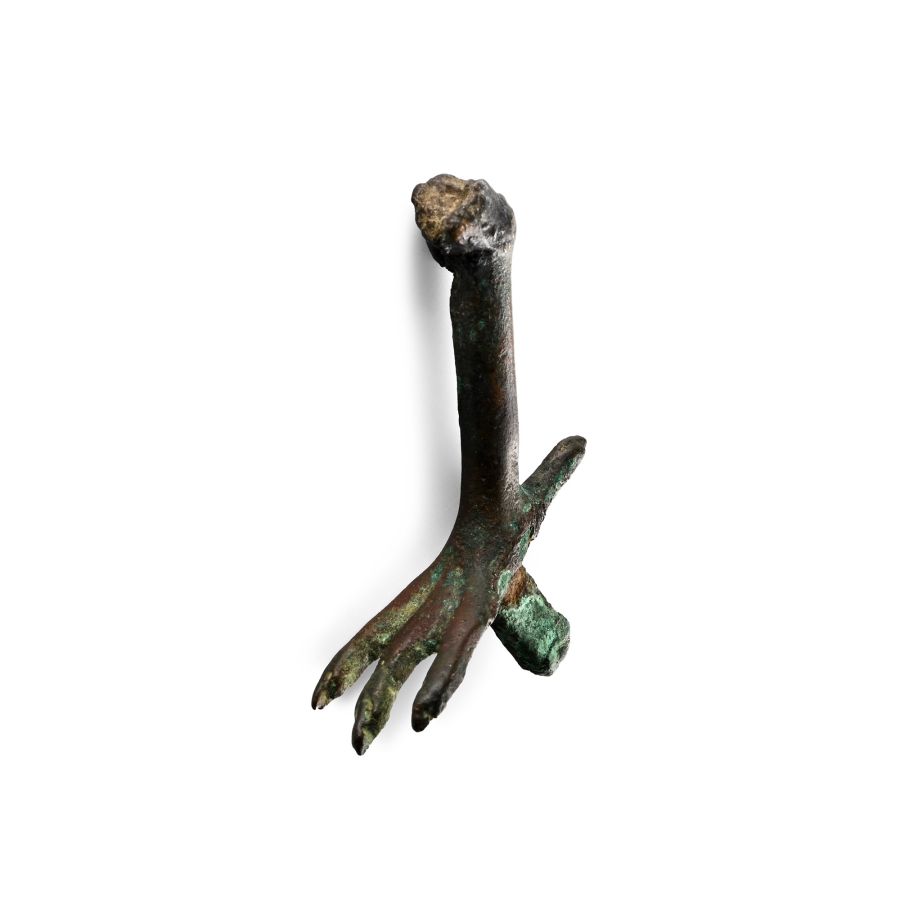
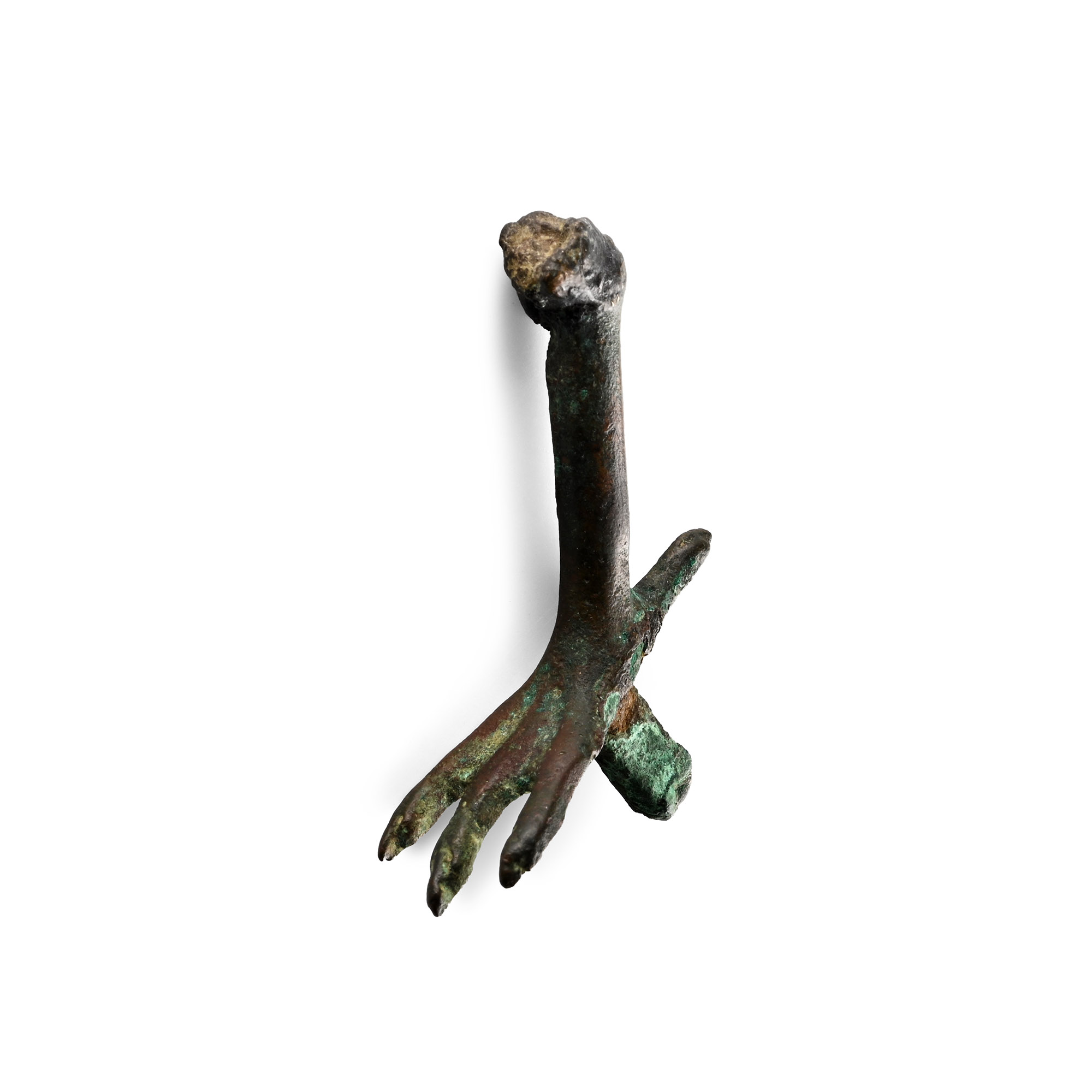
Egyptian Bronze Ibis Statue Foot
LATE PERIOD, 664-332 B.C.
2 3/8 in. (35 grams, 62 mm).
Modelled in the round with three spreading claws and spur to rear, attachment lug to underside. [No Reserve]
ProvenanceFrom the collection of a Buckinghamshire, UK, collector established from the earlier 1960s.
LiteratureCf. Tiribilli, E., The bronze figurines of the Petrie Museum from 2000 BC to AD 400, GHP Egyptology 28, London, 2018, p. 226, no. 329, for a less well-preserved example.
CONDITIONTimeLine Auctions follows a vetting process to ensure the authenticity and legality of all items, reinforcing our commitment to integrity and responsible trading. Each antiquity, antique, and coin lot undergoes thorough examination by a vetting committee of at least ten external specialists, professional trade association members, scientists, and archaeologists: Our Vetting Process
AUCTIONS:
TimeLine is a leading auction house specialising in antiquities, ancient art, collectables, natural history, coins, medals, and books. Our auctions offer museums, collectors, historians, and enthusiasts the opportunity to acquire unique and historically significant pieces.
-
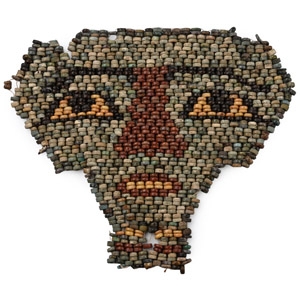
Egyptian Faience Beaded Mummy Mask
Ptolemaic Period, 332-30 B.C.Sold for (Inc. bp): £169
A restrung beadwork panel of small glazed composition beads in various colours representing a mummy face mask with false beard. 29.7 grams, 12 cm wide
Acquired on the UK art market before 2000. Property of an Essex, UK, gentleman.
Bead masks like this were attached to the outside of a mummy's wrappings and often formed part of an elaborate beaded feature covering the entire body. -
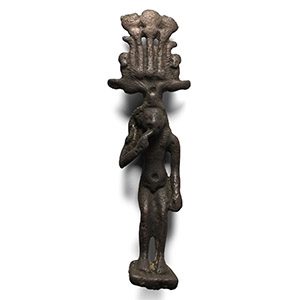
Egyptian Bronze Harpokrates Statuette
Late-Ptolemaic Period, 664-30 B.C.Estimate: £250 - 350 (+bp*)
Opening Bid: £125
Devotional figurine of Harpokrates seated with his hand raised to his mouth, wearing a nemes headdress with curled side lock, topped by an elaborate hem-hem crown characteristic of the god. 59 grams, 10.7 cm
From the collection of a gentleman, acquired on the London art market in the 1990s.
Harpokrates is the Greek rendering of the Egyptian name Hor-pa-khered, which means ‘Horus the Child’. This name refers to Horus as the divine infant of Isis and Osiris. Wearing an amulet of Harpokrates was believed to offer the same protection that Isis granted to her beloved son. Larger bronze statuettes like this example were likely votive offerings to Harpokrates to secure his favour and protection. -
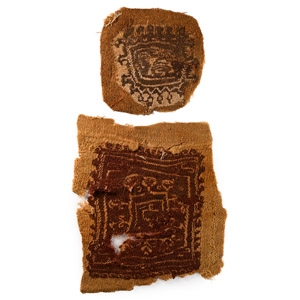
Egyptian Coptic Textile Fragment Group
Circa 4th century A.D.Sold for (Inc. bp): £143
Comprising: an orbiculus in purple wool and coarse linen, on brown linen background, S torsion, embroidered with two stylised lions, the borders crenellated; a tabula in purple wool and coarse linen, on brown linen background, S torsion, embroidered with a central cross, the borders decorated with meanders. 36 grams total including package, 8.7-13 cm
Acquired 1970s-1996. Property of a North American collector. London collection, 2016.
The tabula, or tablion, was a squared embroidery decorating tunics or mantles. The Christian elements, like the cross at the centre of our tabula, began to decorate the garments from the 4th century onwards.
