
Loading, please wait...

LOT 0446
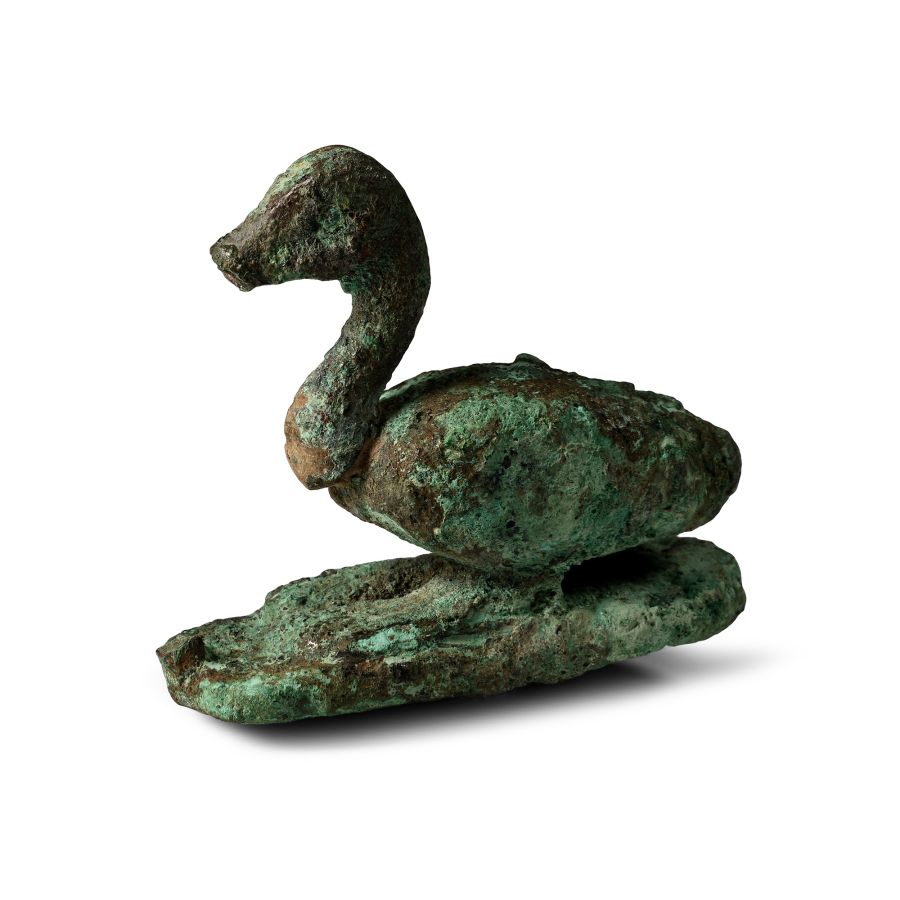
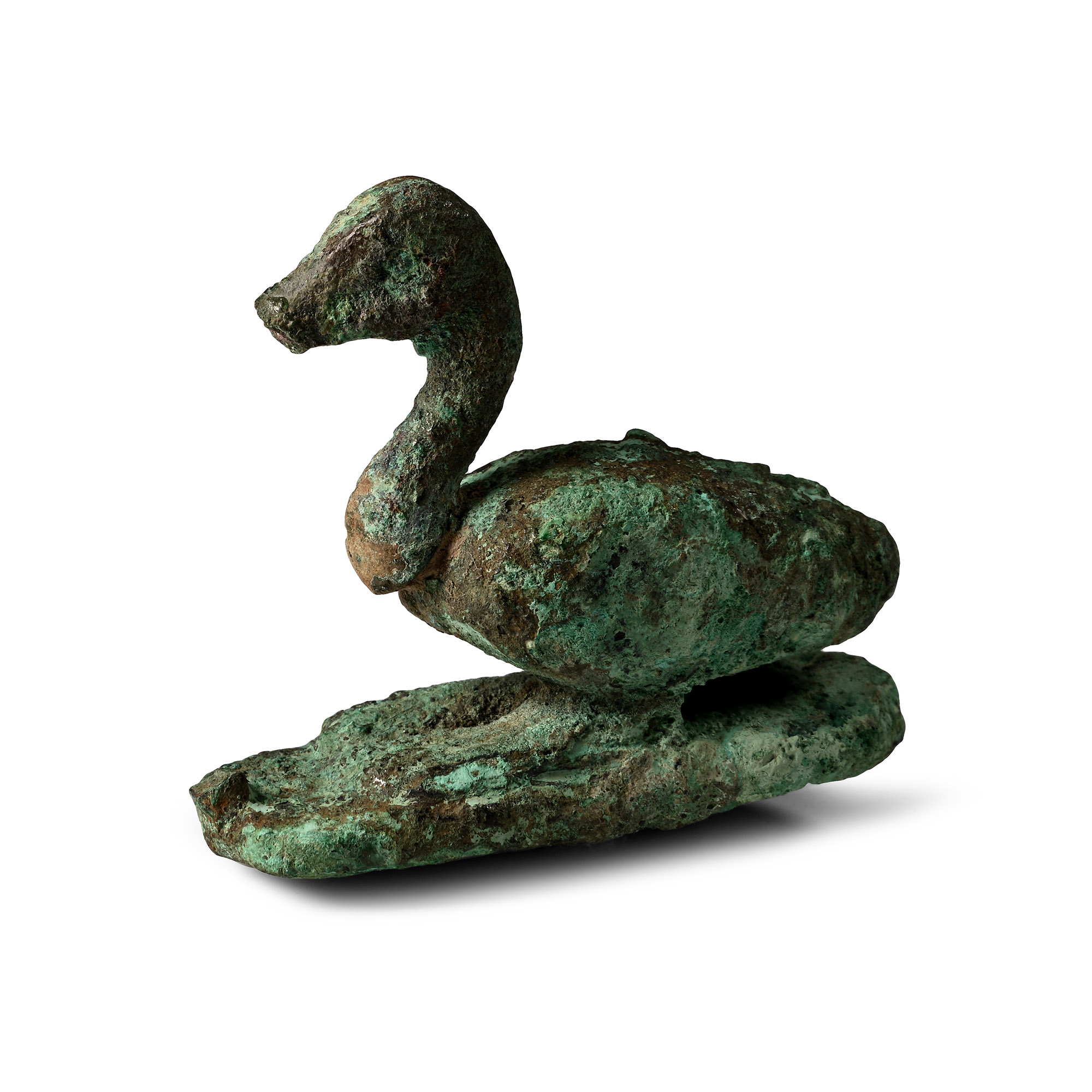
Egyptian Bronze Ibis Attachment
LATE PERIOD, 664-332 B.C. OR LATER
2 3/8 in. (114 grams, 60 mm).
Modelled in the round squatting on an ellipsoid base, lug to the underside, repaired.
ProvenanceFrom the collection of a gentleman, acquired on the London art market in the 1990s.
This lot is accompanied by an illustrated lot declaration signed by the Head of the Antiquities Department, Dr Raffaele D'Amato.
Cf. Roeder, G., Ägyptische Bronzefiguren II, Berlin, 1956, pls.57f, 58a, for similar low-squatting examples.
FootnotesThe ibis, particularly the sacred species known as the Egyptian ibis (Threskiornis aethiopicus), held a prominent place in ancient Egyptian religion and culture as a manifestation of the god Thoth. Revered as the deity of wisdom, writing, and knowledge, Thoth was often depicted in human form with the head of an ibis.
During the Late Period onwards, the practice of mummifying ibises became widespread, leading to the creation of vast necropolises dedicated to these sacred birds. In places like Saqqara and Hermopolis, thousands of ibis mummies have been discovered in specially constructed catacombs. The mummification of these birds was not merely a ritual act; it was seen as a sacred offering to Thoth, meant to honour the god and seek his favour. Egyptians believed that by preserving the ibis through mummification, they could ensure its safe passage to the afterlife, establishing a direct connection between the earthly realm and the divine. These mummies were often accompanied by votive offerings, like this bronze figurine, further emphasising the relationship between the ibises and Thoth.
TimeLine Auctions follows a vetting process to ensure the authenticity and legality of all items, reinforcing our commitment to integrity and responsible trading. Each antiquity, antique, and coin lot undergoes thorough examination by a vetting committee of at least ten external specialists, professional trade association members, scientists, and archaeologists: Our Vetting Process
AUCTIONS:
TimeLine is a leading auction house specialising in antiquities, ancient art, collectables, natural history, coins, medals, and books. Our auctions offer museums, collectors, historians, and enthusiasts the opportunity to acquire unique and historically significant pieces.
LOT 0446
Egyptian Bronze Ibis Attachment
Estimate £180 - 240€210 - 280 (for guidance only)$240 - 320 (for guidance only)
-
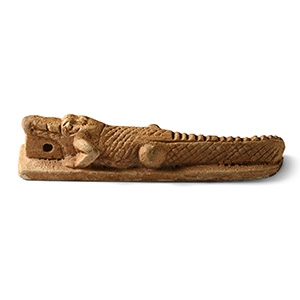
Egyptian Faience Crocodile Amulet
Late-Ptolemaic Period, 664-30 B.C.Sold for (Inc. bp): £2,600
Representing the god Sobek; detailed face and scales; standing on a rectangular plinth; pierced to the front for suspension. 13.4 grams, 74 mm
From the estate of the late Professor Dr E. Bernardo Streiff, Geneva; a distinguished collection of antiquities formed during the 1950s-1970s. with Galerie Rhéa, Zurich, Switzerland. This lot has been checked against the Interpol Database of stolen works of art and is accompanied by a search certificate number no.12629-236404. This lot has been cleared against the Art Loss Register database, and is accompanied by an illustrated lot declaration signed by the Head of the Antiquities Department, Dr Raffaele D'Amato.
Sobek is one of the most ancient and fascinating deities in the Egyptian pantheon. He is typically depicted as a crocodile or a man with the head of a crocodile, embodying various attributes related to the natural world, power, and protection. Sobek was mainly associated with water, fertility, and the Nile, along with strength and military prowess. His worship extends throughout much of ancient Egyptian history, and he was venerated not only as a force of nature but also as a god of healing, protection, and royal authority. His principal cult centres were situated in the Faiyum region, particularly the city of Crocodilopolis, and also at Kom Ombo in Upper Egypt. -
.jpg)
Egyptian Steatite Harpocrates Statuette
Late Period, 664-332 B.C.Estimate: £1,500 - 2,000 (+bp*)
Opening Bid: £750
Carved in the round, the nude standing figure of the god sporting a solar disc and uraeus headdress, wearing a sidelock, and holding a lotus flower, accompanied by an integral dorsal pillar and base; one arm missing. 15.26 grams, 78 mm
Ex Thomas collection, UK, 1980s-1990s. This lot has been cleared against the Art Loss Register database, and is accompanied by an illustrated lot declaration signed by the Head of the Antiquities Department, Dr Raffaele D'Amato.
Harpocrates is the Greek rendering of the Egyptian Hor-pa-khered, which translates as ‘Horus the Child’. This designation refers to Horus as the divine infant of Isis and Osiris. His nudity represents youth and purity. The sun disc and lotus flower symbolises divine rebirth and solar renewal. The sun disc connects him to Ra and the daily cycle of rebirth, while the lotus—opening with the sunrise—emphasises creation and emergence from chaos. Together, these elements express triumph over death and the promise of eternal life. -
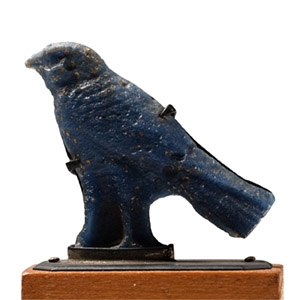
Egyptian Blue Glass Bird Inlay
Ptolemaic Period, circa 332-30 B.C.Sold for (Inc. bp): £624
Modelled in the half-round with low-relief hatched detailing; perching on a D-section base; mounted on a silver support and a wooden display stand. 18 grams total, 55 mm including stand
with Jean-Phillipe Mariaud de Serres, Paris, France. Private collection, London, UK, acquired from the above in 1992. This lot is accompanied by an illustrated lot declaration signed by the Head of the Antiquities Department, Dr Raffaele D'Amato.
The falcon inlay possibly symbolises Horus, the god of the sky, war, and protection. Horus was one of the most significant and widely worshipped gods in ancient Egyptian mythology. His importance spans multiple facets of Egyptian religion, including kingship, protection, the sky, and the sun. Depicted in various human and animal forms, Horus played a vital role in Egyptian cosmology, especially as the protector of the Pharaoh and as a representation of divine authority.
