
Loading, please wait...
LOT 0022
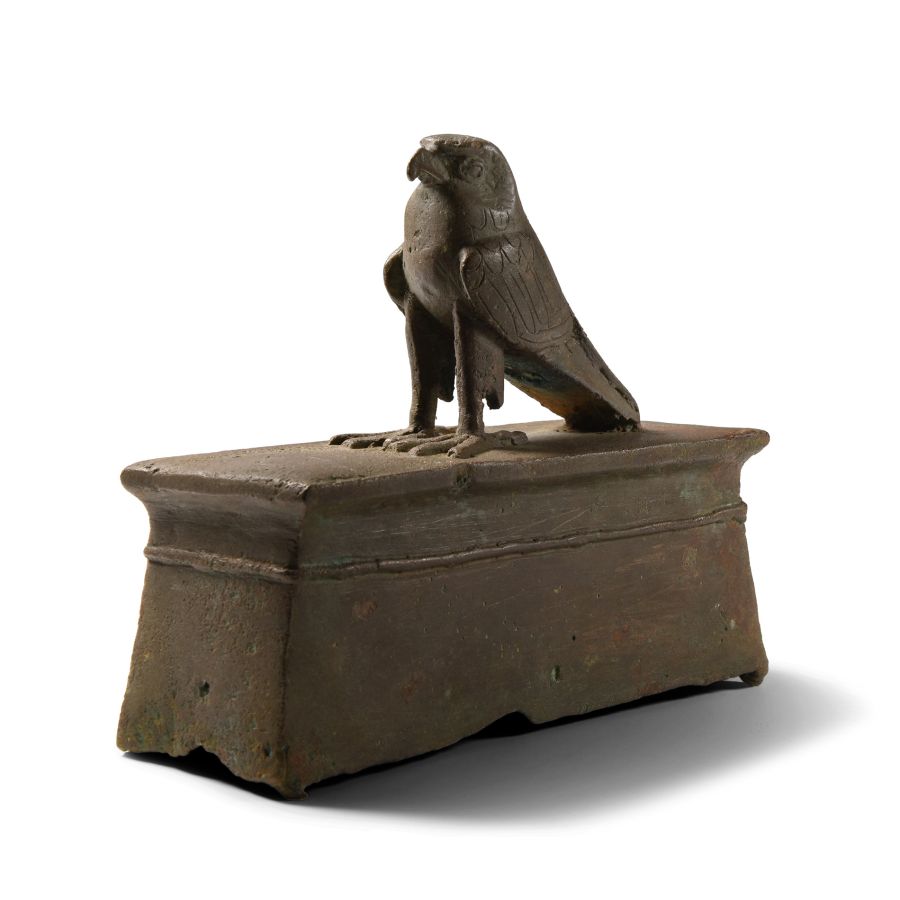
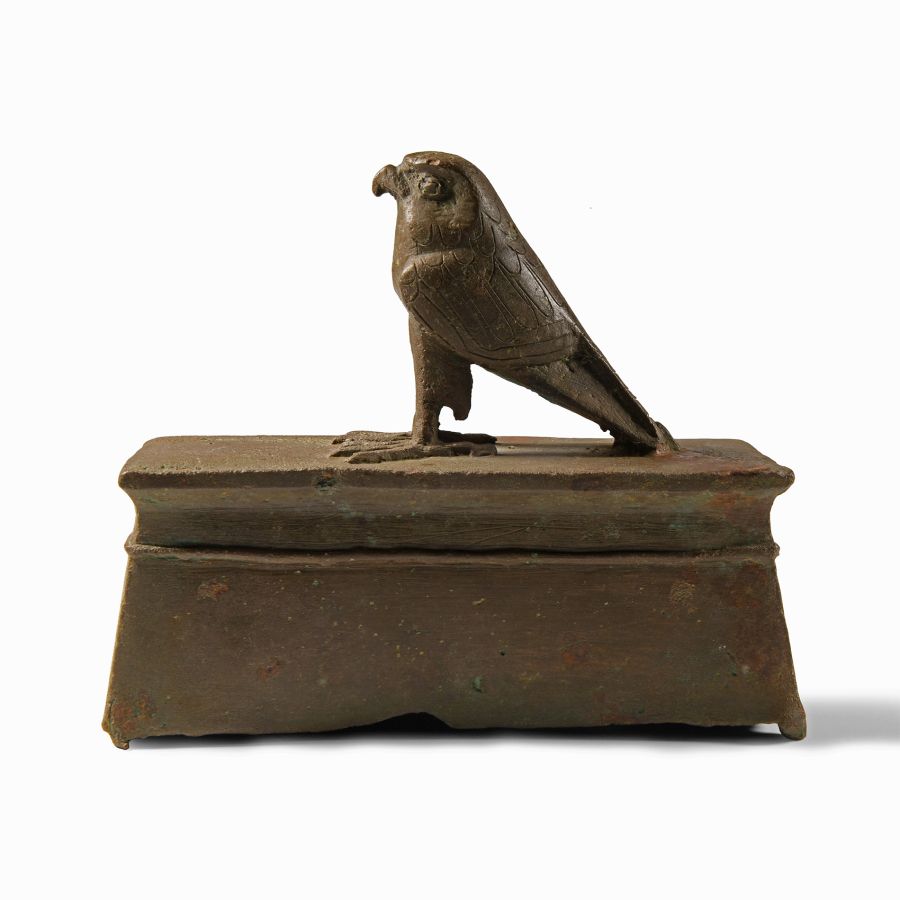
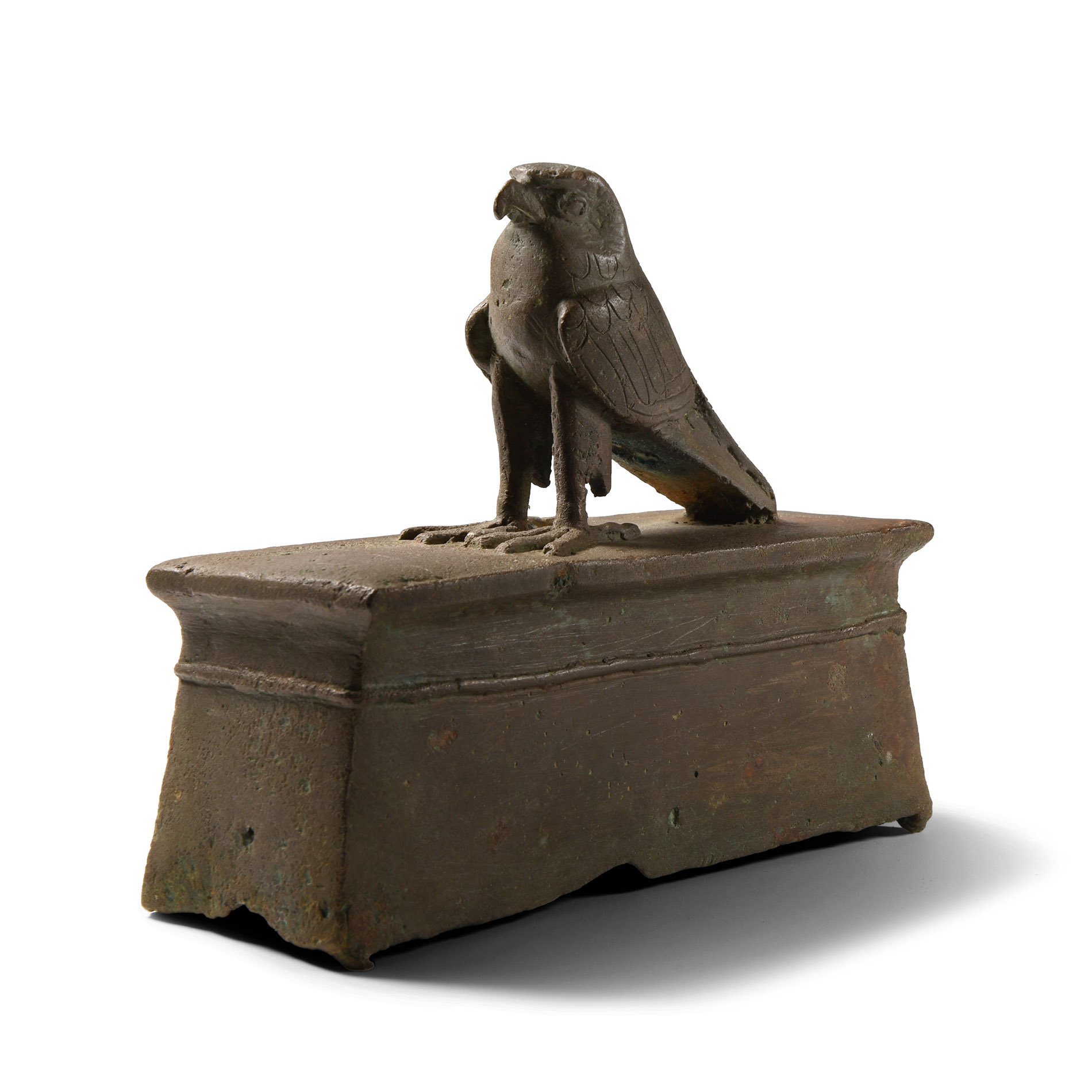
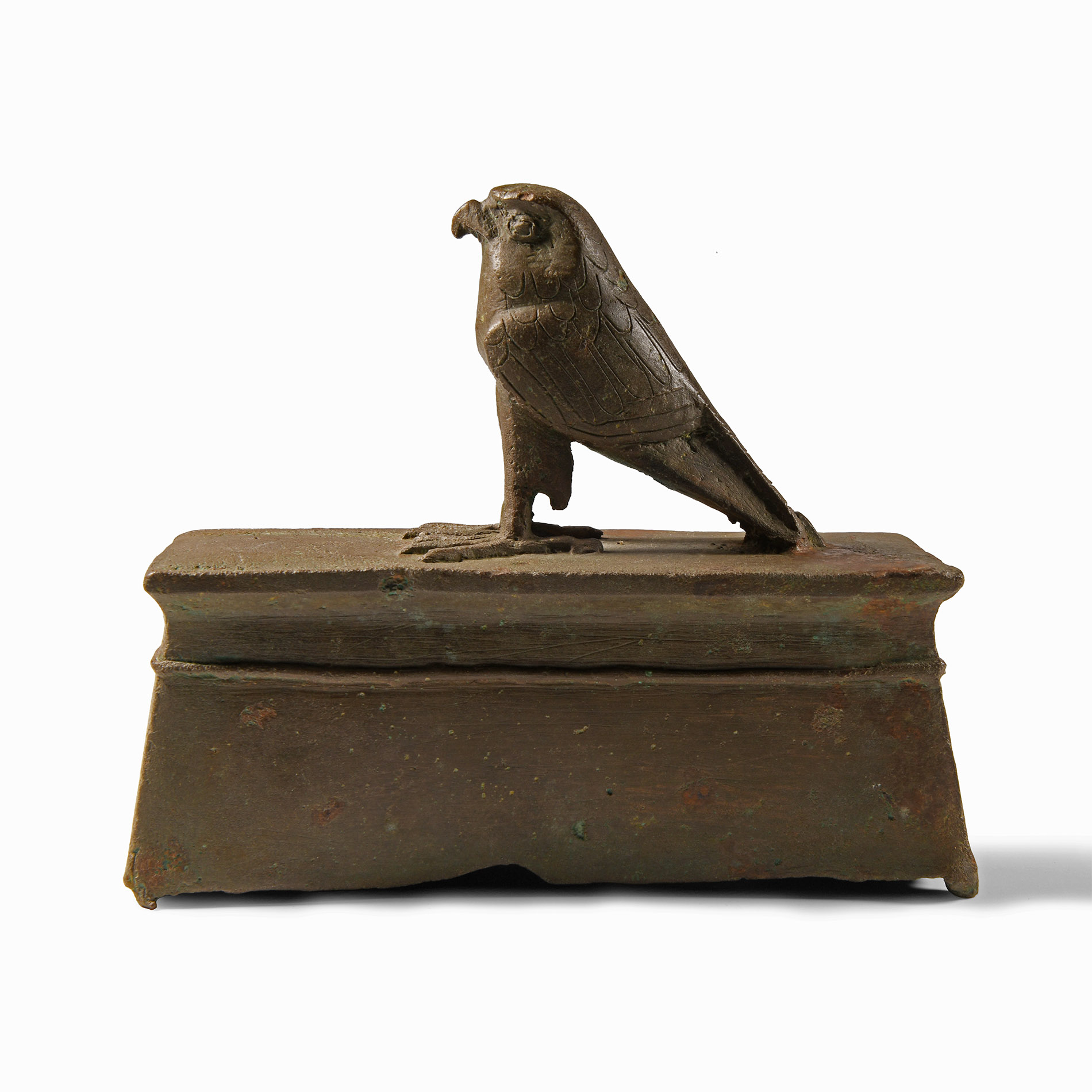
Egyptian Bronze Horus Falcon on Shrine-Shaped Base
LATE PERIOD-PTOLEMAIC PERIOD, 664-31 B.C.
5 7/8 in. (521 grams, 15 cm).
Naturalistically modelled falcon with incised feathers and detailing; standing on a shrine-shaped rectangular box with slightly battered sides and cornice moulding; inked note on the inside of each long side 'E.311' and 'Collection R.L.' respectively.
ProvenanceCollected between the 1950s-1990s.
Ex Roger Liechti (1934-2010) collection, Geneva, Switzerland.
This lot has been checked against the Interpol Database of stolen works of art and is accompanied by search certificate no.12133-211848.
Cf. Davies, S., and Smith, H.S., The Sacred Animal Necropolis at North Saqqara. The Falcon Complex and Catacomb: The Archaeological Report, London, 2005, p.24 (no.FCO-478), pl.LXVIa, for a close parallel from one of the subterranean falcon mummy galleries at Saqqara.
FootnotesThis box almost certainly once contained the mummified remains of a falcon. The falcon was principally identified with the sun-god Horus, and associated with the living king. Numerous falcon cults existed throughout Egypt, but the most spectacular was found at Saqqara, where many thousands of birds were mummified and buried in an extensive complex of underground galleries.
CONDITIONTimeLine Auctions follows a vetting process to ensure the authenticity and legality of all items, reinforcing our commitment to integrity and responsible trading. Each antiquity, antique, and coin lot undergoes thorough examination by a vetting committee of at least ten external specialists, professional trade association members, scientists, and archaeologists: Our Vetting Process
AUCTIONS:
TimeLine is a leading auction house specialising in antiquities, ancient art, collectables, natural history, coins, medals, and books. Our auctions offer museums, collectors, historians, and enthusiasts the opportunity to acquire unique and historically significant pieces.
-
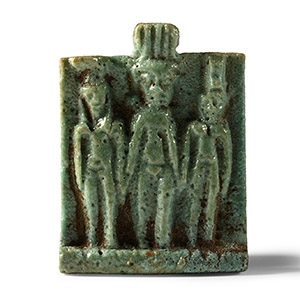
Egyptian Memphis Triad Amulet
Late Period, 664-332 B.C.Estimate: £500 - 700 (+bp*)
Opening Bid: £250
Rectangular plaque with ledge to the lower edge, ribbed loop above, the half-round figures of the goddesses Nephthys and Isis wearing their characteristic headdresses flank the figure of the young Horus wearing the sidelock of youth. 9.1 grams, 37 mm high
From an early Home Counties, UK, collection, 1930-1940. Ex London, UK, collection.
The deities of this triad are the protagonists associated with the myth of Osiris. -
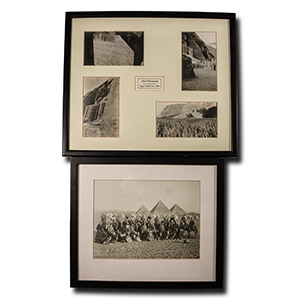
Original Photographs of Abu Simbel and Pyramids
1905 A.D.Sold for (Inc. bp): £111
Montage in a glazed wooden frame comprising four monochrome views of Abu Simbel with caption 'Album Photographs / Silver Gelatin Prints / Egypt Nubia Tour 1905'; plus one other framed photograph by G.M. Georgoulas of a group in front of the Old Kingdom pyramids at Giza dated 29 December 1932. 1.42 kg total, 32 x 27.5 - 37 x 31.5 cm
Property of a North Lincolnshire, UK, gentleman.
The four photographs of Abu Simbel show the original location of the magnificent rock-cut temple complex of Ramesses II before it was dismantled in 1964 and re-assembled on higher ground to rescue it from the rising waters of Lake Nassar. -
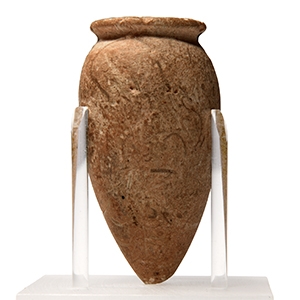
Egyptian Stone Alabastron
Late Old Kingdom, circa 2300 B.C.Estimate: £300 - 400 (‡+bp*)
Opening Bid: £150
The body with rounded shoulders, convex outer face and pointed base, everted rim; accompanied by a custom-made display base. 34.2 grams, 48 mm high (48.9 grams, 55 mm including stand)
Acquired in Europe before 1994. European collection.
