
Loading, please wait...
_900x900.jpg "Egyptian Bronze Head of a Cat")
_200x200.jpg "Egyptian Bronze Head of a Cat")
.jpg "Egyptian Bronze Head of a Cat")
LOT 0030
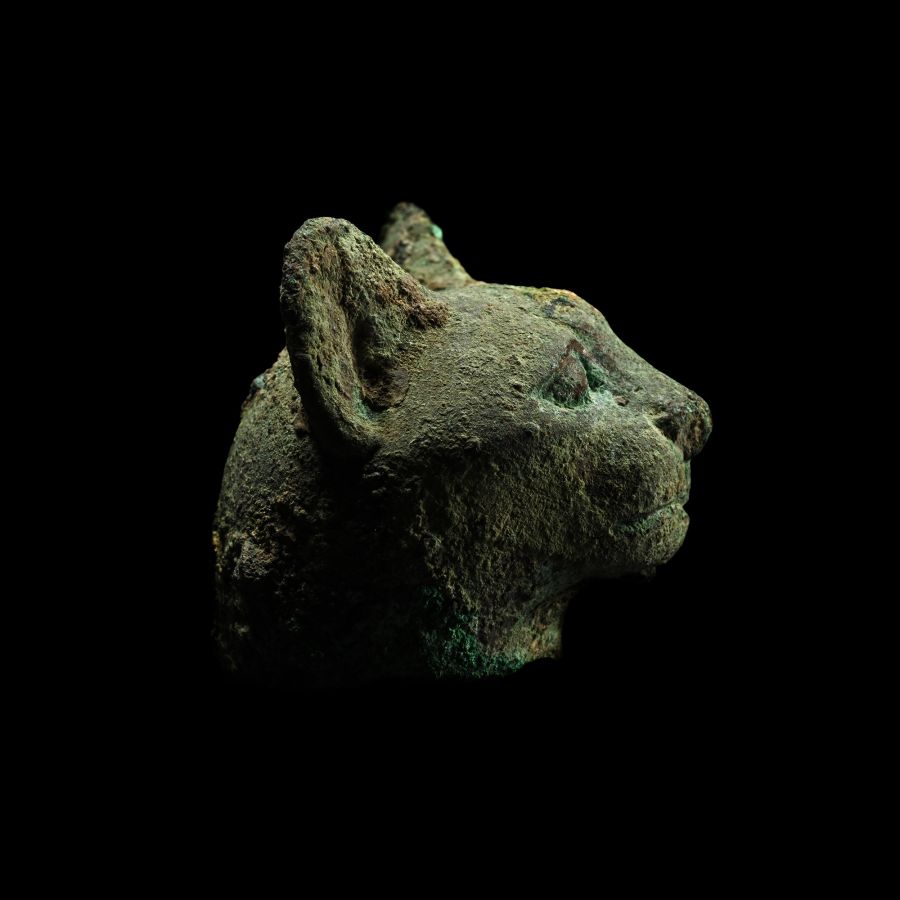
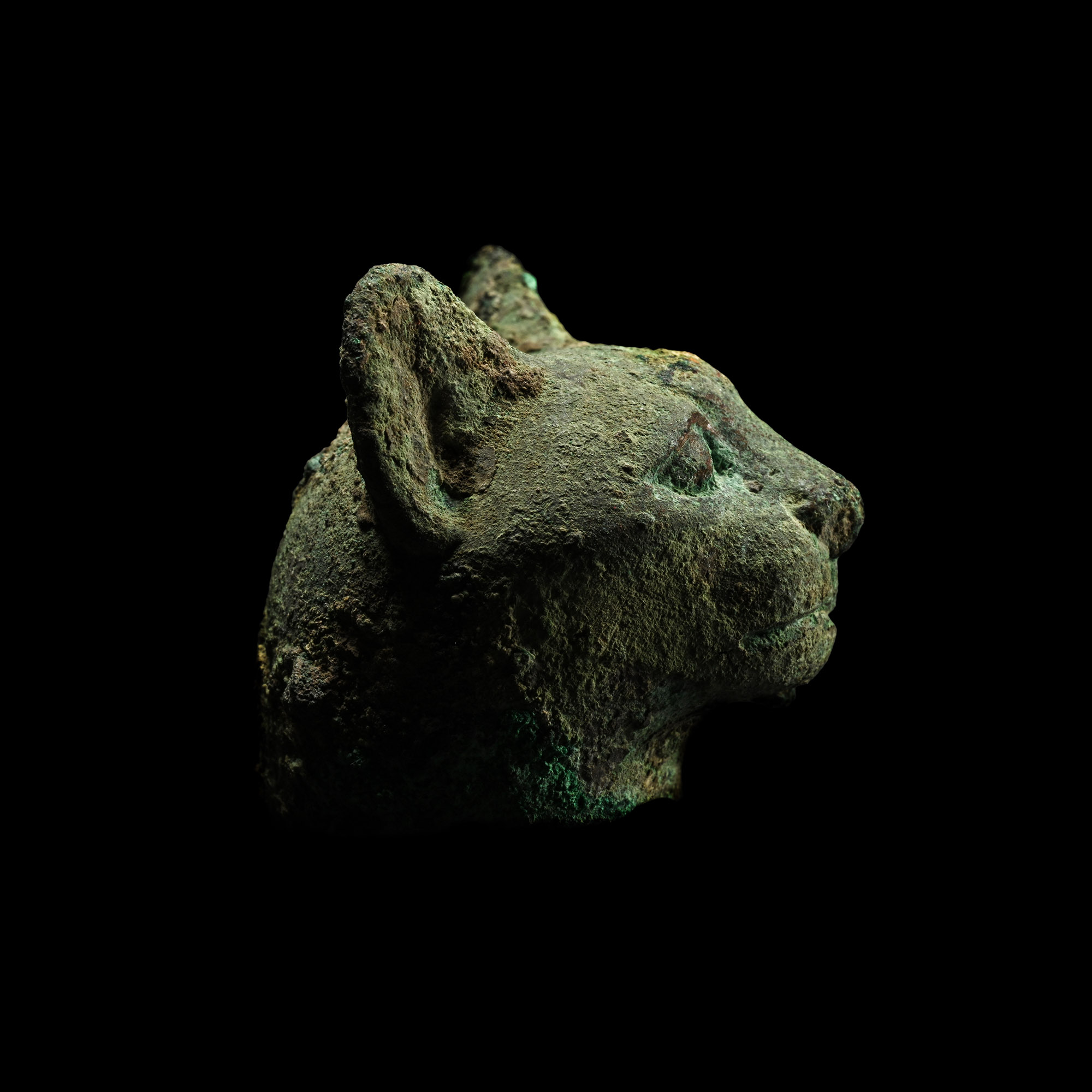
Egyptian Bronze Head of a Cat
LATE-PTOLEMAIC PERIOD, 664-30 B.C.
1 1/4 in. (40.4 grams, 33.6 mm high).
The head of goddess Bastet modelled in the round with alert ears and eyes, ears pierced; hollow-formed.
ProvenanceAcquired in the mid 1990s.
Private collection, Switzerland, thence by descent.
Private collection, since the late 1990s.
This lot is accompanied by an illustrated lot declaration signed by the Head of the Antiquities Department, Dr Raffaele D'Amato.
Cf. Roeder, G., Ägyptische Bronzefiguren II, Berlin, 1956, pl. 50 l and m, for comparable cat heads; Waziry, M., Vestiges of Ancient Egypt: The Bubasteion Votive Cachette at Saqqara, Houston, 2023, p. 68, fig. 19, for an example of a bronze cat head attached to carved wooden body, discovered at the cult centre of Bastet at Saqqara.
FootnotesThe feline's pierced ears likely once held earrings or other ornaments. It was probably attached to a statuette of a cat, whose body may have been crafted from wood.
The cat was sacred to Bastet, a protective mother goddess and the daughter of the sun god Re. Amulets provided the wearer with the goddess's protection. Her name means ‘she of the bast [ointment jar],’ which may have contained a substance favoured by or exclusive to royalty. Originally, Bastet was depicted as a woman with the head of a lioness, but by the late New Kingdom, she was typically shown with a cat's head. She is sometimes portrayed with kittens, emphasising her maternal role as a fierce protector of her offspring.
TimeLine Auctions follows a vetting process to ensure the authenticity and legality of all items, reinforcing our commitment to integrity and responsible trading. Each antiquity, antique, and coin lot undergoes thorough examination by a vetting committee of at least ten external specialists, professional trade association members, scientists, and archaeologists: Our Vetting Process
AUCTIONS:
TimeLine is a leading auction house specialising in antiquities, ancient art, collectables, natural history, coins, medals, and books. Our auctions offer museums, collectors, historians, and enthusiasts the opportunity to acquire unique and historically significant pieces.
LOT 0030
Egyptian Bronze Head of a Cat
Estimate £1,000 - 1,400€1,160 - 1,620 (for guidance only)$1,350 - 1,890 (for guidance only)
-
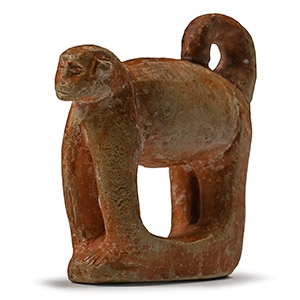
Egyptian Statuette of a Standing Monkey
Ptolemaic Period, 4th-1st century B.C. or laterEstimate: £800 - 1,000 (‡+bp*)
Opening Bid: £400
Standing on a rectangular plinth with head raised and tail curled above the hindquarters, barrel-shaped body with incised detailing at the shoulders and hips, traces of a white and reddish brown coating; partially restored; old collector's labels to underside '51' and 'N13234'. 42.8 grams, 60 mm
Ex Baden-Württemberg, Germany, formed since ca.1930. Private collection Saarland, Germany. Thereafter, Michael Schrôder, Germany. Consigned to DAWO Auktion, 18 February 2017, no.824. Accompanied by a copy of an Art Loss Register certificate no.S00123279. This lot is accompanied by an illustrated lot declaration signed by the Head of the Antiquities Department, Dr Raffaele D’Amato. This lot is accompanied by an illustrated lot declaration signed by the Head of the Antiquities Department, Dr Raffaele D'Amato. -
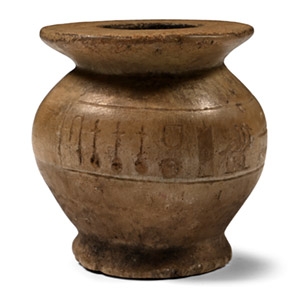
Egyptian Alabaster Kohl Pot with Later Hieroglyphs
Second Intermediate Period, 1650-1550 B.C.Sold for (Inc. bp): £195
Comprising a squat piriform body with a wide everted rim, a band of later hieroglyphs beneath the shoulder: ḳmꜢ.t n bꜢw ı͗wnw nfrw.s (You have gathered the souls (i.e. divine powers) of Heliopolis—her beauties). 208 grams, 55 mm high
Ex late London, UK, gentleman, 1970s. This lot is accompanied by an illustrated lot declaration signed by the Head of the Antiquities Department, Dr Raffaele D'Amato.
The inscription on what is a cosmetic vessel could be interpreted as “You acquire the powers of Heliopolis, source of her beauty”; “her beauties” likely references either the woman using the vessel or perhaps the divine beauty imparted by the contents. -
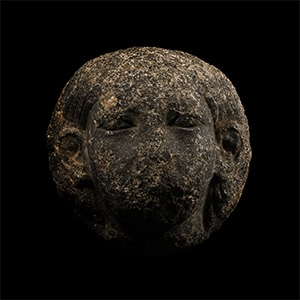
Egyptian Black Stone Head of a Female
Middle Kingdom, late 12th Dynasty, 1862-1787 B.C.Sold for (Inc. bp): £1,235
Carved in the round head with almond-shaped eyes and copious hair, detailed ears; jawline, neck and cheeks abraded. 1.1 kg, 94 mm
Acquired in the mid 1980s-1990s. Private collection, Switzerland, thence by descent. Private collection, since the late 1990s. This lot is accompanied by an illustrated lot declaration signed by the Head of the Antiquities Department, Dr Raffaele D'Amato.
The nearly spherical shape suggests that the head was repurposed as a pounder.
