
Loading, please wait...

LOT 0001
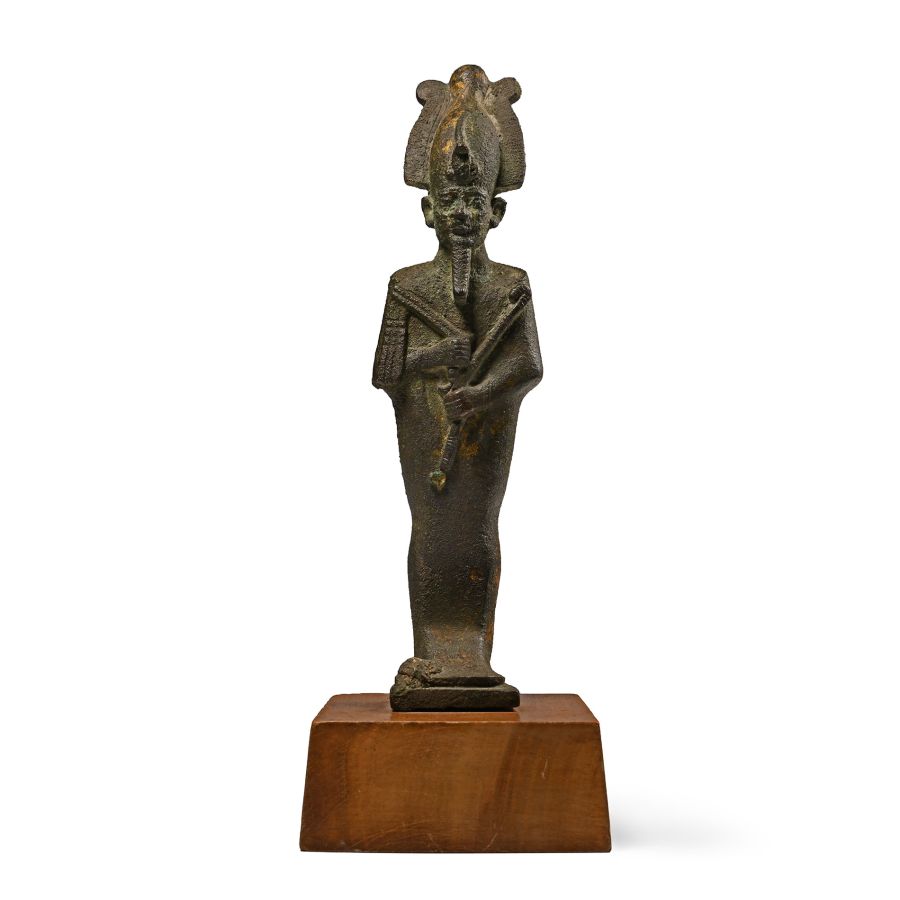
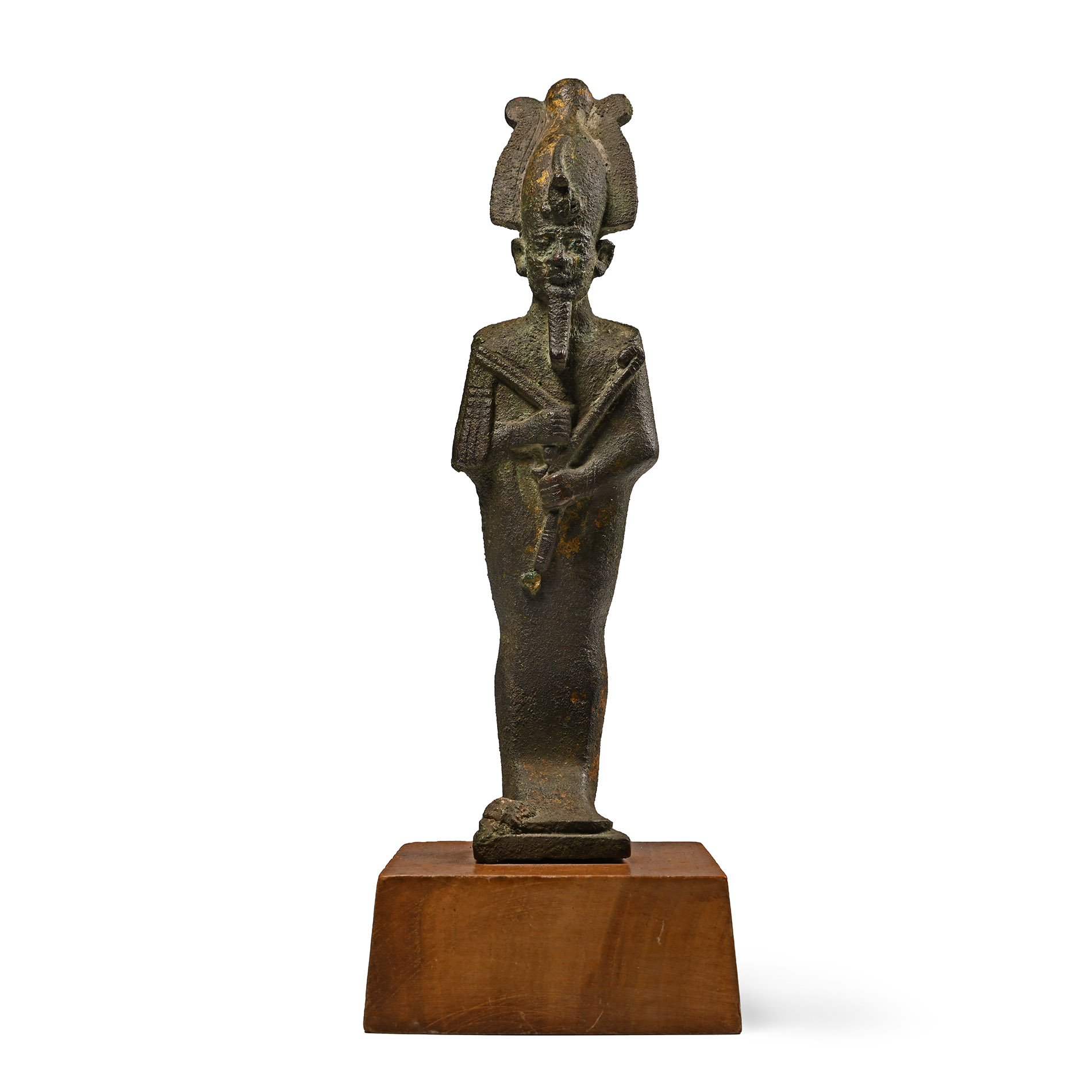
Egyptian Bronze Figure of Osiris
LATE PERIOD, 664-332 B.C.
8 1/4 in. (811 grams total, 21 cm including stand).
Solid cast mummiform figure standing on an integral plinth; the god cloaked in a tight-fitting shroud, sporting the ostrich-plumed atef crown with uraeus, divine beard, and holding the characteristic crook and flail regalia; traces of gilding remain; mounted on a custom-made display stand.
ProvenancePrivate collection, 19th century, thence by descent.
Private collection, Neuchâtel.
This lot has been checked against the Interpol Database of stolen works of art and is accompanied by search certificate number no.12195-222135.
Cf. Roeder, G., Ägyptische Bronzefiguren II, Berlin, 1956, pl. 22e, for similar figurine.
FootnotesOsiris is a deity who represents death and fertility and is commonly regarded as the quintessential god of rebirth. Though he was once a mortal ruler, as a deceased entity, his domain was the Underworld. Abydos was the primary centre of Osiris’s cult, where a renowned yearly celebration of the god was held.
CONDITIONTimeLine Auctions follows a vetting process to ensure the authenticity and legality of all items, reinforcing our commitment to integrity and responsible trading. Each antiquity, antique, and coin lot undergoes thorough examination by a vetting committee of at least ten external specialists, professional trade association members, scientists, and archaeologists: Our Vetting Process
AUCTIONS:
TimeLine is a leading auction house specialising in antiquities, ancient art, collectables, natural history, coins, medals, and books. Our auctions offer museums, collectors, historians, and enthusiasts the opportunity to acquire unique and historically significant pieces.
-
Egypto-Phoenician Hardstone Scarab Group
Late 1st millennium B.C.Sold for (Inc. bp): £650
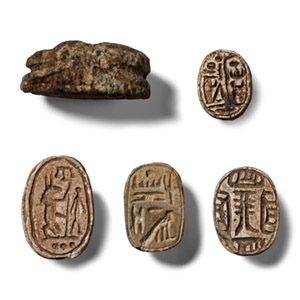
Comprising five scarabs: one with a djed pillar surrounded by nwb signs; one with a jackal-headed Anubis holding a staff before a figure, with the scales of Maat above; one with a seated baboon sporting a crescent and sun disc headdress facing a royal cartouche of Thutmose III men-kheper-Re; one with a standing bird and other hieroglyphs; the largest one with worn underside. 1.97 grams total, 14-26 mm
From an early 20th century Home Counties, UK, collection.
The scarab, which represented the dung beetle, was the most popular amulet in ancient Egypt for approximately two thousand years until the Ptolemaic Period when it gradually fell out of favour. The popularity of scarabs extended beyond the borders of Egypt, and they were also distributed and produced in other regions, such as Phoenicia and Israel. The beetle is named khepri, derived from the verb 'to come into existence', and was considered the embodiment of the creator god Khepri, who was self-engendered. The ancient Egyptians mistakenly believed that the young beetle emerging from the dung ball was the result of an act of self-creation. -
Egyptian Silver Bastet Cat Goddess
Late Period, 664-332 B.C.Estimate: £700 - 900 (‡+bp*)
Opening Bid: £350
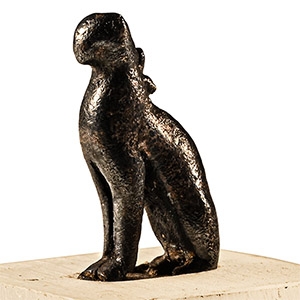
Modelled seated on an oblong base; accompanied by a custom-made display base. 1.27 grams, 13 mm high (6.02 grams total, 33 mm including stand)
Ex Mrs Zimmermann Koutoulakis, December 1977. Ex R. Liechti (1934-2010) Geneva, Switzerland, collection between 1950-1990s.
Bastet was primarily a goddess of fertility, but she also represented festivities and intoxication, which formed part of the temple celebrations of her cult. -
.jpg)
Egyptian Granite Head of a Dignitary
New Kingdom, 1552-1069 B.C.Sold for (Inc. bp): £28,600
Carved with soft facial features and carefully executed cosmetic lines around the eye, earring, and carefully detailed duplex wig with gently wavy curls; likely from the Ramesside Period; mounted on a custom-made stand. 4.23 kg total, 20 cm including stand
Private collection, France. with Christie’s, New York, 18 December 1996, no.60. Acquired by the present owner from the above. Accompanied by an academic report by Egyptologist Paul Whelan. This lot has been checked against the Interpol Database of stolen works of art and is accompanied by search certificate number no.12202-222169.
The shape of the eyes, raised upper and lower cosmetic lines, brows, and mouth on the TimeLine head present a similar countenance to that of the cube statue of Hori, dated to the reign of Ramesses II, now in the Musée du Louvre (inv. no. Louvre E11275). An even closer parallel can be seen in another non-royal statue of Paaha in the British Museum (inv. no. EA 501).
