
Loading, please wait...
LOT 0012
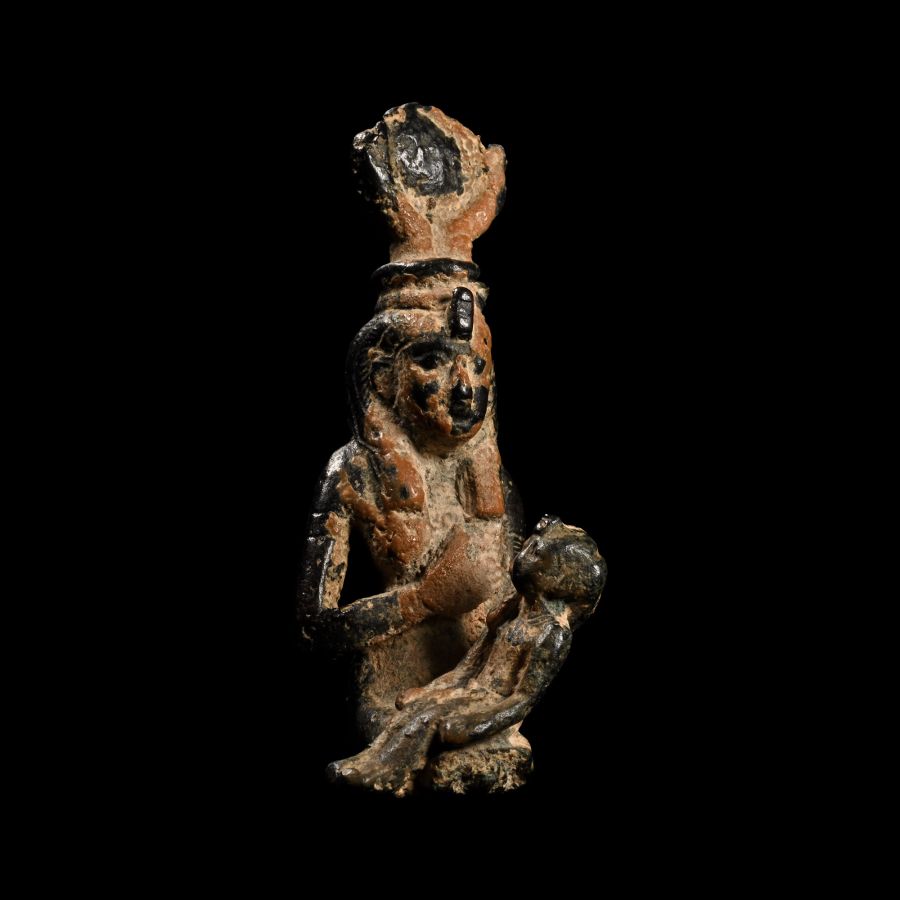
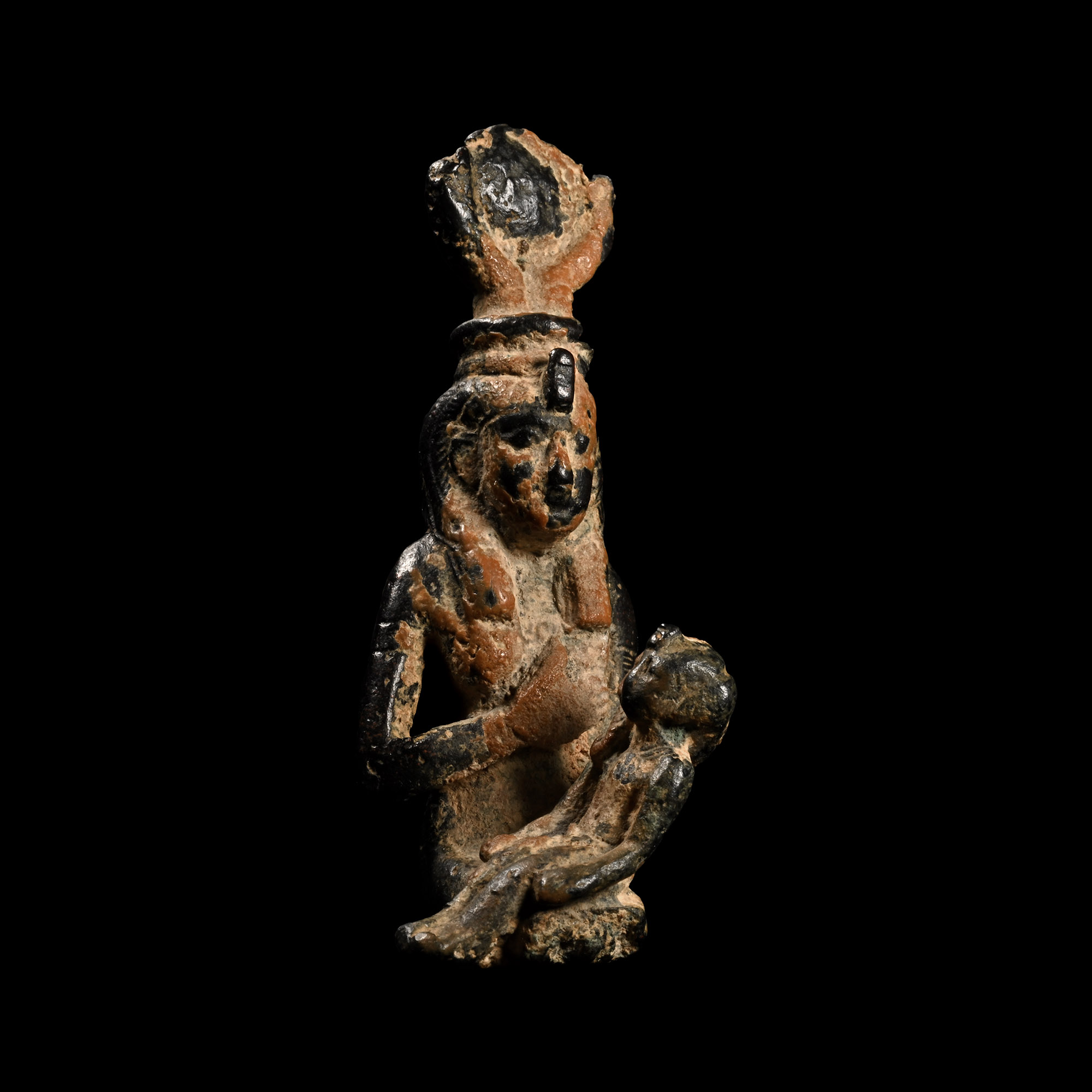
Egyptian Bronze Figure of Isis and Horus
LATE PERIOD, 664-332 B.C.
2 5/8 in. (73.4 grams, 68 mm).
Isis enthroned wearing a cow's horn headdress with a solar disc fronted by uraeus, suckling the infant Horus on her lap; Horus with a side-lock of youth.
ProvenanceAcquired in the mid 1980s-1990s.
Private collection, Switzerland, thence by descent.
Private collection, since the late 1990s.
This lot is accompanied by an illustrated lot declaration signed by the Head of the Antiquities Department, Dr Raffaele D'Amato.
Cf. Fazzini, R. A., Egypt: Dynasty XXII-XXV. Iconography of Religions, Section 16, Egypt 10, Leiden, 1988, p. 12, et 33 with pl. 23, for similar statuette.
FootnotesIn ancient Egyptian mythology, Isis was the sister-wife of Osiris and the mother of the sky god Horus. She is associated with aspects of fertility and motherhood and is often depicted in various artworks seated in a nursing pose with her son Horus on her lap, as here.
CONDITIONTimeLine Auctions follows a vetting process to ensure the authenticity and legality of all items, reinforcing our commitment to integrity and responsible trading. Each antiquity, antique, and coin lot undergoes thorough examination by a vetting committee of at least ten external specialists, professional trade association members, scientists, and archaeologists: Our Vetting Process
AUCTIONS:
TimeLine is a leading auction house specialising in antiquities, ancient art, collectables, natural history, coins, medals, and books. Our auctions offer museums, collectors, historians, and enthusiasts the opportunity to acquire unique and historically significant pieces.
LOT 0012
Egyptian Bronze Figure of Isis and Horus
Estimate £1,000 - 1,400€1,160 - 1,620 (for guidance only)$1,350 - 1,890 (for guidance only)
-
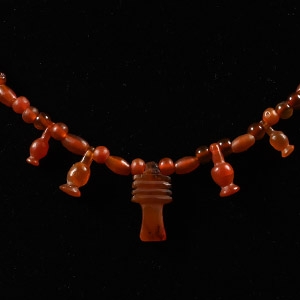
Egyptian Carnelian Necklace with Djed Pillar
Late Period, 664-332 B.C.Sold for (Inc. bp): £715
Composed mainly of oblate and spherical beads, four poppy seed pendants, and a larger djed pillar pendant; restrung with a modern clasp. 12.68 grams, 43.5 cm
From an Israeli collection, formerly with the Archaeological Centre in Jaffa. This lot is accompanied by an illustrated lot declaration signed by the Head of the Antiquities Department, Dr Raffaele D'Amato.
The djed pillar symbolises endurance and stability. Used as a funerary amulet since the Old Kingdom, it was first linked to Ptah and Sokar, later becoming associated with Osiris as his backbone. Chapter 155 of the Book of the Dead references it in the context of resurrection. Beads in the form of poppies were used to heal and alleviate pain and to ward off death. These types of amulets were also linked to Osiris, the Egyptian deity of agriculture, death, and the afterlife. -
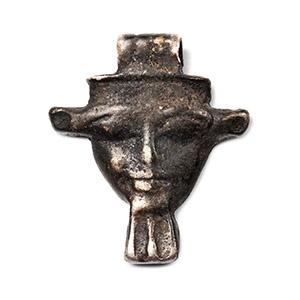
Egyptian Silver Hathor Amulet
Late-Ptolemaic Period, 664-30 B.C.Sold for (Inc. bp): £975
D-shaped mask representing the human-headed Hathor with cow ears and a short beard, a ribbed suspension loop above. 0.7 grams, 11 mm
From an early 20th century collection. This lot is accompanied by an illustrated lot declaration signed by the Head of the Antiquities Department, Dr Raffaele D'Amato. -
.jpg)
Egyptian 'Becker' Serpentine Vessel
New Kingdom, 18th Dynasty, circa 1450 B.C.Estimate: £4,000 - 6,000 (‡+bp*)
Opening Bid: £1,800
Piriform jar with wide, flat rim and short neck, narrow neck and flat base. 1.2 kg, 15.5 cm
Ex Becker collection, 1920s. Private collection, Los Angeles, USA, 1990s. Private European collection. Accompanied by an academic report by Dr Raffaele D’Amato. This lot has been checked against the Interpol Database of stolen works of art and is accompanied by a search certificate number no.12576-232111. This lot has been cleared against the Art Loss Register database, and is accompanied by an illustrated lot declaration signed by the Head of the Antiquities Department, Dr Raffaele D'Amato.
