
Loading, please wait...
_900x900.jpg "Egyptian Bronze Cobra Mount")
_200x200.jpg "Egyptian Bronze Cobra Mount")
_900x900.jpg "Egyptian Bronze Cobra Mount")
_200x200.jpg "Egyptian Bronze Cobra Mount")
.jpg "Egyptian Bronze Cobra Mount")
.jpg "Egyptian Bronze Cobra Mount")
LOT 0440
Egyptian Bronze Cobra Mount
LATE PERIOD, 6TH CENTURY B.C.
8 5/8 in. (182 grams, 22 cm).
Cobra-shaped mount with head raised and hood expanded, two mounting studs to the reverse; mounted on a custom-made stand.
ProvenancePrivate Israeli collection.
Ex Archaeological Center, Tel Aviv, Israel, 2015.
Private European collection.
Cf. Tiribilli, E., The bronze figurines of the Petrie Museum from 2000 BC to AD 400, GHP Egyptology 28, London, 2018, p. 295, no. 480, for a similar, though smaller, example.
FootnotesThe mount quite possibly adorned the Atef crown of a statue of Osiris.
CONDITIONTimeLine Auctions follows a vetting process to ensure the authenticity and legality of all items, reinforcing our commitment to integrity and responsible trading. Each antiquity, antique, and coin lot undergoes thorough examination by a vetting committee of at least ten external specialists, professional trade association members, scientists, and archaeologists: Our Vetting Process
AUCTIONS:
TimeLine is a leading auction house specialising in antiquities, ancient art, collectables, natural history, coins, medals, and books. Our auctions offer museums, collectors, historians, and enthusiasts the opportunity to acquire unique and historically significant pieces.
LOT 0440
Egyptian Bronze Cobra Mount
Estimate £700 - 900€810 - 1,040 (for guidance only)$950 - 1,220 (for guidance only)
-
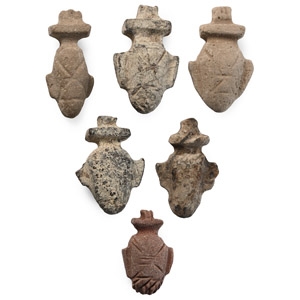
Egyptian Amulet Collection
Late Period, 664-332 B.C.Sold for (Inc. bp): £117
Mainly heart-type amulets in various materials. 14.85 grams total, 20-26 mm
with Archaeologia, Switzerland, before 1983. Ex private North American collection. London private collection, 2016. -
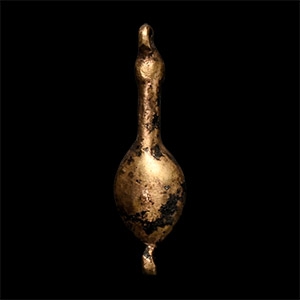
Egyptian Gold Poppy Amulet
Circa 5th-3rd century B.C.Sold for (Inc. bp): £234
Bulbous poppy-head with loop at the apex. 0.21 grams, 12 mm
Ex French collection, early 20th century. From the collection of a late Japanese gentleman, 1970s onwards. -
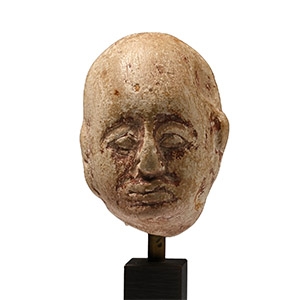
Egyptian Stone Head of a Man
Hyksos Period, circa 1648-1540 B.C.Estimate: £700 - 900 (‡+bp*)
Opening Bid: £350
A miniature male head with high eyebrows, large eyes, and protruding nose and mouth; traces of polychrome; inked collector's number '46' on the back; mounted on a custom-made display stand. 76 grams total, 92 mm including stand
Collection of Ambassador G.P., Nr.203, before 1965. with Galerie Rhéa, Zurich, Switzerland.
