
Loading, please wait...
_900x900.jpg "Egyptian Bronze Cobra Mount")
_200x200.jpg "Egyptian Bronze Cobra Mount")
_900x900.jpg "Egyptian Bronze Cobra Mount")
_200x200.jpg "Egyptian Bronze Cobra Mount")
.jpg "Egyptian Bronze Cobra Mount")
.jpg "Egyptian Bronze Cobra Mount")
LOT 0029
Egyptian Bronze Cobra Mount
LATE PERIOD, 6TH CENTURY B.C.
8 5/8 in. (182 grams, 22 cm).
Cobra-shaped mount with head raised and hood expanded, two mounting studs to the reverse; mounted on a custom-made stand.
ProvenancePrivate Israeli collection.
Ex Archaeological Center, Tel Aviv, Israel, 2015.
Private European collection.
This lot is accompanied by an illustrated lot declaration signed by the Head of the Antiquities Department, Dr Raffaele D'Amato.
Cf. Tiribilli, E., The bronze figurines of the Petrie Museum from 2000 BC to AD 400, GHP Egyptology 28, London, 2018, p. 295, no. 480, for a similar, though smaller, example.
FootnotesThe mount quite possibly adorned the Atef crown of a statue of Osiris.
CONDITIONTimeLine Auctions follows a vetting process to ensure the authenticity and legality of all items, reinforcing our commitment to integrity and responsible trading. Each antiquity, antique, and coin lot undergoes thorough examination by a vetting committee of at least ten external specialists, professional trade association members, scientists, and archaeologists: Our Vetting Process
AUCTIONS:
TimeLine is a leading auction house specialising in antiquities, ancient art, collectables, natural history, coins, medals, and books. Our auctions offer museums, collectors, historians, and enthusiasts the opportunity to acquire unique and historically significant pieces.
LOT 0029
Egyptian Bronze Cobra Mount
Estimate £800 - 1,000€930 - 1,160 (for guidance only)$1,080 - 1,350 (for guidance only)
-
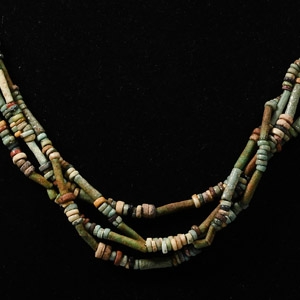
Egyptian Multi-Stranded Mummy Bead Necklace
Late Period, 664-332 B.C.Sold for (Inc. bp): £312
Four-stranded designer necklace composed of beads of mainly annular and tubular types. 21 grams, 67 cm
Acquired before 1979. From the private collection of Mr F.A., South Kensington, London, UK; thence by descent 2014. This lot is accompanied by an illustrated lot declaration signed by the Head of the Antiquities Department, Dr Raffaele D'Amato.
For thousands of years, artisans in Egypt created vibrant ceramics to echo the beauty of rare jewels. These ornaments were created with almost every material, colour, and texture imaginable and they come from across Egypt and beyond: vibrant blue lapis lazuli from Afghanistan, glossy black obsidian from Turkey, and aqua-green turquoise from the Sinai. They were worn in life and, after death, they served as precious ornamentation for mummies. -
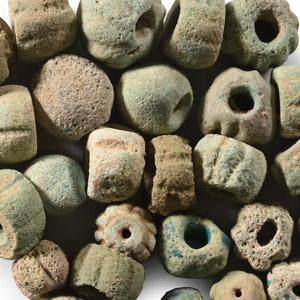
Romano-Egyptian Faience Melon Bead Collection
2nd-1st century B.C.Sold for (Inc. bp): £33
Comprising thirty green and blue beads in various sizes. 42 grams total, 8-18 mm
Ex H. Norry collection, Milton Keynes, UK, 1980s-1990s. This lot is accompanied by an illustrated lot declaration signed by the Head of the Antiquities Department, Dr Raffaele D'Amato. -
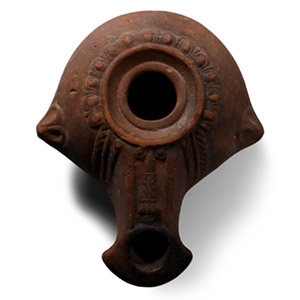
Egyptian Terracotta Oil Lamp
Ptolemaic Period, circa 200-50 B.C.Sold for (Inc. bp): £169
Rounded body with large filler hole and two pointed lugs on the shoulder, the rim with a low-relief ovolo decoration, elongated nozzle with a low-relief pillar motif; low basal ring. 60 grams, 92 mm
with Galerie Rhéa, Zurich, Switzerland. This lot is accompanied by an illustrated lot declaration signed by the Head of the Antiquities Department, Dr Raffaele D'Amato.
