
Loading, please wait...
LOT 0027
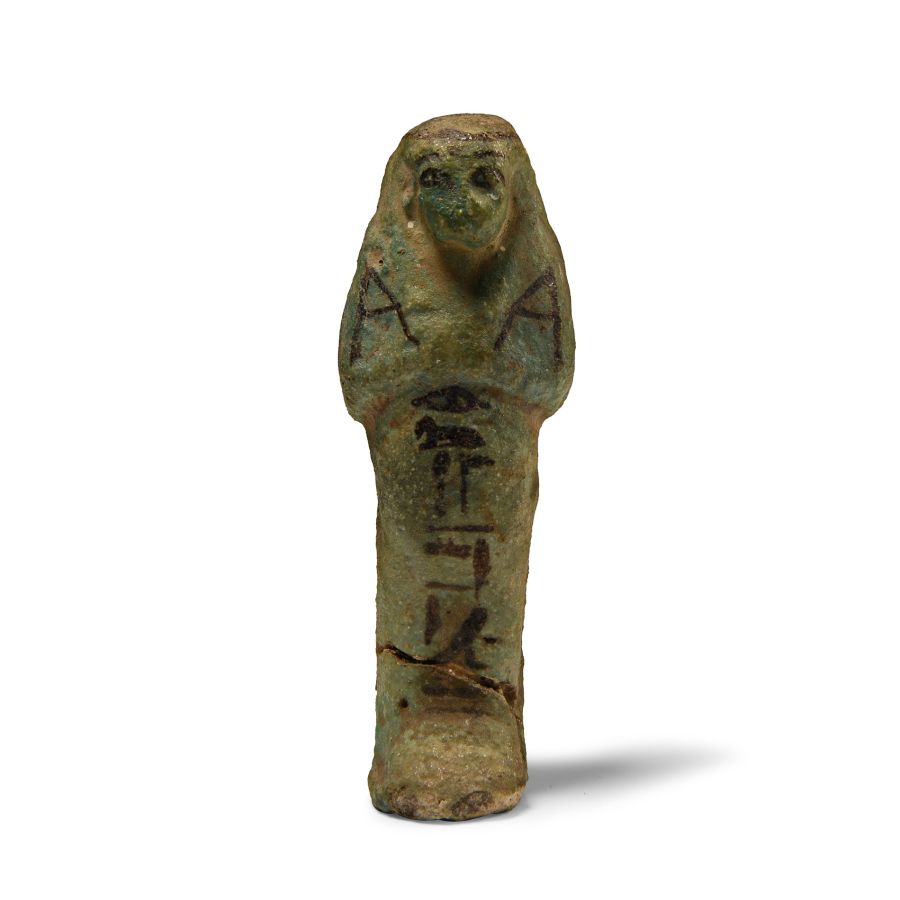
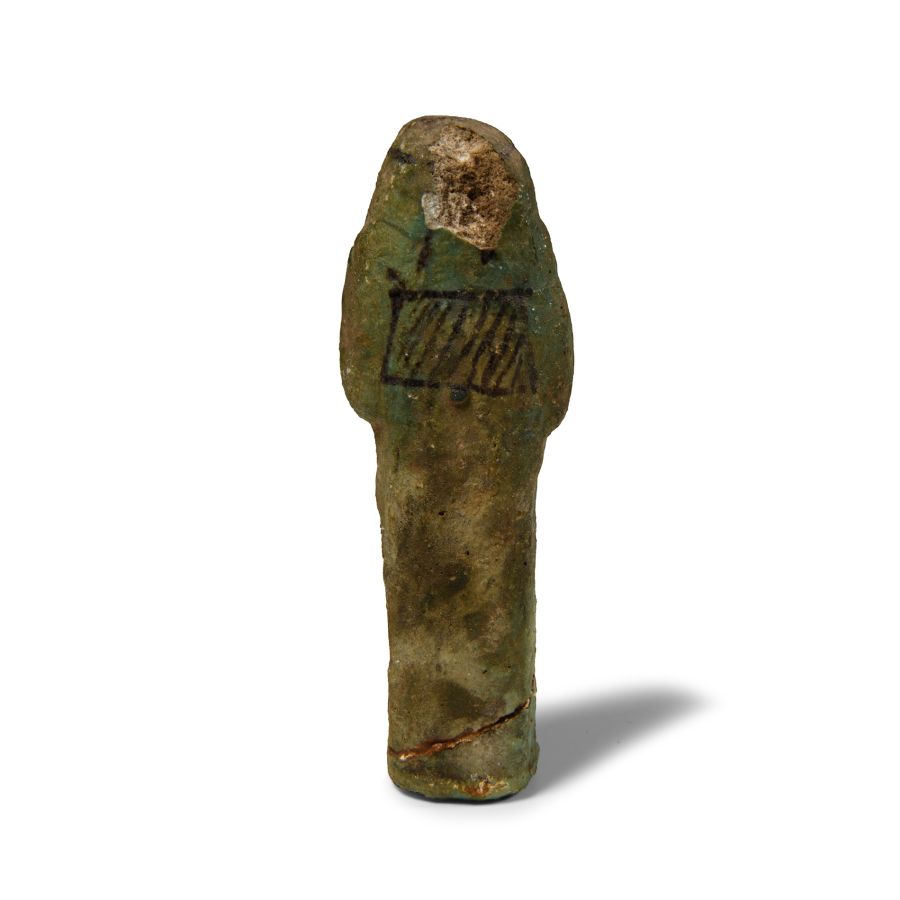
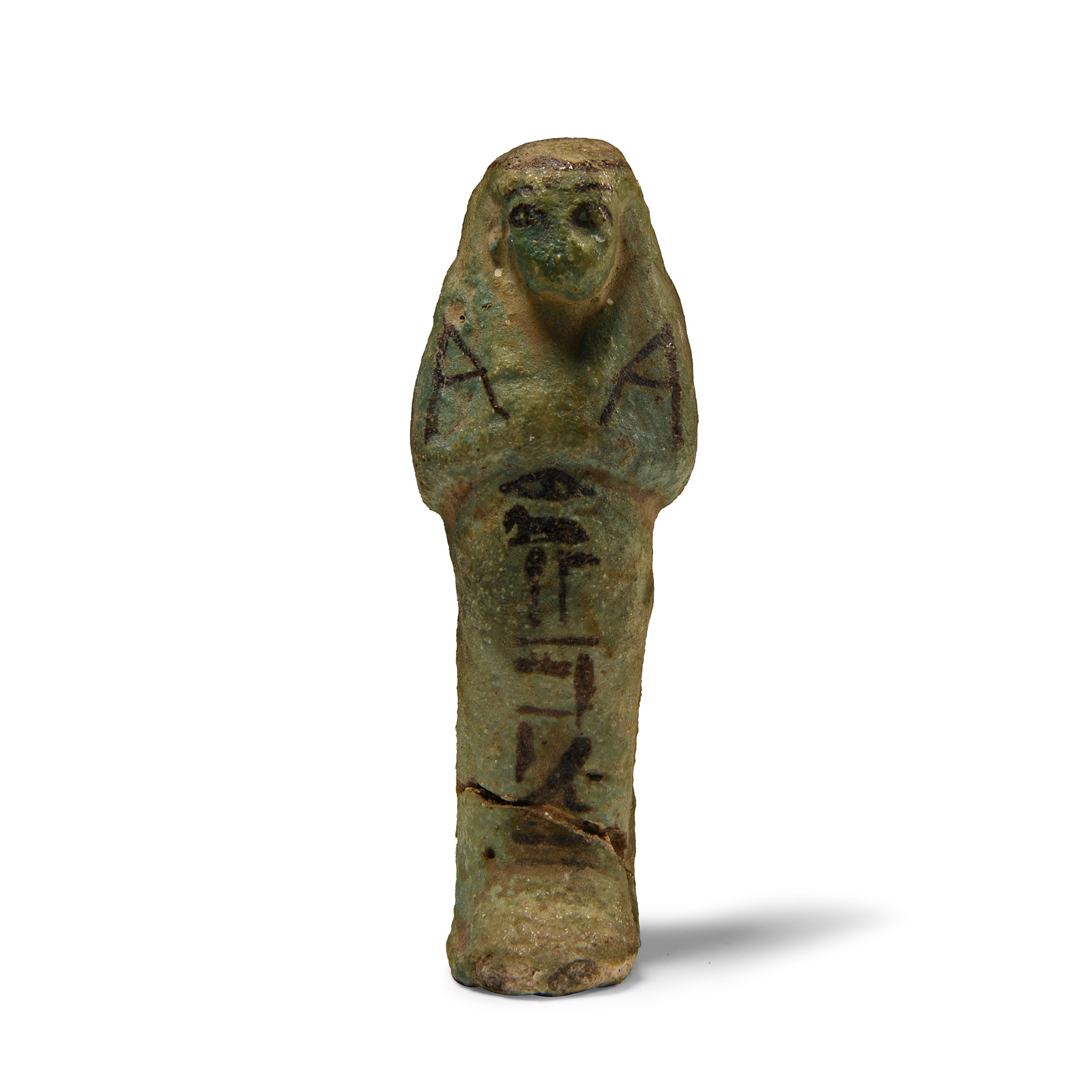
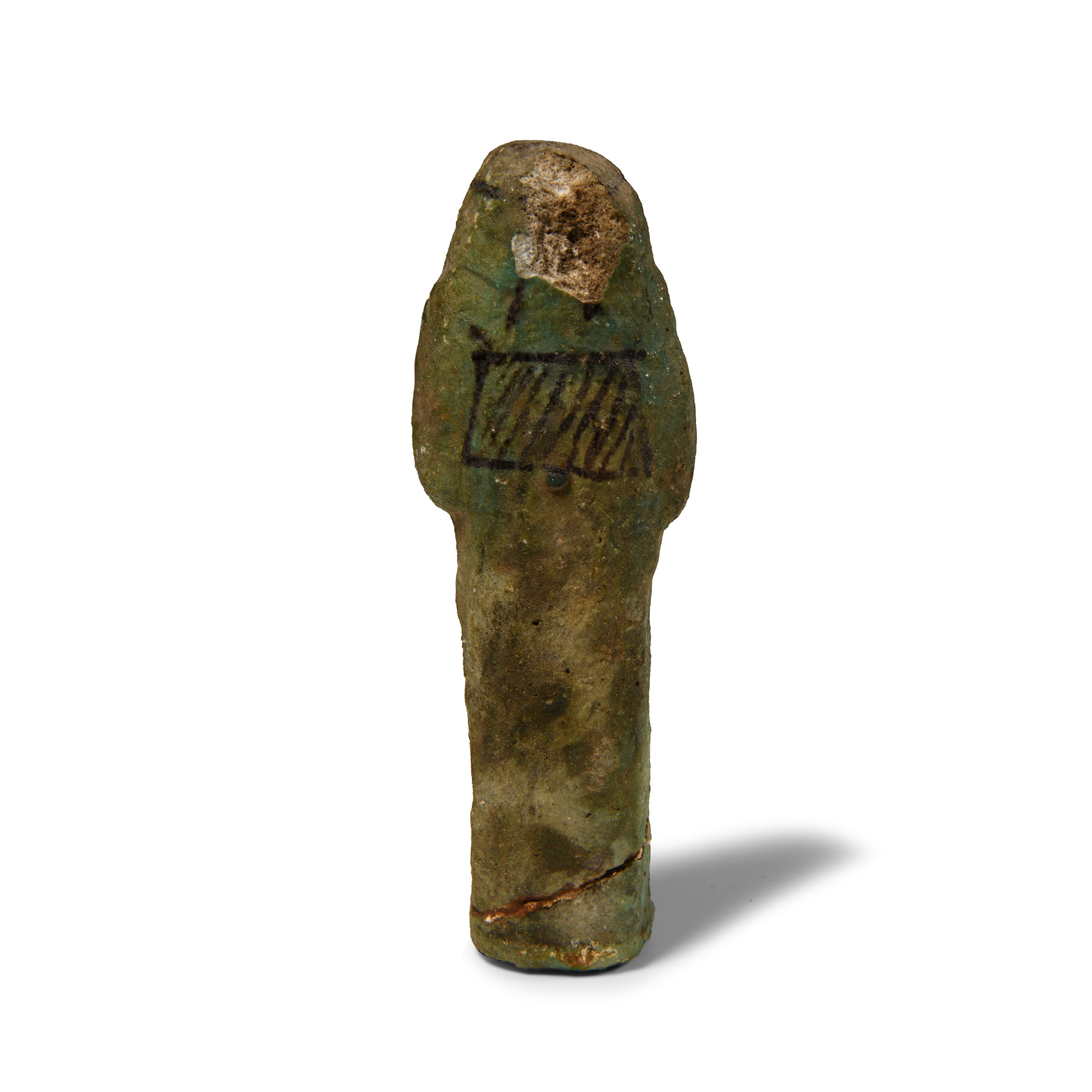
Egyptian Blue Glazed Shabti for the Priest of Amun Mi
THIRD INTERMEDIATE PERIOD, 21ST DYNASTY, 1077-943 B.C.
4 5/8 in. (132 grams, 11.8 cm).
Applied black pigment to the wig, eyes, two hoes, seed bag at the reverse, and a vertical panel of hieroglyphic text on the lower body with the dedication: 'The Osiris, the Priest of Amun Mi, true of voice'.
ProvenanceProbably from a priests’ cachette at Luxor.
Acquired in Egypt by Lieutenant James Alexander Goodman in the 1920s.
Thence by descent to his grandson.
Lieutenant Goodman served in the 4th Battalion Welsh Regiment during World War I and saw action in Palestine during the capture of Bethlehem, (for which he won an MC). After the war, he setup a business selling Fordson trucks and tractors in Alexandria, Egypt. A keen antiquarian, he collected ancient objects during his time in Alexandria and when he visited the pyramids at Giza. After his first marriage failed, he returned to the UK in the early 1930s. On his death in 1959, he passed his small collection of Egyptian objects on to his second wife, Ruby Goodman. On Ruby’s death in 1994, they were left to their second daughter, Rosemary Johnson, (née Goodman), and are currently in the possession of her son.
CONDITIONTimeLine Auctions follows a vetting process to ensure the authenticity and legality of all items, reinforcing our commitment to integrity and responsible trading. Each antiquity, antique, and coin lot undergoes thorough examination by a vetting committee of at least ten external specialists, professional trade association members, scientists, and archaeologists: Our Vetting Process
AUCTIONS:
TimeLine is a leading auction house specialising in antiquities, ancient art, collectables, natural history, coins, medals, and books. Our auctions offer museums, collectors, historians, and enthusiasts the opportunity to acquire unique and historically significant pieces.
-
.jpg)
Egyptian Limestone Female Bust
Coptic, 3rd-6th century A.DEstimate: £8,000 - 10,000 (‡+bp*)
Opening Bid: £4,000
Modelled in the half-round on a flat background as a bust of a woman with stern expression, dressed in a tunic emphasising the rounded shape of the bosom, and a mantle worn on the shoulders descending to the arms; beaded collar to the chest and detailed head-covering; significant remains of polychrome (red, black, and traces of blue) on the face, clothing and hair; mounted on a custom-made display stand. 6.77 kg, 27 x 19.5 cm
From the collection of Nicolas Koutoulakis, Paris-Geneva, 1967. Ex Barbier-Mueller, Geneva, Switzerland. with Boisgirad, Arts D'Orient, 16 November 2007, no.88. Acquired on the French art market in 2007. European private collection. Accompanied by an academic report by Dr Raffaele D’Amato. Accompanied by copies of the relevant Boisgirad, Arts D'Orient catalogue pages. This lot has been checked against the Interpol Database of stolen works of art and is accompanied by a search certificate number no.12065-218189.
The base, back and sides are flat and rough-hewn: it is possible that it served as a funerary stele, perhaps placed as a “lid” of a niche or a loculus. The Egyptian stelae and statues found at the site of Oxyrhynchos (present-day Benhasa) provide the best parallels for the style that characterises this image. These are most often funerary works showing men, women or children (stelae in very high-relief and statues) which are still little known - and even the chronology of which is subject of discussion: current opinion one inclines towards an earlier dating, between the 3rd and 4th centuries A.D., rather than the Coptic period which was previously favoured. In fact these figures, which are devoid of the attributes linked to Christian iconography, generally hold or carry objects which relate to "classical" cults (ie. Isis). Despite a certain naivety of the work, typical of Egyptian sculptures from this region, the woman depicted on this stele certainly belonged to the high contemporary nobility as is evidenced by the richness of her well-pleated clothing and the abundance of adornment, comprising a large necklace with two rows of pearls and some brooches; likewise, the hairstyle, organised in small curls and spiral locks, is worthy of a high-ranking personage. -
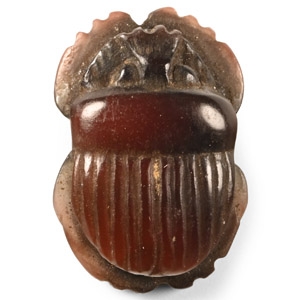
Egyptian Carnelian Heart Scarab
Late Period, 664-332 B.C.Sold for (Inc. bp): £260
With ridged detailing to the carapace, loop to the underside. 1.43 grams, 17 mm
From an early 20th century collection. -
.jpg)
'Egyptian Blue' Counter Weight Menat Amulet
Late Period, 664-525 B.C.Estimate: £800 - 1,000 (+bp*)
Opening Bid: £400
Amuletic pendant with broad bale, keyhole-shaped plaque with gusset to the rim. 14 grams, 67 mm
Acquired on the German art market, 1989-1995. with The Museum Gallery, 19 Bury Place, London, WC1A 2JB, 1998-2003. Property of a London based academic, 2003-present.
The menat necklace was a sacred item of great importance to female Egyptian goddesses, particularly Hathor. Priestesses of Hathor and other powerful goddesses used the necklace as a rattle, holding it in their hand by the counterpoise and evoking protection from the sound of the shaken beads. The amuletic menat counterweight symbolised the whole elaborate necklace. The menat was considered a powerful magical amulet throughout Egyptian history, offering good luck and protection against evil spirits. It was often buried with the dead for protection in the afterlife and was believed to promote fertility and good health for women while signifying virility for men.
