
Loading, please wait...
LOT 0470
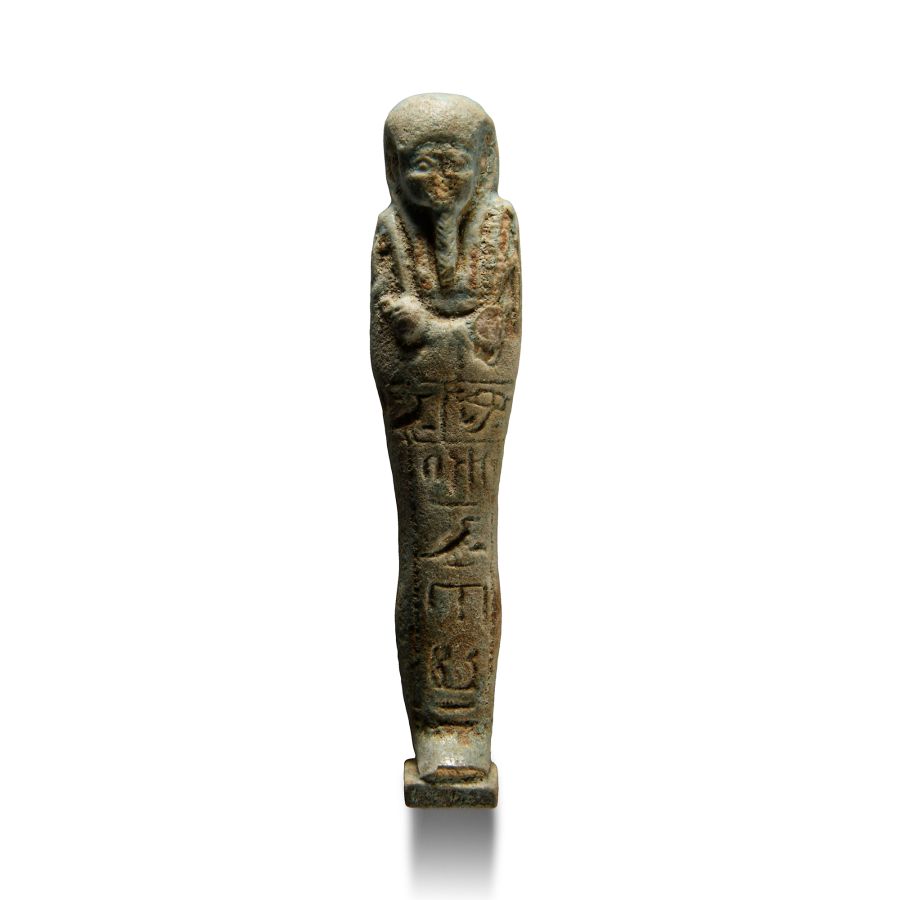
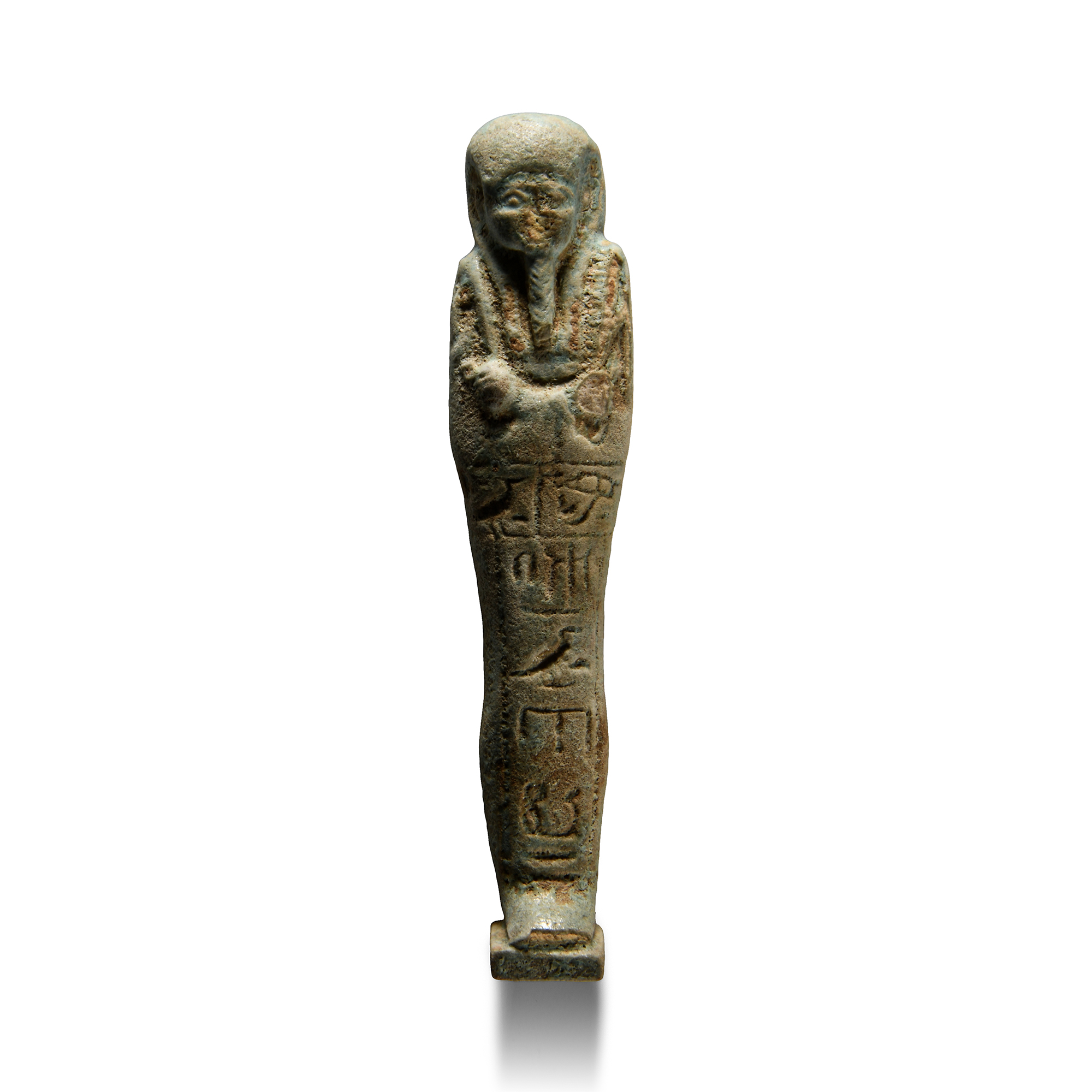
Egyptian Blue Glazed Shabti for Son of Ta-heb
30TH DYNASTY, 380-343 B.C.
4 1/8 in. (36 grams, 10.7 cm).
Composed as a mummiform figure with tripartite wig and hands crossed at the chest, holding a pick, hoe, and seed bag; a T-shaped panel of hieroglyphic text reading: sḥḏ wsỉr tꜢ.... ms.n tꜢ ḥb mꜢʾ ḫrw, ‘The illuminated, the Osiris, Ta…. born to Ta-heb true of voice’. [No Reserve]
ProvenanceAcquired in Egypt in 1933.
Ex Alexander Cameron (1897-1994) collection.
Cf. Janes, G., The Shabti Collections 6: A Selection from the World Museum, Liverpool, Lymm, 2016, p.442, no.230, for a shabti of similar style.
CONDITIONTimeLine Auctions follows a vetting process to ensure the authenticity and legality of all items, reinforcing our commitment to integrity and responsible trading. Each antiquity, antique, and coin lot undergoes thorough examination by a vetting committee of at least ten external specialists, professional trade association members, scientists, and archaeologists: Our Vetting Process
AUCTIONS:
TimeLine is a leading auction house specialising in antiquities, ancient art, collectables, natural history, coins, medals, and books. Our auctions offer museums, collectors, historians, and enthusiasts the opportunity to acquire unique and historically significant pieces.
-
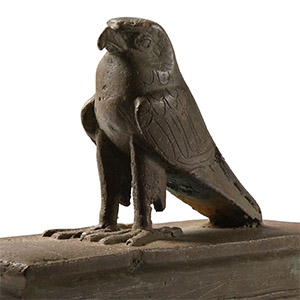
Egyptian Bronze Horus Falcon on Shrine-Shaped Base
Late Period-Ptolemaic Period, 664-31 B.C.Sold for (Inc. bp): £4,680
Naturalistically modelled falcon with incised feathers and detailing; standing on a shrine-shaped rectangular box with slightly battered sides and cornice moulding; inked note on the inside of each long side 'E.311' and 'Collection R.L.' respectively. 521 grams, 15 cm
Collected between the 1950s-1990s. Ex Roger Liechti (1934-2010) collection, Geneva, Switzerland. This lot has been checked against the Interpol Database of stolen works of art and is accompanied by search certificate no.12133-211848.
This box almost certainly once contained the mummified remains of a falcon. The falcon was principally identified with the sun-god Horus, and associated with the living king. Numerous falcon cults existed throughout Egypt, but the most spectacular was found at Saqqara, where many thousands of birds were mummified and buried in an extensive complex of underground galleries. -
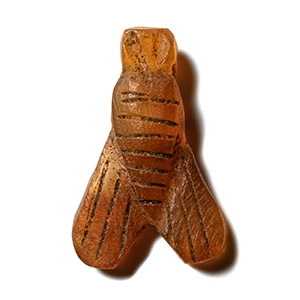
Egyptian Hardstone Fly Amulet
Late Period, 664-332 B.C.Sold for (Inc. bp): £143
With linear detailing to body and wings, pierced at the neck. 0.34 grams, 13 mm
From an early 20th century UK collection. -
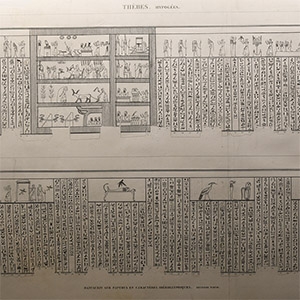
Large Egyptian Expedition Lithograph Print with Hieroglyphs
1820 A.D.Sold for (Inc. bp): £117
Willemin - Thèbes - Hypogées - Manuscrit sur papyrus en caractères hiéroglyphiques. Deuxième partie - Proof etching on laid paper of plate 73 from La Description de l’Égypte: Antiquités, Volume II: Commission des sciences et arts d’Égypte with later backing sheet. 360 grams, 135 x 69.5 cm
From the collection of a North American priest. Acquired between 1981-1996. Property of a North American collector.
Produced between February 1802 and 1830 on the orders of Napoleon Bonaparte; published between 1809 and 1828. Just 1,000 copies were distributed to various institutions, printed on on laid paper with an 'Égypte ancienne et moderne' watermark. The book is subtitled Recueil des observations et des recherches qui ont été faites en Égypte pendant l’expédition de l’Armée française, publié par les ordres de Sa Majesté l’Empereur Napoléon le Grand (Gathering of observations and discoveries which were made in Egypt during the expedition of the French army, published on the orders of His Majesty the Emperor Napoleon the Great). It was the world's first encyclopedia devoted exclusively to the remains of ancient Egypt. The plates of this book are the first to present the archaeological sites of Thebes (Luxor). The papyrus manuscript was recovered from the underground chambers (hypogea).
