
Loading, please wait...
_900x900.jpg "Egyptian Blue-Glazed Faience White Lotus Chalice")
_200x200.jpg "Egyptian Blue-Glazed Faience White Lotus Chalice")
.jpg "Egyptian Blue-Glazed Faience White Lotus Chalice")
LOT 0016
Egyptian Blue-Glazed Faience White Lotus Chalice
NEW KINGDOM-THIRD INTERMEDIATE PERIOD, 1315-945 B.C.
4 3/4 in. (205 grams, 12 cm).
The lotiform cup modelled as an open lotus flower with incised petal detailing to the outer face, short stem and flared foot; some restoration.
ProvenanceAcquired 1970s-1996.
Property of a North American collector.
London collection, 2016.
This lot has been checked against the Interpol Database of stolen works of art and is accompanied by search certificate no.12100-214087.
Cf. Freed, R., et al., Egypt’s Golden Age, the Art of Living in the New Kingdom, 1558-1085 B.C, Boston, 1982, p.147, no.147, for a similar pale blue faience white lotus chalice; S., Reeves, N., and Quirke, S., Egyptian Art at Eton College: Selections from the Myers Museum, Windsor/New York, 1999, p.39, no.56, for a squatter version of this chalice style in deep blue faience.
FootnotesFaience chalices shaped like the flowers of the white lotus (Nymphaea albicans) first appeared in the 18th Dynasty, and are thought to be drinking vessels.
CONDITIONTimeLine Auctions follows a vetting process to ensure the authenticity and legality of all items, reinforcing our commitment to integrity and responsible trading. Each antiquity, antique, and coin lot undergoes thorough examination by a vetting committee of at least ten external specialists, professional trade association members, scientists, and archaeologists: Our Vetting Process
AUCTIONS:
TimeLine is a leading auction house specialising in antiquities, ancient art, collectables, natural history, coins, medals, and books. Our auctions offer museums, collectors, historians, and enthusiasts the opportunity to acquire unique and historically significant pieces.
LOT 0016
Egyptian Blue-Glazed Faience White Lotus Chalice
Estimate £10,000 - 14,000€11,600 - 16,240 (for guidance only)$13,500 - 18,900 (for guidance only)
-
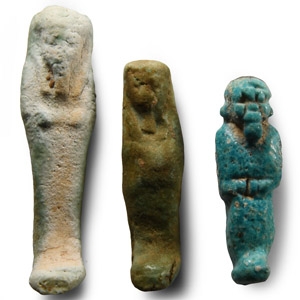
Egyptian Faience Shabti Group
Ptolemaic Period, 332-30 B.C.Sold for (Inc. bp): £169
Comprising: one olive-green with lobe base, one rich blue with black detailing, one with tripartite wig. 21 grams total, 45-63 mm
Ex Cummings collection, UK, 1990s. -
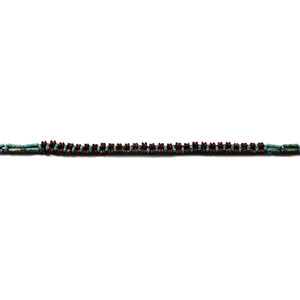
Egyptian Faience Mummy Bead Necklace
Late New Kingdom, 1295-1069 B.C.Estimate: £600 - 800 (+bp*)
Opening Bid: £300
Restrung designer necklace using tubular green-glazed beads in a double row, interspersed with small two-holed beads; the central feature a net-like composition of small brown and blue-glazed ring-shaped beads. 9.54 grams, 46 cm long
By repute, 'Excavated at Gurob by Prof. Flinders Petrie. From a quantity of beadwork taken from the neck of a mummy'. Ex 1920s UK collection. -
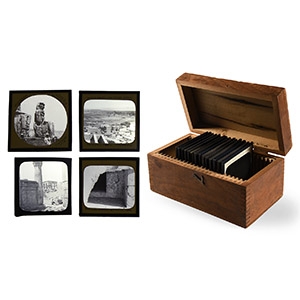
Historic Collection of Fourteen Original Slides of Egyptian Archaeological Sites
Circa 1897 A.D.Sold for (Inc. bp): £910
Fourteen glass photographic slides recording an expedition to the Thebes; in a rectangular wooden box with hinged lid and inner numbered racking, marked 'D.W.Collings'. 929 grams total, 19.5 x 11 x 9.5 cm
From the private collection of Dudley Collings, from his travels in Egypt in the late 19th century.
Includes views of Thebes and the royal and nobles' tombs, the temple of Horus at Edfu, river transport, view of the rear of the sphinx, the Great Pyramid, and other images with handwritten annotations.
