
Loading, please wait...
LOT 0503
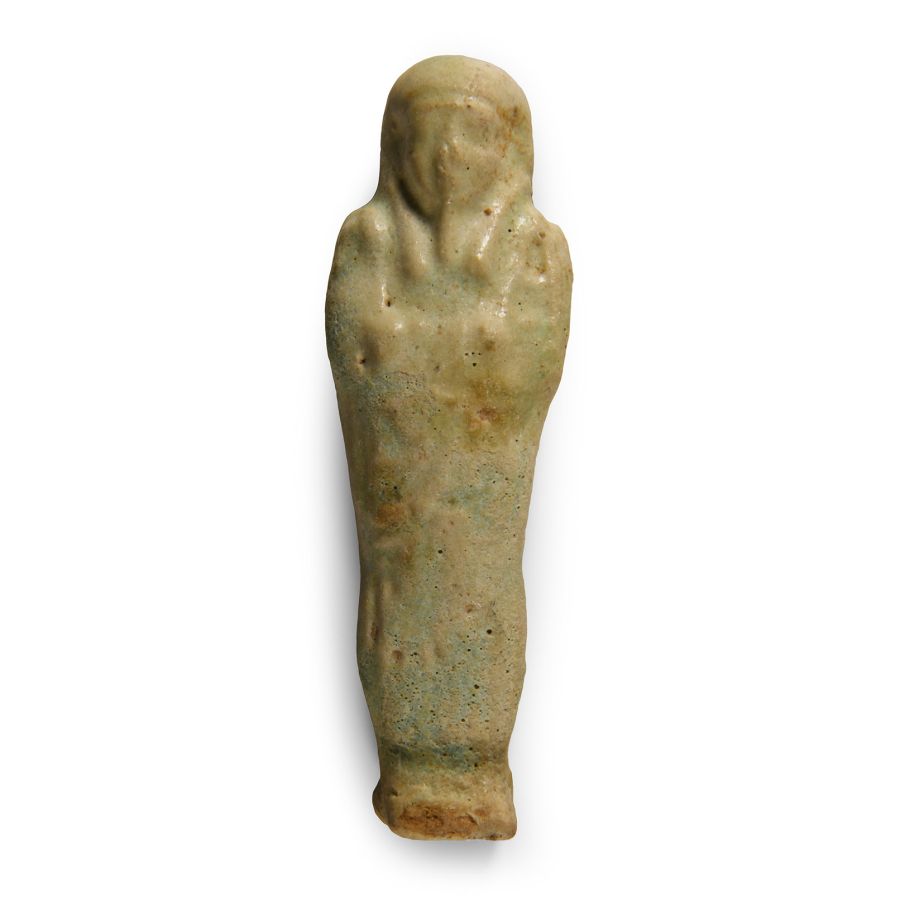
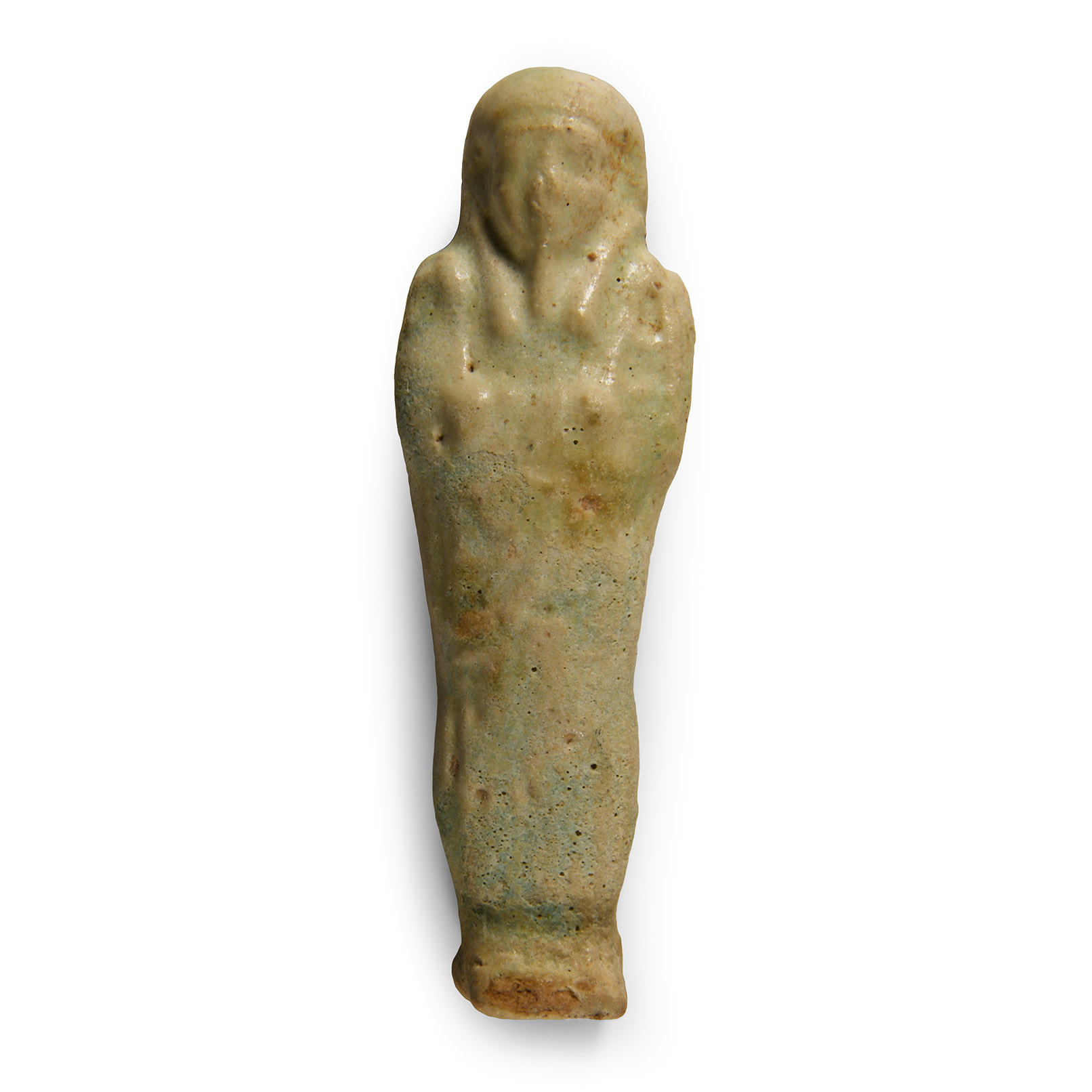
Egyptian Blue Glazed Faience Shabti
LATE PERIOD, 664-332 B.C.
4 1/4 in. (72 grams, 10.7 cm).
With dorsal pillar, hands folded across the chest holding a pick and hoe, with a front panel of faintly impressed hieroglyphic text. [No Reserve]
ProvenanceEx M.S. Ciappara collection, Norfolk, UK, 1939-1950.
LiteratureCf. von Droste zu Hülsdorf, V. and Schlick-Nolte, B., Ägyptische Bildwerke II: Statuetten, Gefässe und Geräte, Melsungen, 1990, pp.167-169, no. 81, for the type.
FootnotesShabti figures were created to carry out heavy manual tasks on behalf of a person in the afterlife. They were often depicted with tools in their hands, such as baskets, mattocks, and hoes. Over time, the number of shabtis in a standard elite burial increased, from one in the Eighteenth Dynasty to several in the Nineteenth Dynasty, to one for every day of the year by the Third Intermediate Period. The number of shabtis remained in the hundreds during the Late Period.
CONDITIONTimeLine Auctions follows a vetting process to ensure the authenticity and legality of all items, reinforcing our commitment to integrity and responsible trading. Each antiquity, antique, and coin lot undergoes thorough examination by a vetting committee of at least ten external specialists, professional trade association members, scientists, and archaeologists: Our Vetting Process
AUCTIONS:
TimeLine is a leading auction house specialising in antiquities, ancient art, collectables, natural history, coins, medals, and books. Our auctions offer museums, collectors, historians, and enthusiasts the opportunity to acquire unique and historically significant pieces.
-
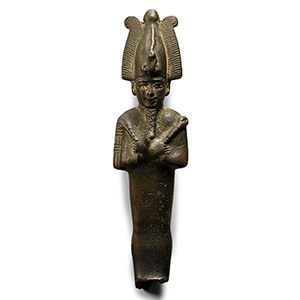
Egyptian Bronze Statuette of Osiris
Late Period, 664-525 B.C.Sold for (Inc. bp): £910
Modelled in the round wearing the atef crown with a uraeus to the brow, arms crossed on the chest holding the nekhakha (flail) and heka (crook); loop to rear of the neck; feet absent and damage to left shoulder revealing original lead core. 74 grams, 92 mm
Acquired on the German art market, 1989-1995. with The Museum Gallery, 19 Bury Place, London, WC1, UK, 1998-2003. Property of a London based academic, 2003-present.
Osiris was a deity who represents death and fertility and is commonly regarded as the quintessential god of rebirth. Though he was once a mortal ruler, as a deceased entity, his domain was the Underworld. Small figurines like this example were dedicated to the god to ensure his good favour. -
.jpg)
Egyptian Steatite Scaraboid for Pharaoh Shabaka
Late 8th-early 9th century B.C.Estimate: £2,000 - 3,000 (+bp*)
Opening Bid: £1,000
Bifacial carved scaraboid; reverse with royal cartouche for Pharaoh Shabaka, flanked by the uraeus of Lower and Upper Egypt, surmounted by the Pharaonic epithet “King of the Upper and Lower Egypt” (“king of the reed” and “king of the bee”) and by the title “the son of Ra” and below, the sign of neb (damaged) “lord”; obverse with on the left, wedjat (winged cobra with the red crown – Lower Egypt), embracing with his wings shen (solar symbol) and in the centre, a lion with a ram's head, crowned and on the right, wedjat with the white crown of the Upper Egypt; on the upper section, a scarab with opened wings, instead of a lotus flower is depicted on the lower section. 7.65 grams, 27 mm
UK private collection before 2000. On the UK art market. Property of a London gentleman. This lot has been checked against the Interpol Database of stolen works of art and is accompanied by a search certificate number no.12081-217354. -
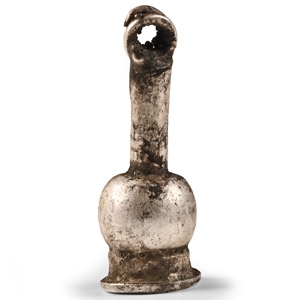
Egyptian Silver Poppy Head Amulet
Late Period, 664-332 B.C.Sold for (Inc. bp): £65
With bulb and disc finial, integral shank and gusseted suspension loop. 1.03 grams, 17 mm
From an early 20th century collection.
Amulets in the form of poppies were utilised for healing and alleviating pain, as well as for warding off death. These types of amulets were also linked to Osiris, the Egyptian deity of agriculture, death, and the afterlife.
