
Loading, please wait...
LOT 0014
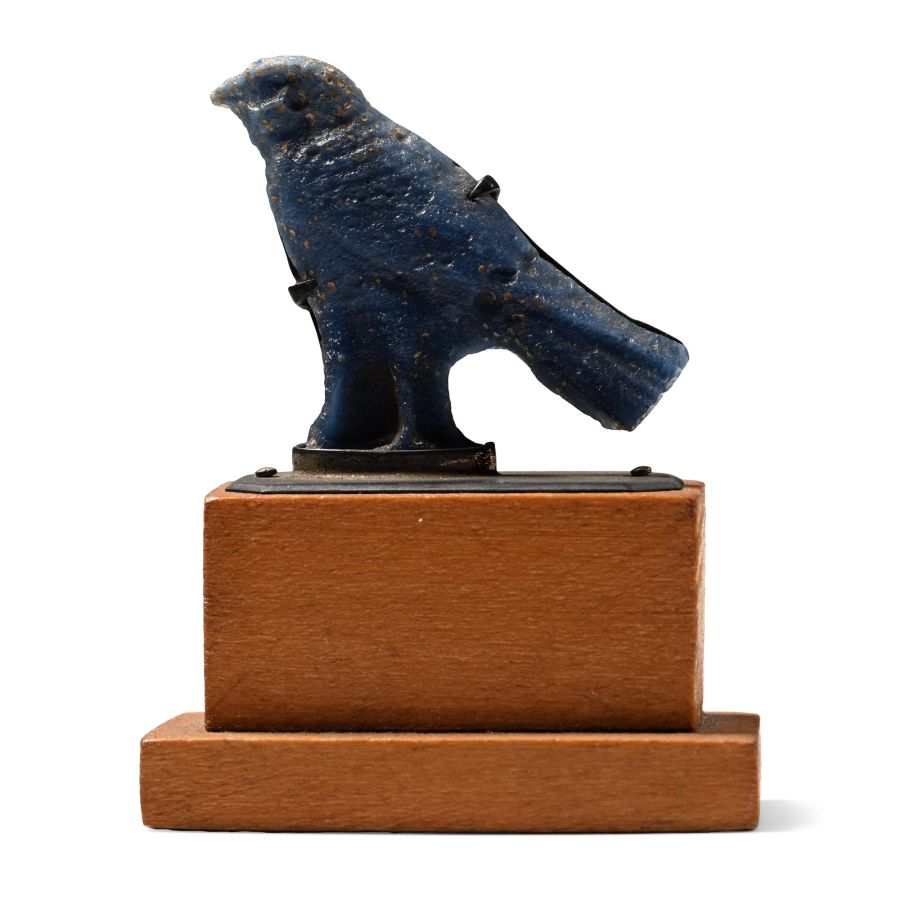
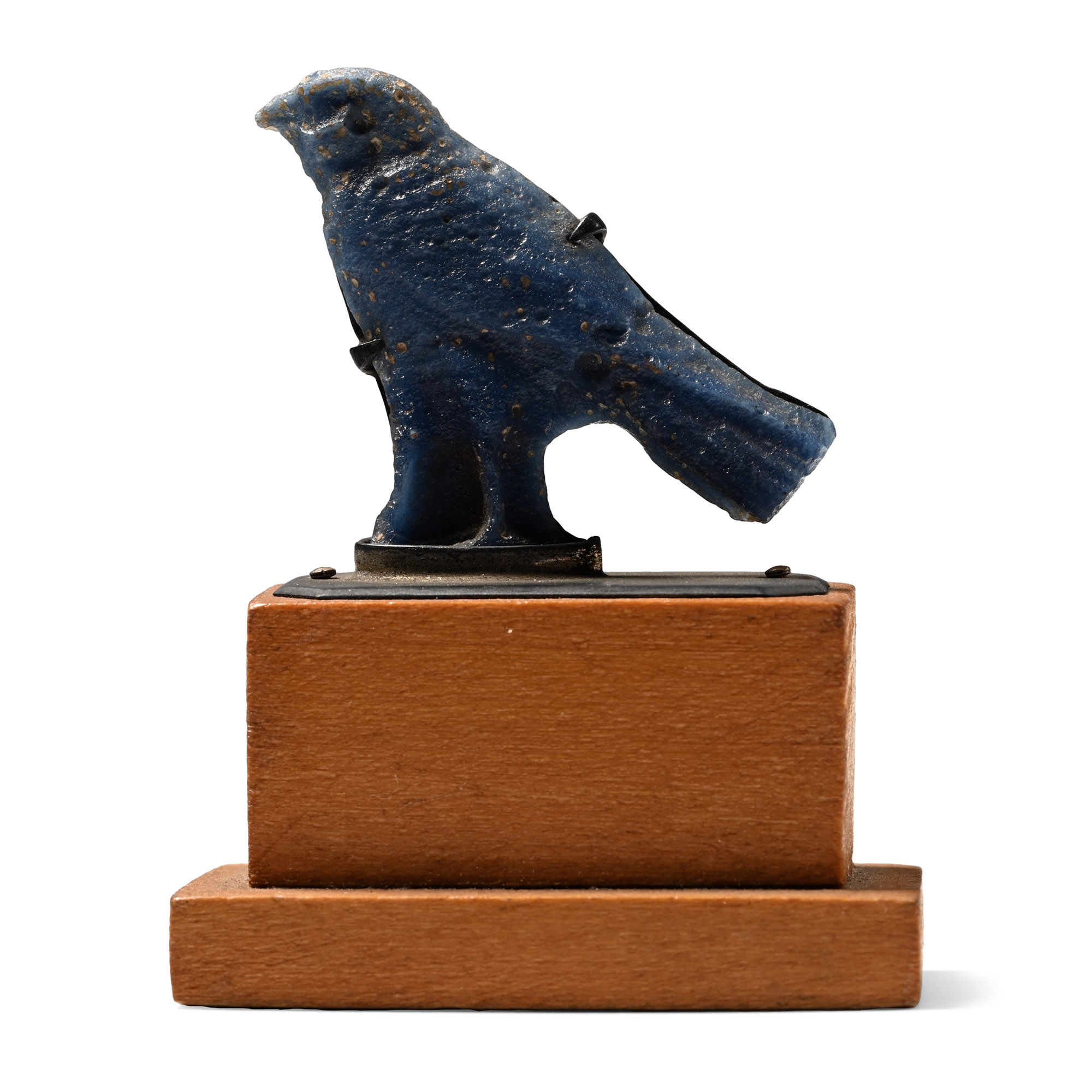
Egyptian Blue Glass Bird Inlay
PTOLEMAIC PERIOD, CIRCA 332-30 B.C.
2 1/8 in. (18 grams total, 55 mm including stand).
Modelled in the half-round with low-relief hatched detailing; perching on a D-section base; mounted on a silver support and a wooden display stand.
Provenancewith Jean-Phillipe Mariaud de Serres, Paris, France.
Private collection, London, UK, acquired from the above in 1992.
This lot is accompanied by an illustrated lot declaration signed by the Head of the Antiquities Department, Dr Raffaele D'Amato.
The falcon inlay possibly symbolises Horus, the god of the sky, war, and protection. Horus was one of the most significant and widely worshipped gods in ancient Egyptian mythology. His importance spans multiple facets of Egyptian religion, including kingship, protection, the sky, and the sun. Depicted in various human and animal forms, Horus played a vital role in Egyptian cosmology, especially as the protector of the Pharaoh and as a representation of divine authority.
CONDITIONTimeLine Auctions follows a vetting process to ensure the authenticity and legality of all items, reinforcing our commitment to integrity and responsible trading. Each antiquity, antique, and coin lot undergoes thorough examination by a vetting committee of at least ten external specialists, professional trade association members, scientists, and archaeologists: Our Vetting Process
AUCTIONS:
TimeLine is a leading auction house specialising in antiquities, ancient art, collectables, natural history, coins, medals, and books. Our auctions offer museums, collectors, historians, and enthusiasts the opportunity to acquire unique and historically significant pieces.
-
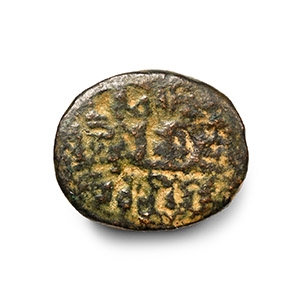
Phoenician Inscribed Bronze Scaraboid Seal
Late 1st millennium B.C.Sold for (Inc. bp): £52
Plain domed body pierced longitudinally, inscribed underside. 8.9 grams, 17 mm
Ex London, UK, gentleman, 1990. This lot is accompanied by an illustrated lot declaration signed by the Head of the Antiquities Department, Dr Raffaele D'Amato.
Although it is difficult to make out for certain, the outer design appears to be composed of the 'a-n-r' hieroglyphs. The signs do not form a word and are thought to have been a decorative device used by Asiatic scarab makers, employing recognisably Egyptian hieroglyphs. -
.jpg)
Egyptian Copper Ring with the Name of Akhenaten
New Kingdom, 18th Dynasty, 1353-1336 B.C.Sold for (Inc. bp): £7,150
A 'stirrup' type ring with a substantial oval-shaped bezel bearing the name of Pharaoh Akhenaten - Nefer-kheperu-re Wah-en-re; supplied with a museum-quality impression. 7.28 grams, 19.03 mm overall, 12.08 mm internal diameter
Acquired in the mid 1980s-1990s. Private collection, Switzerland, thence by descent. Private collection, since the late 1990s. This lot is accompanied by an illustrated lot declaration signed by the Head of the Antiquities Department, Dr Raffaele D'Amato.
Akhenaten, an 18th Dynasty pharaoh (c. 1353-1336 BCE), introduced a major religious shift by promoting the Aten, the sun disc, as the sole god. Rejecting the traditional polytheistic religion of ancient Egypt, Akhenaten elevated the Aten above all other gods and even changed his name from Amenhotep (IV) to Akhenaten, meaning ‘Effective for the Aten’. He founded a new short-lived capital in Middle Egypt called Akhetaten. However, traditional polytheism was restored after his death, and his reforms were largely reversed. -
.jpg)
Coptic Marble Liturgical Vessel Fragment with Inscription
6th century A.D.Estimate: £1,800 - 2,400 (‡+bp*)
Opening Bid: £900
Tongue-shaped with low rounded pad on the underside, raised edge with low-relief decoration of grape vines and leaves, the edge with pairs of opposing doves eating grapes; dedicatory Demotic inscription on the underside. 87 grams, 55 mm
Acquired in the mid 1980s-1990s. Private collection, Switzerland, thence by descent. Private collection, since the late 1990s. Accompanied by an academic report by Dr Raffaele D'Amato. This lot has been checked against the Interpol Database of stolen works of art and is accompanied by a search certificate number no.12575-232108. This lot has been cleared against the Art Loss Register database, and is accompanied by an illustrated lot declaration signed by the Head of the Antiquities Department, Dr Raffaele D'Amato.
These vessels were used as liturgical objects for church offerings or ritual cult and were extensively employed from late antiquity in ecclesiastical contexts.
