
Loading, please wait...
LOT 0434
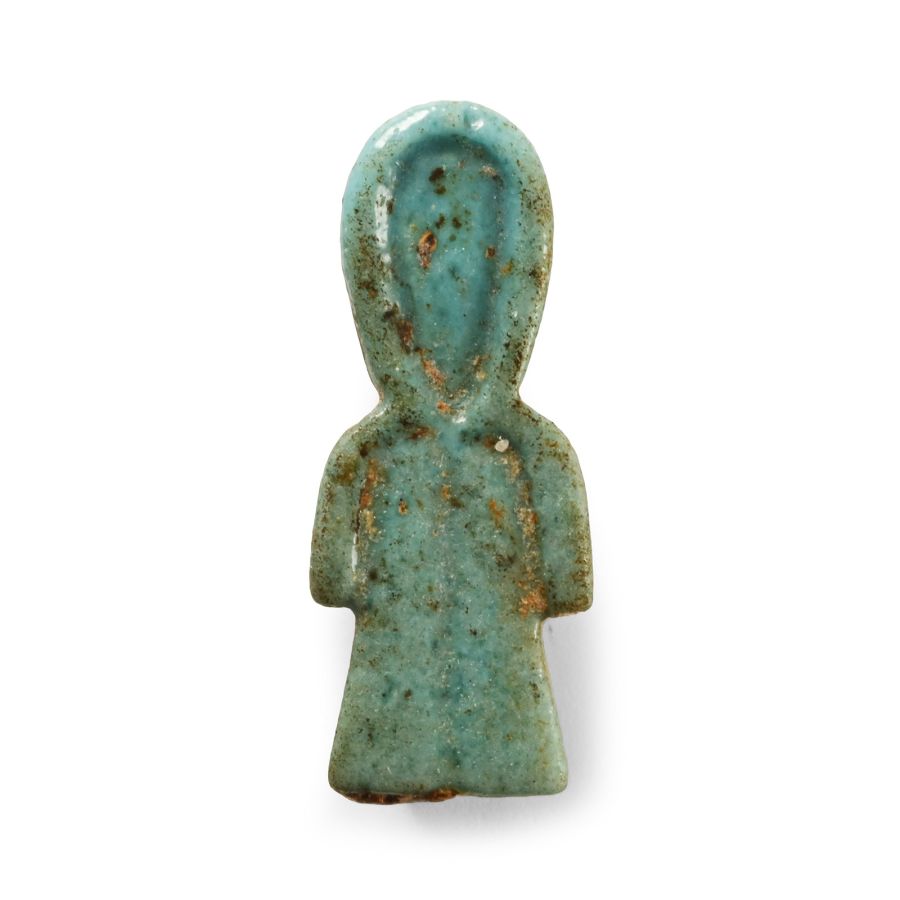
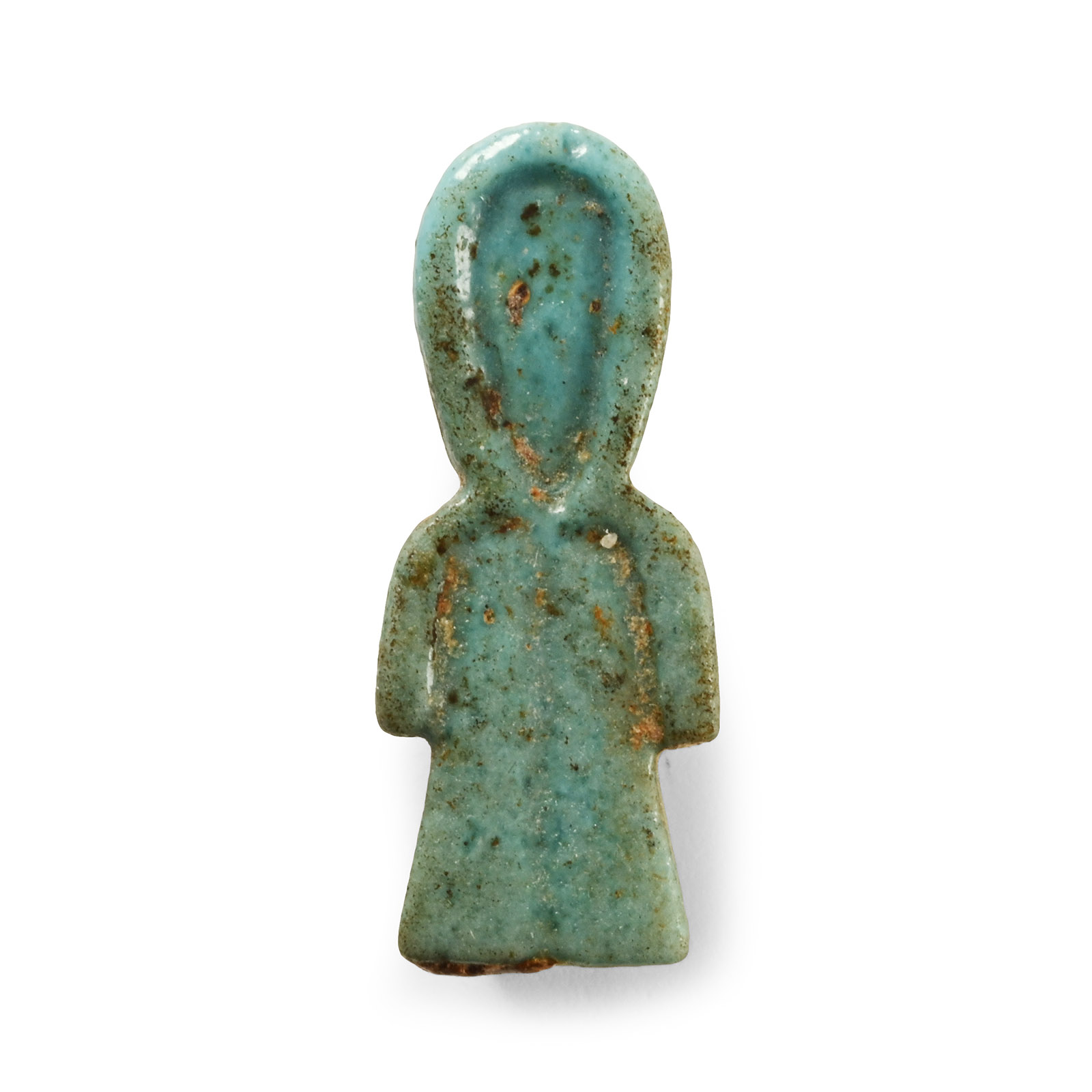
Egyptian Blue Faience Tyet 'Isis Knot' Amulet
LATE PERIOD, 664-332 B.C.
1 in. (1.76 grams, 25 mm).
With dorsal pillar, pierced for suspension. [No Reserve]
ProvenanceFrom the collection of Doctor Girard, a collector for over 60 years.
with Hotel des Ventes de Clermont-Ferrand, 22 May 2017.
Property of a French collector.
Cf. Andrews, C., Amulets of Ancient Egypt, London, 1994, pl.100(a).
FootnotesThe tyet amulet was associated with the goddess Isis and was often referred to as the "knot" or "girdle" of Isis. It was commonly placed within the mummy wrappings on the upper torso of the deceased, with the belief that it would invoke Isis' protection and safeguard the body, thus ensuring their rebirth in the afterlife.
CONDITIONTimeLine Auctions follows a vetting process to ensure the authenticity and legality of all items, reinforcing our commitment to integrity and responsible trading. Each antiquity, antique, and coin lot undergoes thorough examination by a vetting committee of at least ten external specialists, professional trade association members, scientists, and archaeologists: Our Vetting Process
AUCTIONS:
TimeLine is a leading auction house specialising in antiquities, ancient art, collectables, natural history, coins, medals, and books. Our auctions offer museums, collectors, historians, and enthusiasts the opportunity to acquire unique and historically significant pieces.
-
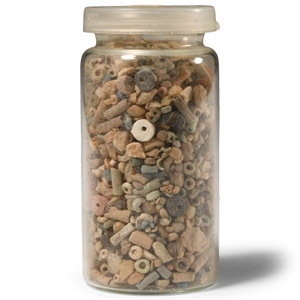
Egyptian Faience Bead Collection
New Kingdom-Late Period, circa 1550-332 B.C.Sold for (Inc. bp): £52
Mainly tubular, annular and oblate types in various colours. 61 grams total, 64 mm
Acquired from Ancient & Oriental, circa 1987. Ian Wilkinson collection, Nottinghamshire, UK, formed since 1985.
The faience of the New Kingdom period is frequently decorated with an expanded palette of red, black, and yellow. This polychrome decoration was often accomplished by inlaying one colour of paste onto another. -
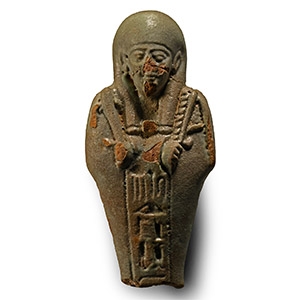
Egyptian Blue Glazed Hieroglyphic Shabti Fragment for Neith
26th Dynasty, 664-525 B.C.Estimate: £400 - 600 (+bp*)
Opening Bid: £200
Pale grey-green composition fragment of the upper half of a mummiform shabti wearing a tripartite wig, holding a pick, hoe, and cord for a seed bag, which hangs over the left shoulder; a vertical band to the chest and lower body inscribed with hieroglyphic text giving the opening 'The illuminated one, the Osiris' and the name or title beginning with 'Neith'. 62 grams, 89 mm
Acquired on the German art market, 1989-1995. with The Museum Gallery, 19 Bury Place, London, WC1, UK, 1998-2003. Property of a London based academic, 2003-present. -
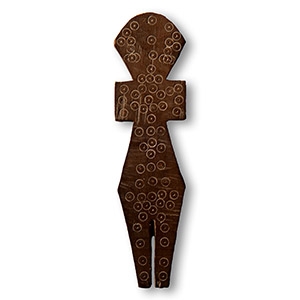
Egyptian Wooden Doll with Circular Decorations
Coptic, 7th-11th centuries A.D. or laterSold for (Inc. bp): £117
Flat anthropomorphic panel with incised ring-and-dot ornament to obverse, single central ring-and-dot to the reverse. 16 grams, 12.4 cm
Acquired on the German art market, 1989-1995. with The Museum Gallery, 19 Bury Place, London, WC1A 2JB, 1998-2003. Property of a London based academic, 2003-present.
In the late Roman Egypt or early Islamic period (7th–11th century A.D.) a new type of figurine appeared in the archaeological record: small, crudely crafted human figures made of bone. Some researchers considered them as toys meant to prepare girls for motherhood; others saw them as fertility figurines. They are mostly referred to as early Christian or “Coptic dolls”. In Egypt and Palestine they seem to appear suddenly in the 7th century, coinciding with the Arab conquests, but they might have existed earlier. With the new Muslim empire bridging former Roman and Sassanian lands, these dolls found their way to Egypt and Palestine where they were reproduced in huge numbers, becoming popular in all levels of society of the 8th and 9th century. By the end of the 11th century they disappeared as quickly as they appeared, probably because of restrictions placed on their production by Islamic laws.
