
Loading, please wait...
LOT 0494
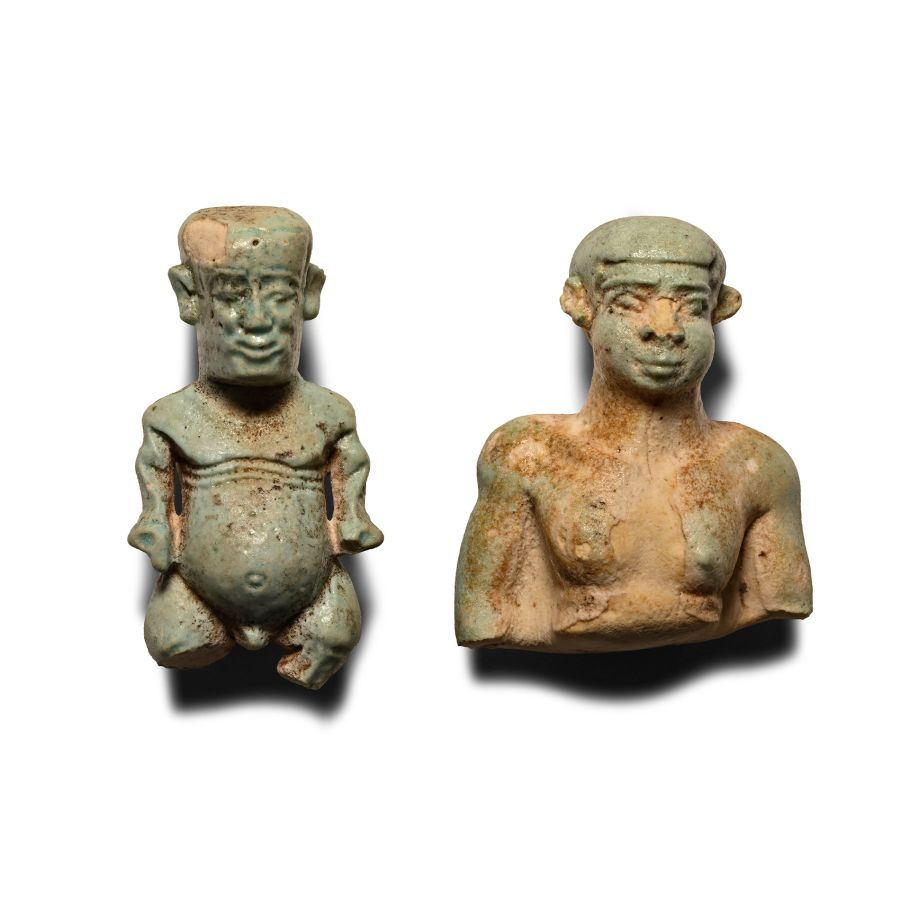
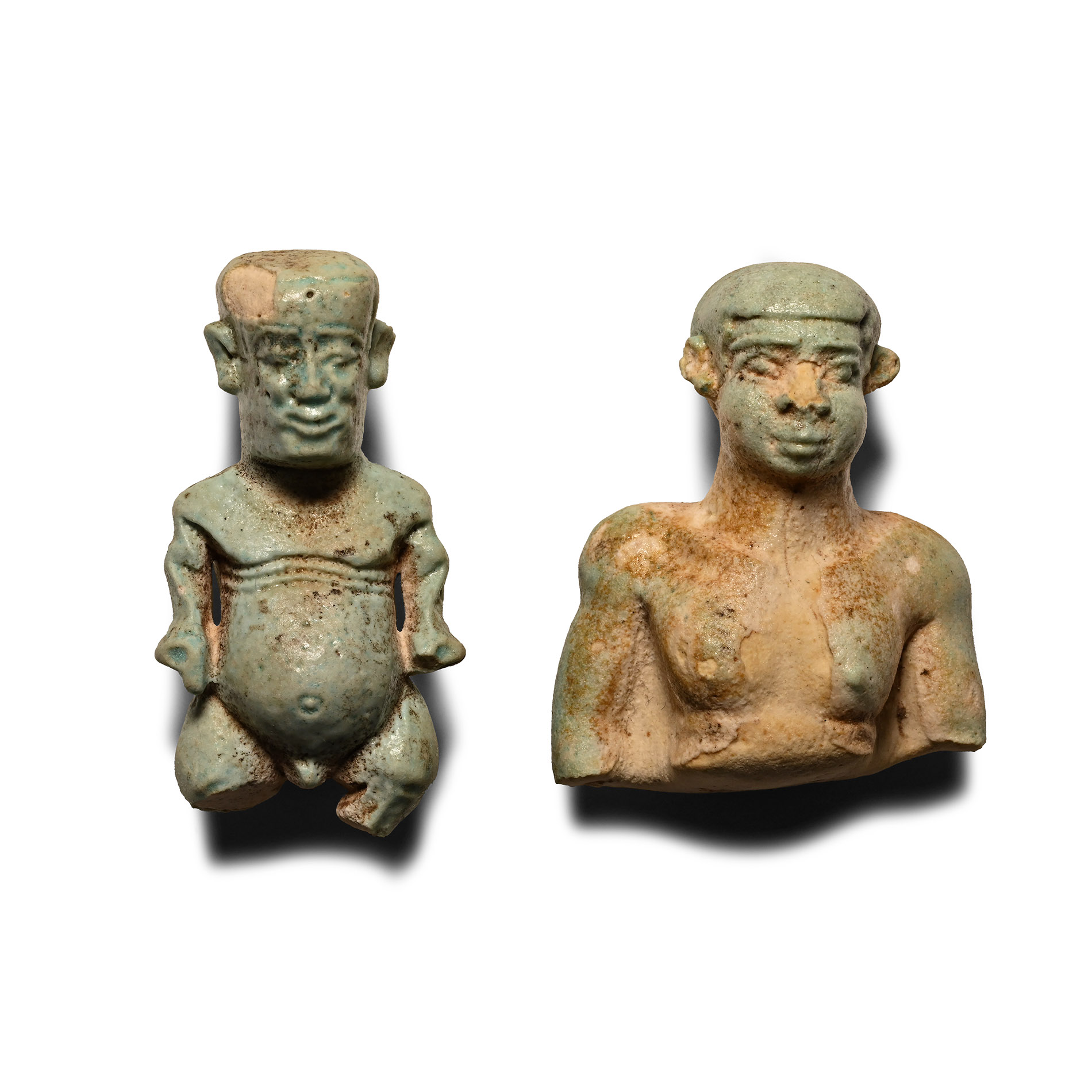
Egyptian Blue Faience Pataikos Amulet Pair
LATE PERIOD, 664-525 B.C.
1 1/2 - 1 3/4 in. (22 grams total, 40-43 mm).
Each in pale blue composition, the larger a bust with bale to rear of the neck, the smaller the full nude form (minus the lower legs). [2]
ProvenanceAcquired on the German art market, 1989-1995.
with The Museum Gallery, 19 Bury Place, London, WC1, UK, 1998-2003.
Property of a London based academic, 2003-present.
Cf. Daressy, G., Catalogue général des antiquités égyptiennes du Musée du Caire N° 38001-39384 Statues de divinités, Cairo, 1906, pl. XLII, nos. 38.778 and 38.801, for similar.
FootnotesPataikos is a representation of the creator deity Ptah, and his diminutive form is a symbol of his immense magical power.
CONDITIONTimeLine Auctions follows a vetting process to ensure the authenticity and legality of all items, reinforcing our commitment to integrity and responsible trading. Each antiquity, antique, and coin lot undergoes thorough examination by a vetting committee of at least ten external specialists, professional trade association members, scientists, and archaeologists: Our Vetting Process
AUCTIONS:
TimeLine is a leading auction house specialising in antiquities, ancient art, collectables, natural history, coins, medals, and books. Our auctions offer museums, collectors, historians, and enthusiasts the opportunity to acquire unique and historically significant pieces.
-
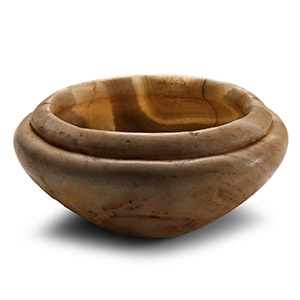
Egyptian Alabaster Bowl
1st Dynasty, circa 3000 B.C.Estimate: £1,800 - 2,400 (‡+bp*)
Opening Bid: £1,000
Of conical profile with flattened base, carinated shoulder and stepped rounded rim, possibly for accepting a lid. 380 grams, 11.6 cm wide
Property from an American deceased estate, acquired between 19770-1989. with Bonhams, London, 28 October 2009, no.16 (Part). Private European collection. Accompanied by copies of the relevant Bonhams catalogue pages. This lot has been checked against the Interpol Database of stolen works of art and is accompanied by a search certificate number no.12071-215259. -
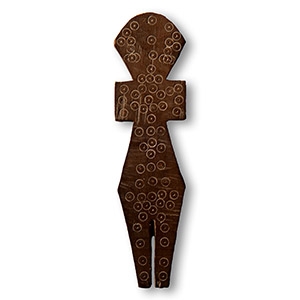
Egyptian Wooden Doll with Circular Decorations
Coptic, 7th-11th centuries A.D. or laterSold for (Inc. bp): £117
Flat anthropomorphic panel with incised ring-and-dot ornament to obverse, single central ring-and-dot to the reverse. 16 grams, 12.4 cm
Acquired on the German art market, 1989-1995. with The Museum Gallery, 19 Bury Place, London, WC1A 2JB, 1998-2003. Property of a London based academic, 2003-present.
In the late Roman Egypt or early Islamic period (7th–11th century A.D.) a new type of figurine appeared in the archaeological record: small, crudely crafted human figures made of bone. Some researchers considered them as toys meant to prepare girls for motherhood; others saw them as fertility figurines. They are mostly referred to as early Christian or “Coptic dolls”. In Egypt and Palestine they seem to appear suddenly in the 7th century, coinciding with the Arab conquests, but they might have existed earlier. With the new Muslim empire bridging former Roman and Sassanian lands, these dolls found their way to Egypt and Palestine where they were reproduced in huge numbers, becoming popular in all levels of society of the 8th and 9th century. By the end of the 11th century they disappeared as quickly as they appeared, probably because of restrictions placed on their production by Islamic laws. -
.jpg)
Egyptian Basalt Torso of Naophoros
Late Period, 664-332 B.C.Sold for (Inc. bp): £1,690
Carved in the round, depicting a male carrying a rectangular shrine intended to hold a figure of a goddess; arms and upper chest bare, strap to the chest to support an apron, dorsal pillar to the reverse; accompanied by a custom-made stand. 4.6 kg, 19.3 cm (5.18 kg total, 25 cm including stand)
From the collection of Danish furniture designer Ole Wanscher (1903-1985). Accompanied by an academic report by Egyptologist Paul Whelan. Accompanied by a copy of a photo of Wanscher in his office, circa 1960. This lot has been checked against the Interpol Database of stolen works of art and is accompanied by search certificate number no.11843-207728.
Ole Wanscher was a leading figure of the Scandinavian Design movement. Wanscher was inspired by ancient designs, and one of his most famous creations, the 'Egyptian Stool', was based on folding chairs from Egypt's New Kingdom. This piece is visible in the background of a photo of Wanscher in his office, circa 1960.
