
Loading, please wait...
LOT 0432
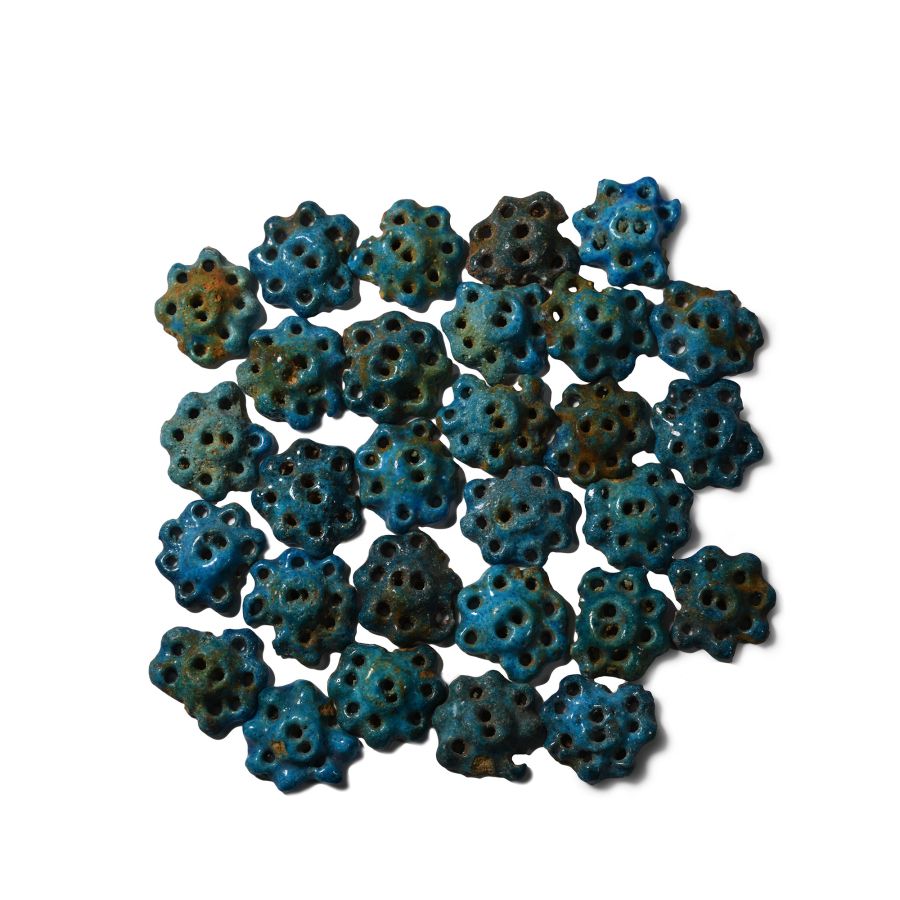
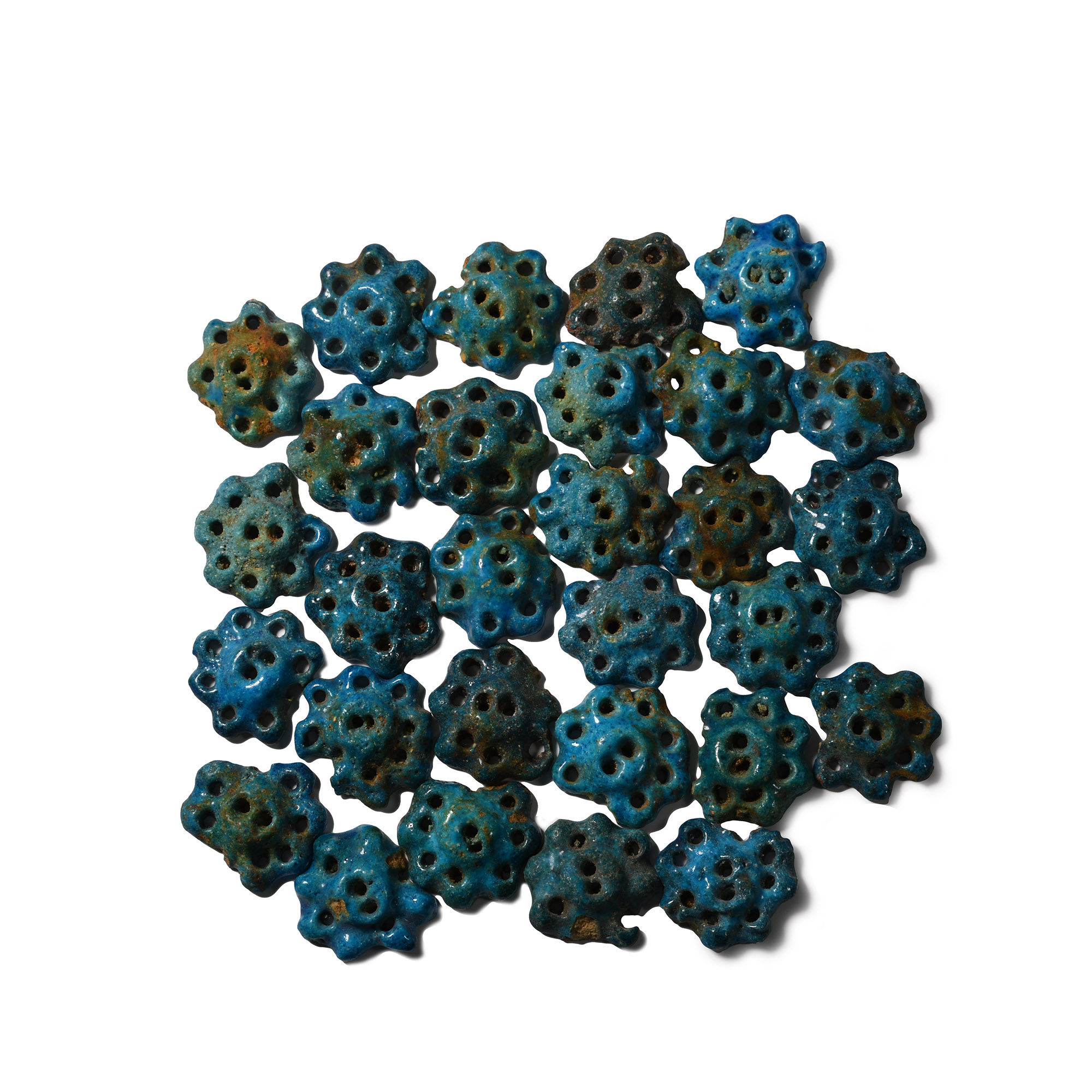
Egyptian Blue Faience Clothing Mounts
ROMAN PERIOD, 30 B.C.-323 A.D.
1 - 1 1/4 in. (124 grams total, 25-30 mm).
Group of rosette mounts, each plano-convex in profile with two attachment holes to the centre and pierced loops to the rim. [29]
ProvenanceUK private collection, formed in the 1980s.
This lot is accompanied by an illustrated lot declaration signed by the Head of the Antiquities Department, Dr Raffaele D’Amato.
This lot is accompanied by an illustrated lot declaration signed by the Head of the Antiquities Department, Dr Raffaele D'Amato.
TimeLine Auctions follows a vetting process to ensure the authenticity and legality of all items, reinforcing our commitment to integrity and responsible trading. Each antiquity, antique, and coin lot undergoes thorough examination by a vetting committee of at least ten external specialists, professional trade association members, scientists, and archaeologists: Our Vetting Process
AUCTIONS:
TimeLine is a leading auction house specialising in antiquities, ancient art, collectables, natural history, coins, medals, and books. Our auctions offer museums, collectors, historians, and enthusiasts the opportunity to acquire unique and historically significant pieces.
-
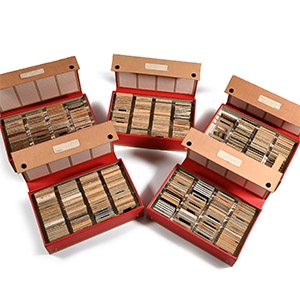
Historic Collection of 725 Slides of Archaeological Sites and Artefacts Including Other Sites in Egypt
1960s-1980s A.D.Sold for (Inc. bp): £650
Housed in five linen-covered boxes, covering general Egyptian sites, religion, Gods of Amun and Osiris, minor gods, environment, boats, and Book of the Dead etc. 4.44 kg total, 26.5 x 16.5 x 6.5 cm each box
Property of archaeologist Stephanie Gee, N.W. London, UK, 1960s-1980s. This lot is accompanied by an illustrated lot declaration signed by the Head of the Antiquities Department, Dr Raffaele D'Amato.
Stephanie Gee was a prominent archaeologist who took part in several expeditions in Egypt. She was a trusted assistant to the British-Australian archaeologist Veronica Seton-Williams, who excavated in Egypt, Britain, and the Near East. Stephanie also took part in the Tell El-Farâ'în expeditions of 1965-1968, and assisted Seton-Williams with preparing the 1966 expedition report. Their collaboration continued and Stephanie helped with the manuscript of Seton-Williams’ book ‘The Road to El-Aguzein’, a narrative account of her life that was first published in 1988. -
.jpg)
Egyptian Bronze Statuette of Isis Seated with Young Horus
Late-Ptolemaic Period, 664-30 B.C.Sold for (Inc. bp): £130
Isis enthroned wearing a cow's horn headdress with a solar disc, suckling the infant Horus on her lap. 39 grams, 10.7 cm
From the property of a lady since the early to mid 20th century. From the private collection of Mr M.L. since circa 2005. This lot is accompanied by an illustrated lot declaration signed by the Head of the Antiquities Department, Dr Raffaele D'Amato.
In ancient Egyptian mythology, Isis was the sister-wife of Osiris and the mother of the sky god Horus. She is associated with aspects of fertility and motherhood and is often depicted in various artworks seated in a nursing pose with her son Horus on her lap, as here. -
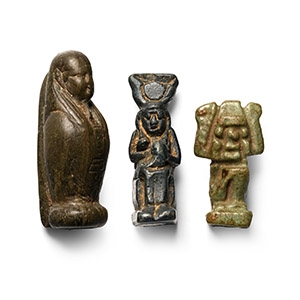
Egyptian Stone and Faience Amulet Group
Late Period-Roman Period, circa 664 B.C.-100 A.D.Sold for (Inc. bp): £572
Comprising: a seated figure of Isis suckling infant Horus on her lap, the goddess crowned with large cow horns flanking a solar disc, pierced behind the head; a mummiform Osiris-Canopus amulet wearing a nemes headdress and plain dorsal pillar, a winged scarab with solar disc above at the base of the figure; a kneeling Shu amulet, his arms raised above his head holding a large solar disc, pierced through the dorsal pillar. 6.47 grams total, 18-25 mm
Ex Prof. Dr Emil Vogt (1906-1974), The Former Director of the Swiss National Museum, Zürich, in his collection before 1970. with Galerie Rhéa, Zurich, Switzerland. This lot is accompanied by an illustrated lot declaration signed by the Head of the Antiquities Department, Dr Raffaele D'Amato.
