
Loading, please wait...
_900x900.jpg "'Egyptian Blue' Counter Weight Menat Amulet")
_200x200.jpg "'Egyptian Blue' Counter Weight Menat Amulet")
.jpg "'Egyptian Blue' Counter Weight Menat Amulet")
LOT 0047
'Egyptian Blue' Counter Weight Menat Amulet
LATE PERIOD, 664-525 B.C.
2 5/8 in. (14 grams, 67 mm).
Amuletic pendant with broad bale, keyhole-shaped plaque with gusset to the rim.
ProvenanceAcquired on the German art market, 1989-1995.
with The Museum Gallery, 19 Bury Place, London, WC1A 2JB, 1998-2003.
Property of a London based academic, 2003-present.
Cf. Reisner, G.A., Catalogue général des antiquités égyptiennes du Musée du Caire, Nos.12528-13595, Vol. II, Amulets, Cairo, 1958, pl. V, nos. 12701 and 12694, for type.
FootnotesThe menat necklace was a sacred item of great importance to female Egyptian goddesses, particularly Hathor. Priestesses of Hathor and other powerful goddesses used the necklace as a rattle, holding it in their hand by the counterpoise and evoking protection from the sound of the shaken beads. The amuletic menat counterweight symbolised the whole elaborate necklace. The menat was considered a powerful magical amulet throughout Egyptian history, offering good luck and protection against evil spirits. It was often buried with the dead for protection in the afterlife and was believed to promote fertility and good health for women while signifying virility for men.
CONDITIONTimeLine Auctions follows a vetting process to ensure the authenticity and legality of all items, reinforcing our commitment to integrity and responsible trading. Each antiquity, antique, and coin lot undergoes thorough examination by a vetting committee of at least ten external specialists, professional trade association members, scientists, and archaeologists: Our Vetting Process
AUCTIONS:
TimeLine is a leading auction house specialising in antiquities, ancient art, collectables, natural history, coins, medals, and books. Our auctions offer museums, collectors, historians, and enthusiasts the opportunity to acquire unique and historically significant pieces.
LOT 0047
'Egyptian Blue' Counter Weight Menat Amulet
Estimate £800 - 1,000€930 - 1,160 (for guidance only)$1,080 - 1,350 (for guidance only)
-
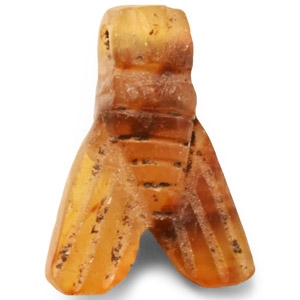
Egyptian Hardstone Fly Amulet
Late Period, 664-332 A.D.Sold for (Inc. bp): £117
With linear detailing to body and wings, pierced at the neck. 0.38 grams, 12 mm
From the H.N. collection, Milton Keynes, Berkshire, UK, 1990s.
Fly amulets were believed to protect against insect bites and ward off flying creatures through apotropaic magic. Additionally, the pharaoh would give gold fly-shaped pendants as military awards to recognise the bravery and persistence of soldiers in battle. -
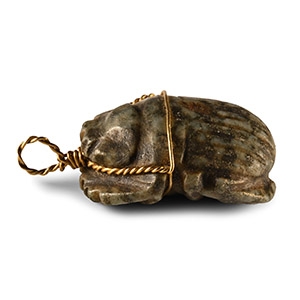
Egyptian Hardstone Heart Scarab in Gold Mount
Late Period, 664-332 B.C. and laterSold for (Inc. bp): £286
Carved scarab with textured carapace and detailed legs; set in a 19th century gold mount. 6.02 grams, 28 mm
From an early 20th century collection. -
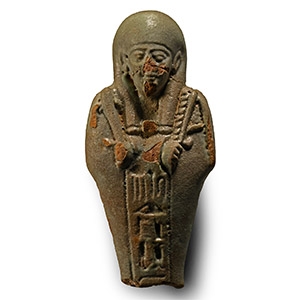
Egyptian Blue Glazed Hieroglyphic Shabti Fragment for Neith
26th Dynasty, 664-525 B.C.Estimate: £400 - 600 (+bp*)
Opening Bid: £200
Pale grey-green composition fragment of the upper half of a mummiform shabti wearing a tripartite wig, holding a pick, hoe, and cord for a seed bag, which hangs over the left shoulder; a vertical band to the chest and lower body inscribed with hieroglyphic text giving the opening 'The illuminated one, the Osiris' and the name or title beginning with 'Neith'. 62 grams, 89 mm
Acquired on the German art market, 1989-1995. with The Museum Gallery, 19 Bury Place, London, WC1, UK, 1998-2003. Property of a London based academic, 2003-present.
