
Loading, please wait...
_900x900.jpg "Egyptian Black Stone Amulet with Cartouche")
_200x200.jpg "Egyptian Black Stone Amulet with Cartouche")
.jpg "Egyptian Black Stone Amulet with Cartouche")
LOT 0559
Egyptian Black Stone Amulet with Cartouche
LATE PERIOD, 664-332 B.C.
1 1/8 in. (3.15 grams, 29.8 mm).
Carved in low relief with hieroglyphs to the sub-rectangular plaque, with two feathers above; integral pierced lug to reverse. [No Reserve]
Provenancewith Archaeologia, Switzerland, before 1983.
Ex private North American collection.
London private collection, 2016.
Cf. Andrews, C., Amulets of Ancient Egypt, London, 1994, p.77, Fig. 77b, for the type.
CONDITIONTimeLine Auctions follows a vetting process to ensure the authenticity and legality of all items, reinforcing our commitment to integrity and responsible trading. Each antiquity, antique, and coin lot undergoes thorough examination by a vetting committee of at least ten external specialists, professional trade association members, scientists, and archaeologists: Our Vetting Process
AUCTIONS:
TimeLine is a leading auction house specialising in antiquities, ancient art, collectables, natural history, coins, medals, and books. Our auctions offer museums, collectors, historians, and enthusiasts the opportunity to acquire unique and historically significant pieces.
-
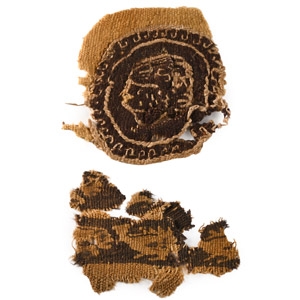
Egyptian Coptic Textile Fragment Group
Circa 4th-5th century A.D.Sold for (Inc. bp): £65
Comprising: an orbiculus in coarse linen and brown wool, S torsion, embroidered with the image of a stylised bird, surrounded by tondos ornamented with geometric embroidery, borders meander decorated; a similar fragment of double segmenta, embroidered with hares alternated to fishes. 9 grams total including package, 60-64 mm
Acquired 1970s-1996. Property of a North American collector. London collection, 2016.
The iconography of this fragment is called "Nilotic," as it depicts plant and human elements linked to life on the Nile River. These images are very recurrent on Coptic textiles. Weavers created patterns that allowed them to reproduce these motifs on any type of fabric (curtains, tassels, clothing). -
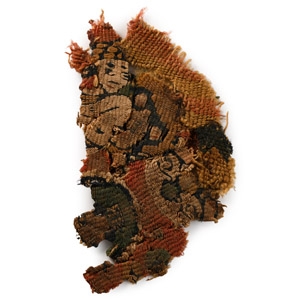
Egyptian Coptic Textile Fragment
Circa 7th-8th century A.D.Sold for (Inc. bp): £72
A fragment of an orbiculus in linen and red, brown, yellow and blue wool, S torsion, embroidered with an image of a putto with vine leaves around the head, surrounded by tondos ornamented with vegetal embroidery. 11 grams total including package, 78 mm
Acquired 1970s-1996. Property of a North American collector. London collection, 2016.
This is a fragment from a tunic decoration, usually forming part of a double band on a red background, decorated with a series of motifs related to the Dionysian cult: usually depicting cherubs, fish, heads, palmettes, and figures of dancing puttoes within the orbiculi. The decorative motifs on these tunics were usually arranged vertically and horizontally. -
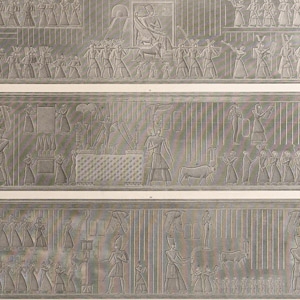
Very Large Egyptian Expedition Lithograph of the Reliefs of the Temple of Medynet-Abou at Thebes
Early 19th century A.D.Sold for (Inc. bp): £117
Proof etching on laid paper of plate 11 from Phillipeaux Thèbes - Medynet-Abou Marche Triomphale sculptée dans la Galerie-Nord du Péristyle du Palais with military procession in three registers. 231 grams, 104 x 70 cm
From the collection of a North American priest. Acquired between 1981-1996. Property of a North American collector.
Produced between February 1802 and 1830 on the orders of Napoleon Bonaparte; published between 1809 and 1828. Just 1,000 copies were distributed to various institutions, printed on laid paper with an 'Égypte ancienne et moderne' watermark. The book is subtitled Recueil des observations et des recherches qui ont été faites en Égypte pendant l’expédition de l’Armée française, publié par les ordres de Sa Majesté l’Empereur Napoléon le Grand (Gathering of observations and discoveries which were made in Egypt during the expedition of the French army, published on the orders of His Majesty the Emperor Napoleon the Great). It was the world's first encyclopedia devoted exclusively to the remains of ancient Egypt. The plates of this book are the first to present the archaeological sites of Thebes (Luxor). Medinet Habu is the name given to the impressive mortuary temple built for Ramesses III. The walls are covered with scenes of religious and royal ceremonies, as well as battle scenes. An earlier temple and later tomb complexes are found within its impressive enclosure walls.
