
Loading, please wait...
_900x900.jpg "Egyptian 'Becker' Serpentine Vessel")
_200x200.jpg "Egyptian 'Becker' Serpentine Vessel")
.jpg "Egyptian 'Becker' Serpentine Vessel")
LOT 0023
Egyptian 'Becker' Serpentine Vessel
NEW KINGDOM, 18TH DYNASTY, CIRCA 1450 B.C.
6 1/8 in. (1.2 kg, 15.5 cm).
Piriform jar with wide, flat rim and short neck, narrow neck and flat base.
ProvenanceEx Becker collection, 1920s.
Private collection, Los Angeles, USA, 1990s.
Private European collection.
Accompanied by an academic report by Dr Raffaele D’Amato.
This lot has been checked against the Interpol Database of stolen works of art and is accompanied by a search certificate number no.12576-232111.
This lot has been cleared against the Art Loss Register database, and is accompanied by an illustrated lot declaration signed by the Head of the Antiquities Department, Dr Raffaele D'Amato.
See Aston, B.G., Ancient Egyptian Stone Vessels, materials and forms, Heidelberg, 1994, pl.12, for examples of serpentine vessels; for the shape of the vessel, idem, p.97, no.185, type a (p.154, New Kingdom); Lilyquist, C., Egyptian Stone Vessels, Khian through Tuthmosis IV, New York, 1995, figs.67, 68, 85, 87.
CONDITIONTimeLine Auctions follows a vetting process to ensure the authenticity and legality of all items, reinforcing our commitment to integrity and responsible trading. Each antiquity, antique, and coin lot undergoes thorough examination by a vetting committee of at least ten external specialists, professional trade association members, scientists, and archaeologists: Our Vetting Process
AUCTIONS:
TimeLine is a leading auction house specialising in antiquities, ancient art, collectables, natural history, coins, medals, and books. Our auctions offer museums, collectors, historians, and enthusiasts the opportunity to acquire unique and historically significant pieces.
LOT 0023
Egyptian 'Becker' Serpentine Vessel
Estimate £4,000 - 6,000€4,640 - 6,960 (for guidance only)$5,400 - 8,100 (for guidance only)
-
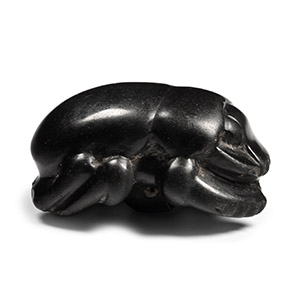
Egyptian Glass Heart Scarab
Late Period, 664-332 B.C. or laterSold for (Inc. bp): £910
Modelled in the round with ribbed loop to the underside, carapace and leg detailing. 6.49 grams, 24.6 mm
Ex London and Home Counties collection, UK, 1920-1940. This lot is accompanied by an illustrated lot declaration signed by the Head of the Antiquities Department, Dr Raffaele D'Amato. -
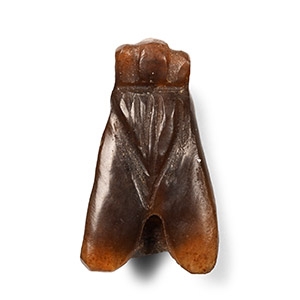
Egyptian Jasper Fly Amulet
Late Period, 664-332 B.C.Sold for (Inc. bp): £208
Carved in the round resting on an oval base, striated body; pierced longitudinally. 0.88 grams, 14 mm
Ex London and Home Counties collection, UK, 1920-1940. This lot is accompanied by an illustrated lot declaration signed by the Head of the Antiquities Department, Dr Raffaele D'Amato.
Egyptian artists often depicted fly whisks with pharaohs and officials, suggesting flies were just nuisances. In reality, Egyptians valued flies for their speed and persistence. Small fly amulets appeared around 3200 B.C. in Naqada II burials, gaining popularity and varying materials during the New Kingdom, including gold, silver, lapis lazuli, carnelian, amethyst, faience, and gemstones. These amulets were thought to protect against insect bites and troublesome creatures via apotropaic magic and possibly symbolised fecundity. Pharaohs awarded gold fly-shaped pendants to honour soldiers' bravery in battle. -
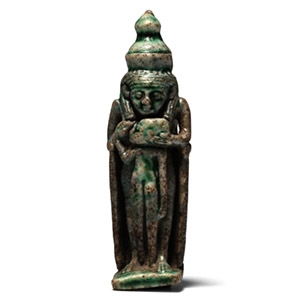
Egyptian Green Glazed Steatite Syncretic Amulet of Mut
Third Intermediate Period, circa 1069-735 B.C.Estimate: £2,500 - 3,500 (+bp*)
Opening Bid: £1,250
Modelled in the round, formed as the goddess standing before a high-backed throne cradling the head of a standing child to her chest; the goddess with tiered double-crown and tripartite wig; throne with low-relief figure of the lioness-headed goddess Sekhmet to the rear with spread wings forming the arms of the chair. 22.6 grams, 61 mm
with Jean-Phillipe Mariaud de Serres, Paris, France. Private collection, London, UK, acquired from the above in 1992. This lot has been checked against the Interpol Database of stolen works of art and is accompanied by a search certificate number no.12633-235083. This lot has been cleared against the Art Loss Register database, and is accompanied by an illustrated lot declaration signed by the Head of the Antiquities Department, Dr Raffaele D'Amato.
Mut was a prominent mother goddess in ancient Egyptian religion, associated with creation, motherhood, and the sky. She was the consort of the god Amun and the mother of Khonsu, forming the Theban triad with them in Thebes. Mut's name ("mother" in ancient Egyptian), reflects her role as a divine mother and patroness of motherhood. Sekhmet was revered as a powerful and fierce protector. Her presence was believed to ward off evil and safeguard the people from harm. In ancient Egyptian mythology, Sekhmet was also a manifestation of Hathor, another powerful birth goddess.
