
Loading, please wait...
LOT 0500
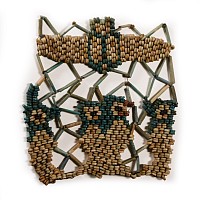
Egyptian Beaded Mummy Mask Panel with Four Sons of Horus
PTOLEMAIC PERIOD, 332-30 B.C.
6 1/4 in. (57 grams, 16 cm).
Openwork restrung panel depicting Imsety, Hapy, Duamutef, and Qebehsenuef, the Four Sons of Horus with a winged scarab above; restrung with some later beads.
ProvenanceEx Mariaud de Serres, Paris, France, 1980-1990s.
From a London, UK, collection.
Accompanied by an old collection ticket.
The Four Sons of Horus were deities responsible for protecting the internal organs of the deceased. The human-headed Imsety protected the liver, the baboon-headed Hapy protected the lungs, the jackal-headed Duamutef protected the stomach, and the falcon-headed Qebehsenuef protected the intestines.
CONDITIONTimeLine Auctions follows a vetting process to ensure the authenticity and legality of all items, reinforcing our commitment to integrity and responsible trading. Each antiquity, antique, and coin lot undergoes thorough examination by a vetting committee of at least ten external specialists, professional trade association members, scientists, and archaeologists: Our Vetting Process
AUCTIONS:
TimeLine is a leading auction house specialising in antiquities, ancient art, collectables, natural history, coins, medals, and books. Our auctions offer museums, collectors, historians, and enthusiasts the opportunity to acquire unique and historically significant pieces.
LOT 0500
Egyptian Beaded Mummy Mask Panel with Four Sons of Horus
Sold for (Inc. bp): £117
-
Egyptian Hardstone Heart Amulet
Late Period, 664-332 B.C.Sold for (Inc. bp): £156
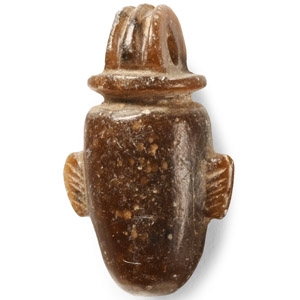
Modelled in the round with ribbed loop above, flange and two lateral tabs. 1.64 grams, 18 mm
From the collection of Doctor Girard, a collector for over 60 years. with Hotel des Ventes de Clermont-Ferrand, 22 May 2017. Property of a French collector.
According to ancient Egyptian beliefs, the heart (ib) was considered to be the centre of intelligence, emotions, and behaviour. The heart was also believed to store an individual's memories. During the Weighing of the Heart ceremony in the afterlife, the heart could speak up for the deceased and account for their lifetime of actions before Osiris. For this reason, heart amulets were placed on the mummy to safeguard the organ and ensure a favourable outcome during judgment. -
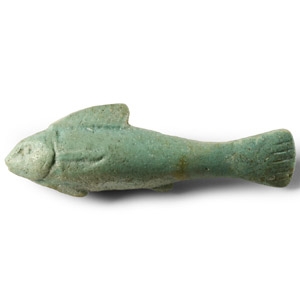
Egyptian Faience Fish Amulet
Late Period, 664-332 B.C.Sold for (Inc. bp): £390
Tilapia fish modelled in the round; tail restored. 3.20 grams, 43 mm
From the collection of Doctor Girard, a collector for over 60 years. with Hotel des Ventes de Clermont-Ferrand, 22 May 2017. Property of a French collector.
This amulet represents a ‘Tilapia nilotica’ or ‘bolti’, a prevalent fish species found in the Nile. Not only was it esteemed for its delicious taste, but it was also revered as a symbol of rebirth and resurrection due to its unique ability to carry its eggs in its mouth, suggesting self-creation. -
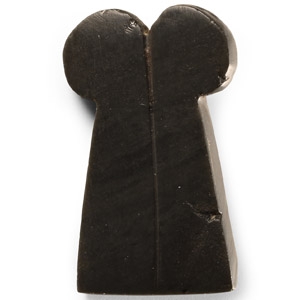
Egyptian Hardstone Double Plume Amulet
Late Period, 664-332 B.C.Estimate: £250 - 350 (+bp*)
Opening Bid: £125
Carved with integral ribbed loop to the reverse; unfinished. 4.4 grams, 31 mm
with Hotel des Ventes, Drouot, Paris, France. From the collection of Mr H. Naudy, Paris, France. Acquired at between 2004-2010. Property of a French collector.
This ancient amulet represents two ostrich feathers or shuty. Interestingly, these feathers were also present on the Atef crown of Osiris, the god of the afterlife and the dead. This suggests the amulet was believed to imbue the wearer with Osiris' divine power and protection.
