
Loading, please wait...
LOT 0027
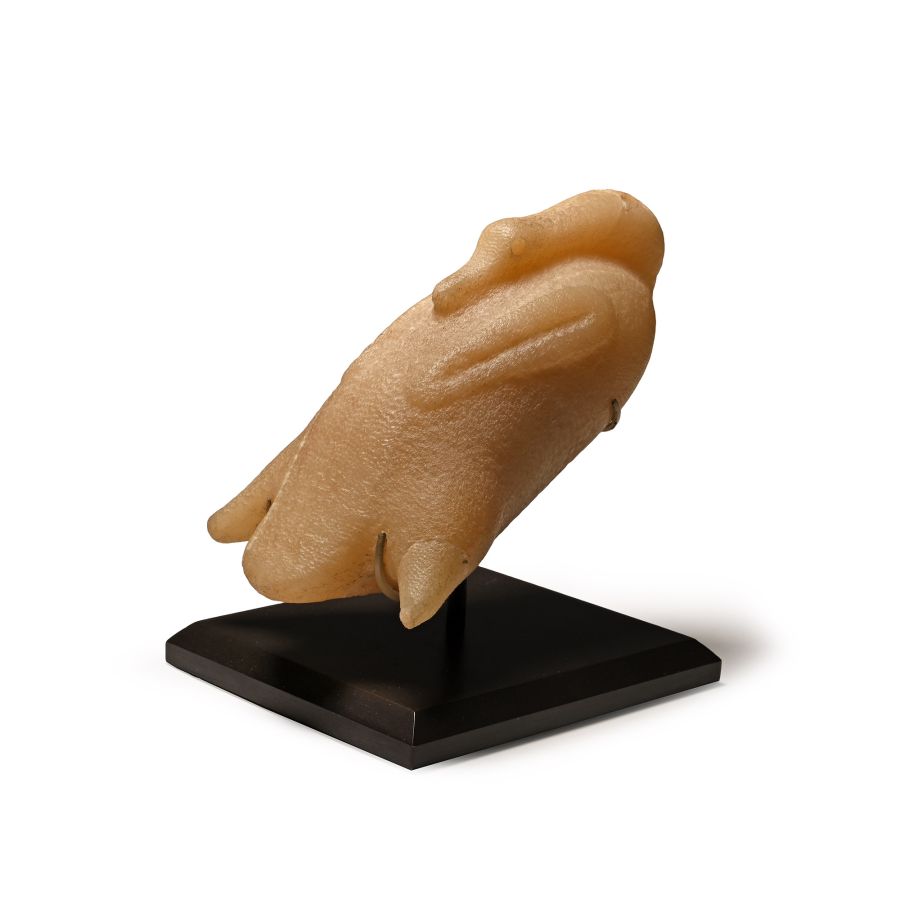
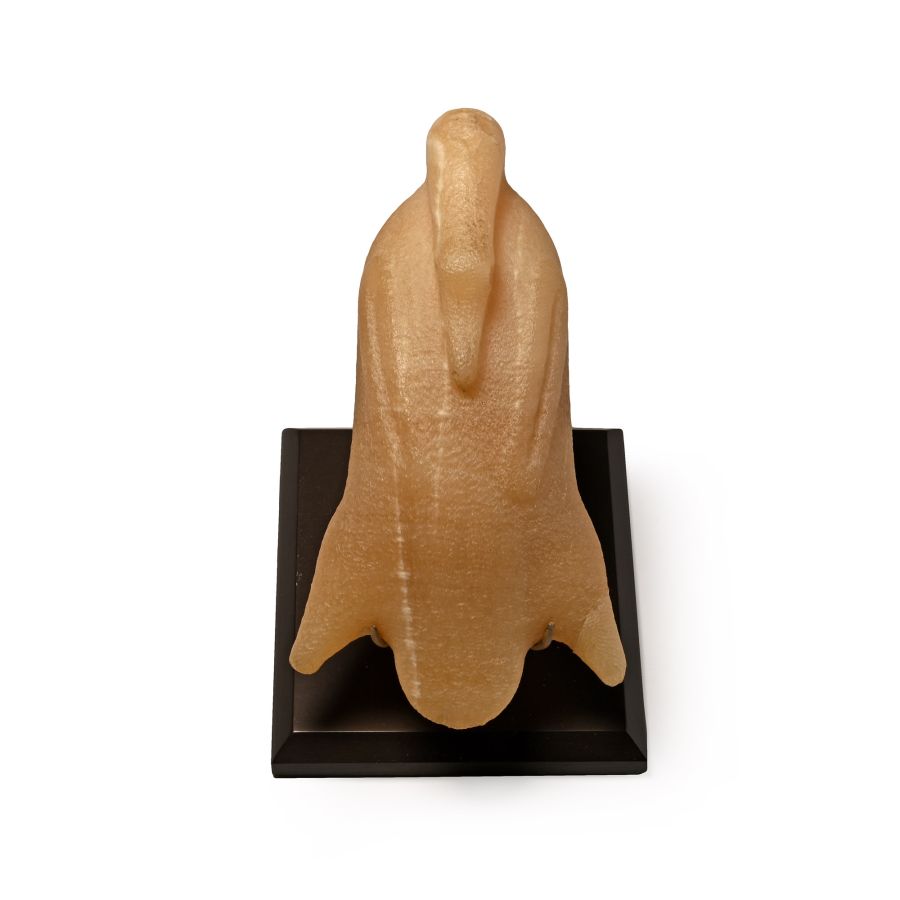
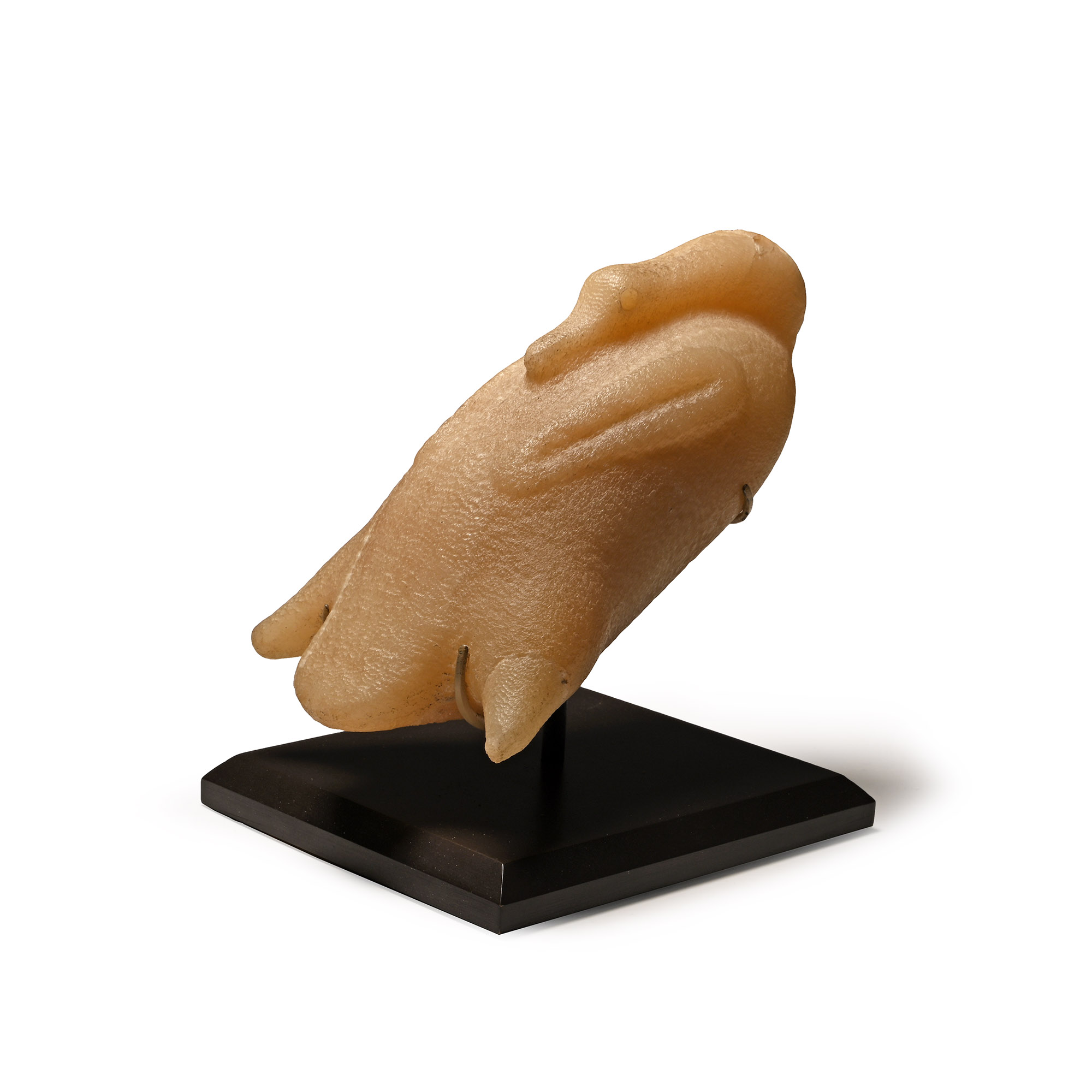
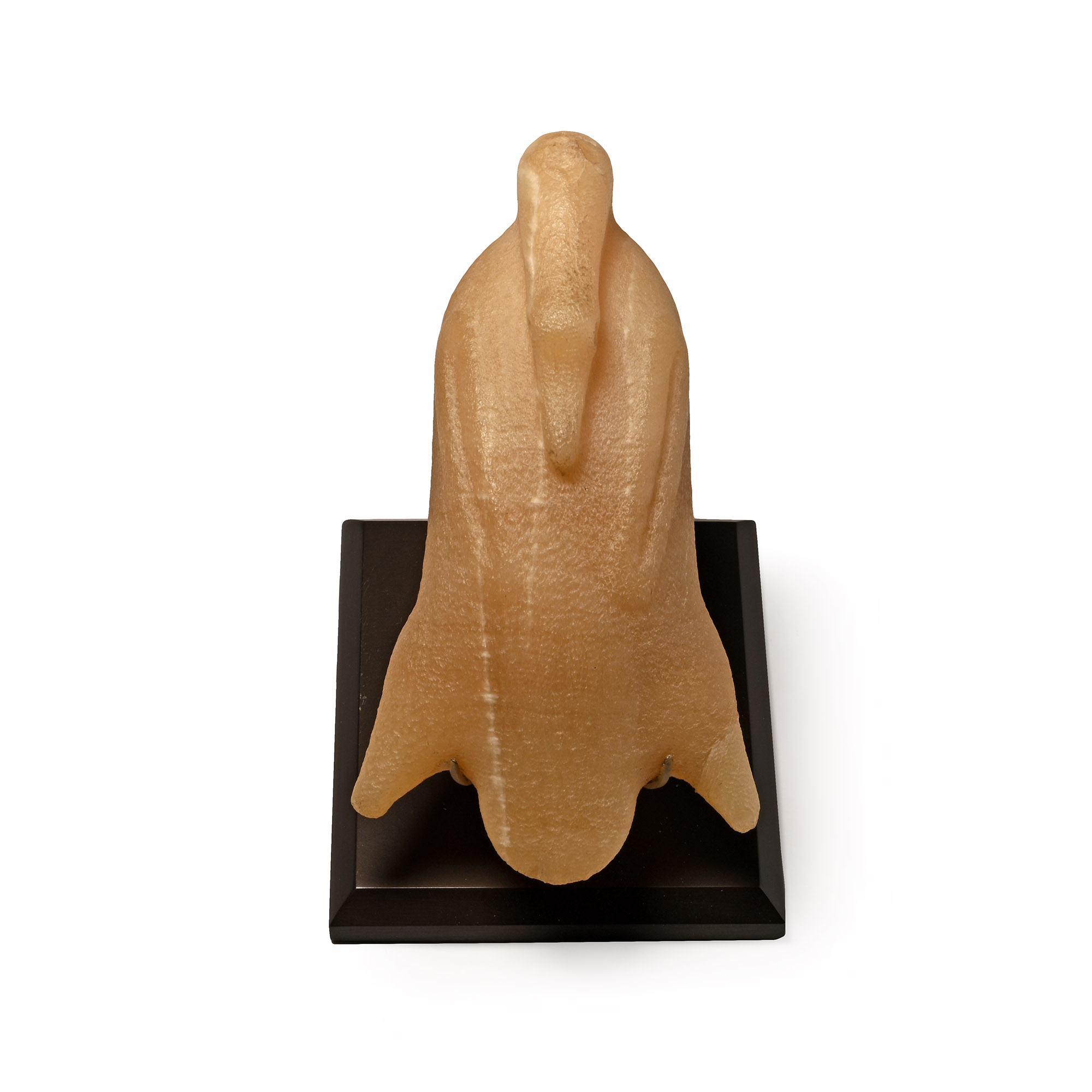
Egyptian Alabaster Trussed Duck
OLD KINGDOM, 6TH DYNASTY, CIRCA 2345-2181 B.C.
4 in. (890 grams total, 10 cm wide including stand).
Carved in the round with the head and neck laid backwards along the spine; mounted on a custom-made stand.
ProvenanceAcquired before 1970.
Private French collection.
with Bonhams, New Bond Street, London, 29 April 2009, lot 58.
Ex Middle Eastern royal family, living in the UK, 2013-2017.
Accompanied by a copy of a French cultural passport no.099505.
Accompanied by a copy of an Art Loss Register certificate, no.S000149104.
Accompanied by a copy of the relevant Bonhams catalogue pages.
This lot has been checked against the Interpol Database of stolen works of art and is accompanied by search certificate number no.12942-245247.
Cf. S. D'Auria, et al, Mummies and Magic - The Funerary Arts of Ancient Egypt, Boston, 1988, p.38, fig 25, for examples of model offerings.
FootnotesIn ancient Egypt, the duck (actually the Egyptian goose) was considered a sacred and very popular animal, often depicted in art and associated with symbolic meanings. It was a common bird in the Nile Valley and considered a symbol of fertility, life, and family, which is why it frequently appeared in scenes of daily life and rituals, and in the artworks.
CONDITIONTimeLine Auctions follows a vetting process to ensure the authenticity and legality of all items, reinforcing our commitment to integrity and responsible trading. Each antiquity, antique, and coin lot undergoes thorough examination by a vetting committee of at least ten external specialists, professional trade association members, scientists, and archaeologists: Our Vetting Process
AUCTIONS:
TimeLine is a leading auction house specialising in antiquities, ancient art, collectables, natural history, coins, medals, and books. Our auctions offer museums, collectors, historians, and enthusiasts the opportunity to acquire unique and historically significant pieces.
LOT 0027
Egyptian Alabaster Trussed Duck
Estimate £7,000 - 9,000€8,120 - 10,440 (for guidance only)$9,450 - 12,150 (for guidance only)
-
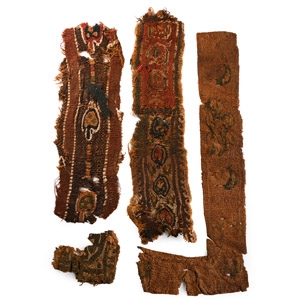
Egyptian Coptic Textile Fragment Group
Circa 7th-8th century A.D.Sold for (Inc. bp): £208
Comprising: a fragment of a segmentum in linen and red, brown, yellow and blue wool, S torsion, embroidered with a series of heads alternating with a flying putto holding a melograne; a fragment of another segmentum in linen and red, brown, yellow and blue wool, S torsion, embroidered with vegetal patterns, borders decorated with meanders; a fragment of a segmentum in linen and red, brown, white, yellow and blue wool, S torsion, embroidered with floral buds; a small fragment of a tablion with geometric decoration, purple wool on linen. 44 grams total including package, 4.3-20.5 cm
Acquired 1970s-1996. Property of a North American collector. London collection, 2016.
Some of these pieces are fragments from a tunic decoration, usually belonging to bands on red background, decorated with a series of motifs related to the Dionysian cult: usually these depict cherubs, fish, heads, palmettes, vegetal and floral ornaments, as well as figures of dancing puttoes within the orbiculi. The decorative motifs on these tunics were usually arranged vertically and horizontally. -
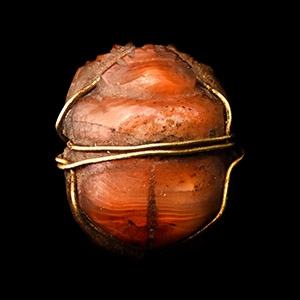
Egyptian Hardstone Scarab with Later Gold Pendant Mount
Late Period, 664-332 B.C.Sold for (Inc. bp): £572
Carved scarab with detailed carapace and mouth parts; later gold wire mount for suspension. 2.88 grams, 16.54 mm
Early 20th century UK, collection. -
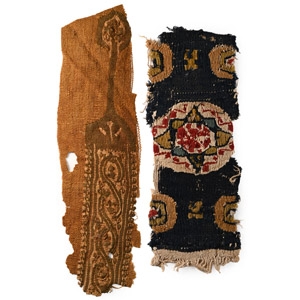
Egyptian Coptic Textile Fragment Group
Circa 4th-5th century A.D.Sold for (Inc. bp): £234
Comprising: terminal part of a clavus from a tunic with an orbiculus, in purple wool on linen, embroidered with vegetal and floral motifs, framed by straight borders with external crenellation; a fragment of segmentum in yellow, green and red wool, S torsion, embroidered with floral and geometric patterns. 40 grams total including package, 17-20 cm
Acquired 1970s-1996. Property of a North American collector. London collection, 2016.
The fragments are decorative parts of tunics. These are fabrics of great decorative finesse, with some elements displaying an unusual and extremely well-preserved color palette. The plant designs recall Iranian motifs.
