
Loading, please wait...
LOT 0472
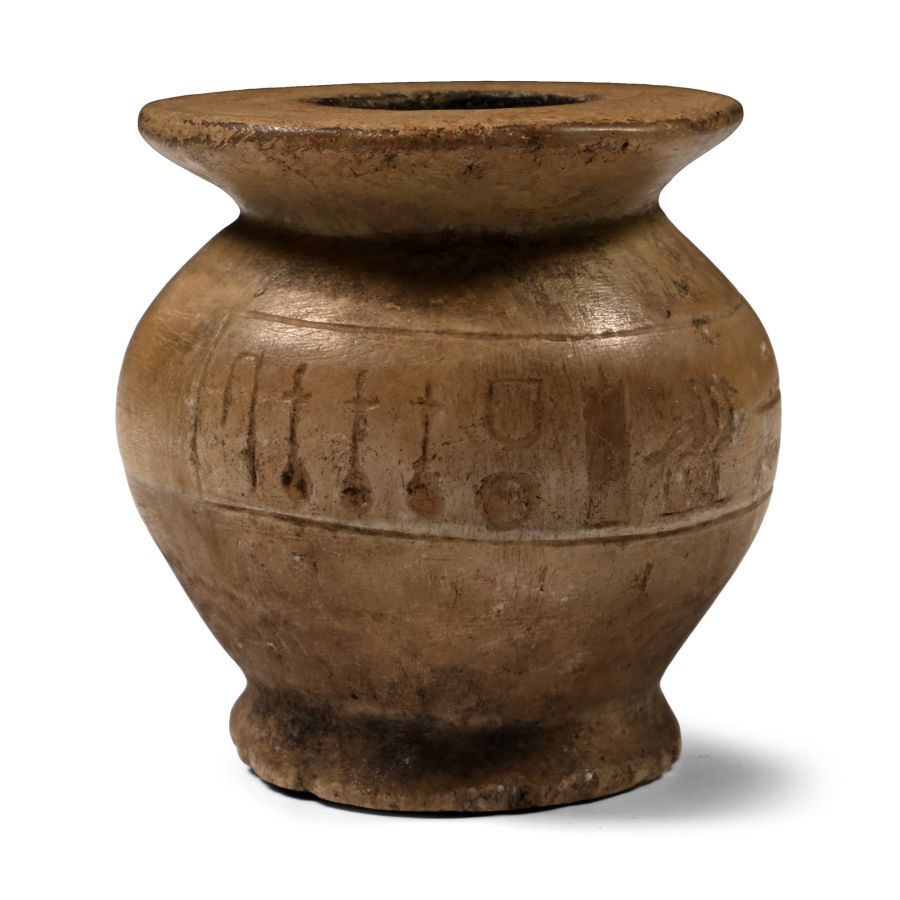
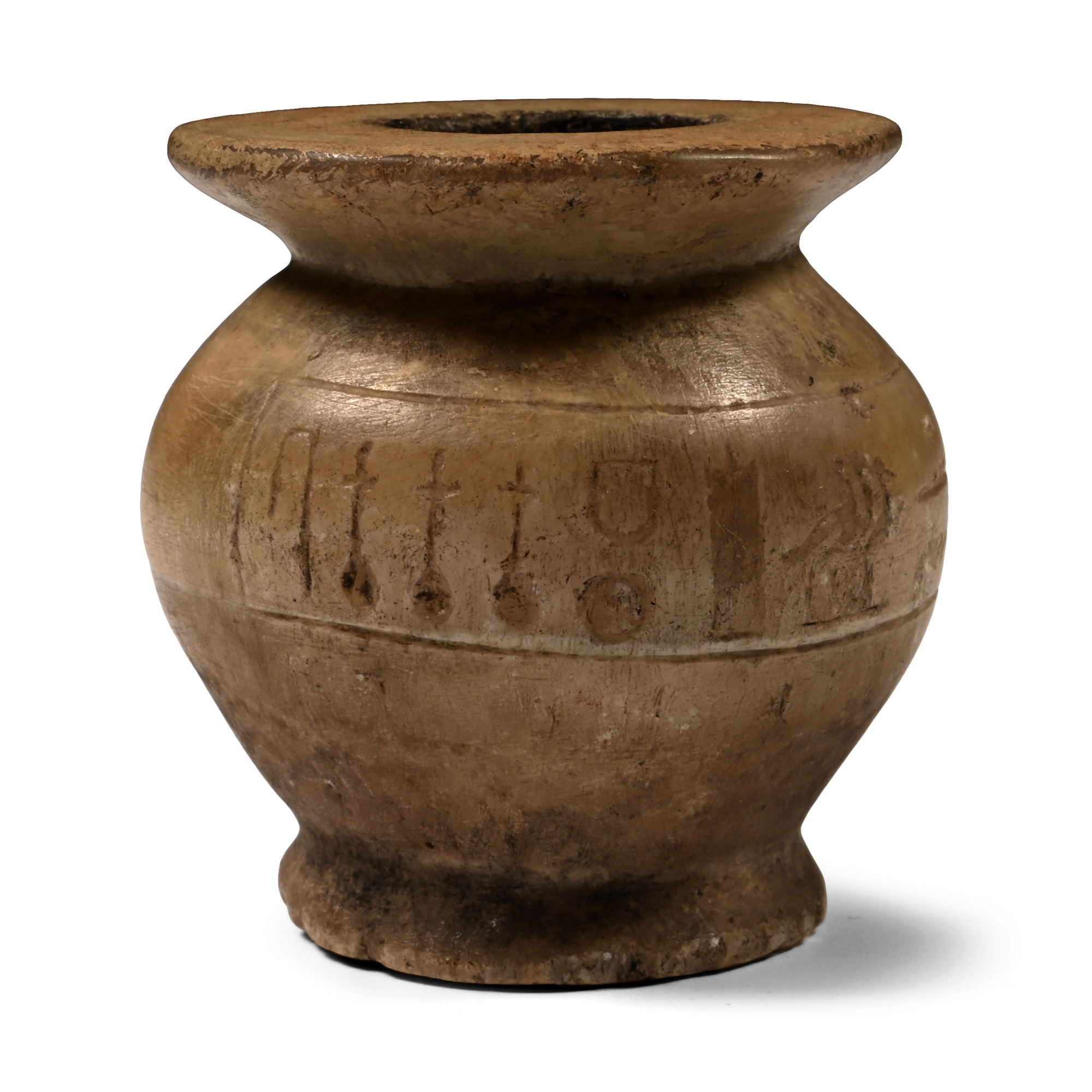
Egyptian Alabaster Kohl Pot with Later Hieroglyphs
SECOND INTERMEDIATE PERIOD, 1650-1550 B.C.
2 1/8 in. (208 grams, 55 mm high).
Comprising a squat piriform body with a wide everted rim, a band of later hieroglyphs beneath the shoulder: ḳmꜢ.t n bꜢw ı͗wnw nfrw.s (You have gathered the souls (i.e. divine powers) of Heliopolis—her beauties).
ProvenanceEx late London, UK, gentleman, 1970s.
This lot is accompanied by an illustrated lot declaration signed by the Head of the Antiquities Department, Dr Raffaele D'Amato.
Cf. Vandier d’Abbadie, J., Les objets de toilette égyptiens au Musée du Louvre, Paris, 1972, pp. 84-85, no. 316, for a similar vessel.
FootnotesThe inscription on what is a cosmetic vessel could be interpreted as “You acquire the powers of Heliopolis, source of her beauty”; “her beauties” likely references either the woman using the vessel or perhaps the divine beauty imparted by the contents.
CONDITIONTimeLine Auctions follows a vetting process to ensure the authenticity and legality of all items, reinforcing our commitment to integrity and responsible trading. Each antiquity, antique, and coin lot undergoes thorough examination by a vetting committee of at least ten external specialists, professional trade association members, scientists, and archaeologists: Our Vetting Process
AUCTIONS:
TimeLine is a leading auction house specialising in antiquities, ancient art, collectables, natural history, coins, medals, and books. Our auctions offer museums, collectors, historians, and enthusiasts the opportunity to acquire unique and historically significant pieces.
-
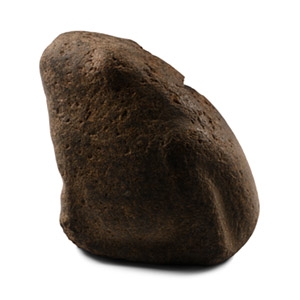
Egyptian Pre-Dynastic Stone Frog
4th millennium B.C.Estimate: £1,800 - 2,400 (‡+bp*)
Opening Bid: £810
Pyramidal in form with shallow-carved hip and facial detailing. 537 grams, 81 mm
with Artemis Gallery, Munich, Germany, 2001. Private collection, Europe. This lot has been checked against the Interpol Database of stolen works of art and is accompanied by a search certificate number no.12580-232124. This lot has been cleared against the Art Loss Register database, and is accompanied by an illustrated lot declaration signed by the Head of the Antiquities Department, Dr Raffaele D'Amato.
The frog had a great role in ancient Egyptian mythology and was connected with the mythology of creation. A number of gods and goddesses were connected with the frog such as Heqet, Ptah, and Heh. The connection with the god Ptah as a god of creation was probably due to the idea that Ptah was the only god who created the world in ancient Egypt through his heart and his tongue. Every work of the god came about through what his heart devised and his tongue commanded. Frogs were often associated with Hekat, deity of birth and fecundity. Amulets of frogs were frequent votive gifts at such Predynastic and Archaic sites at Abydos, Naqada, and Saqqara. -
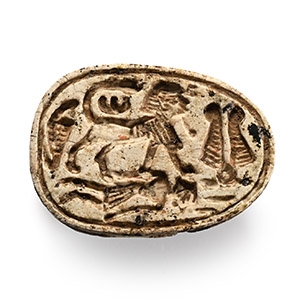
Large Egyptian Steatite Scarab with Sphinx
Late Period, 664-332 B.C.Sold for (Inc. bp): £468
With detailed carapace, head, and legs; the underside depicting the king as an advancing sphinx trampling a male enemy in a short kilt, with a rearing cobra behind, a pair of ostrich feathers atop a sun disc in front, and the symbol for foreign lands placed in the curl of the sphinx’s tail. 13.4 grams, 32 mm
From the collection of a gentleman, acquired on the London art market in the 1990s. This lot is accompanied by an illustrated lot declaration signed by the Head of the Antiquities Department, Dr Raffaele D'Amato. -
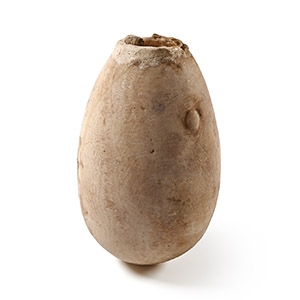
Egyptian Alabaster Alabastron
7th-6th century B.C.Sold for (Inc. bp): £156
With an ovoid body and two small lug handles to the upper body. 121 grams, 72 mm
Acquired in the mid 1980s-1990s. Private collection, Switzerland, thence by descent. Private collection, since the late 1990s. This lot is accompanied by an illustrated lot declaration signed by the Head of the Antiquities Department, Dr Raffaele D'Amato.
The name by which we know the vessel in question comes directly from its name in Greek— alábastron —which itself was derived from Egyptian, although It is difficult to say whether the name in Egyptian first applied to the type of vessel or to the stone used to make it. Pliny (NH 36.12, 37.54) includes an alabastrites or alabastritis from Alabastrum near Thebes in Egypt among his description of stones, and Theophrastus (On Stones, 1.6) an alabastrítes, also from near Thebes. Ptolemy (Geography, 4.5) even mentions an alabastrites mons, a mountain of alabaster, in the same vicinity. The prototype of the alabastron shape with two lug handles first appeared in Egypt at the end of the Middle Kingdom and continued in use with slight variations through New Kingdom times. After an apparent hiatus in the use of the shape at the end of the Late Bronze Age, it appeared again in the second half of the eighth century in a form more similar to our specimen and became common by the 26th Dynasty.
