
Loading, please wait...

LOT 0009
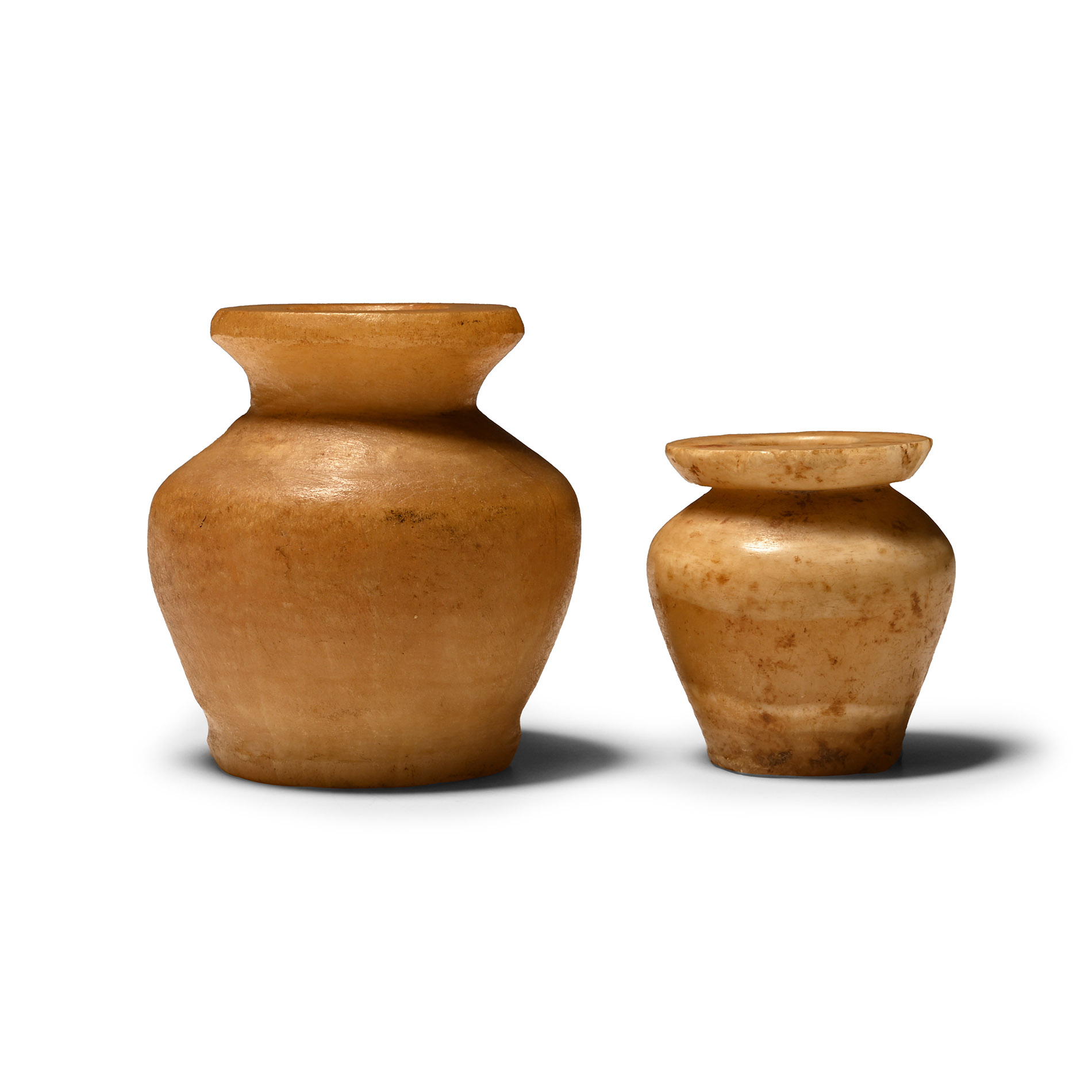
Egyptian Alabaster Kohl Jars
NEW KINGDOM, CIRCA 1550-1070 B.C.
1 1/2 - 2 1/4 in. (310 grams total, 43-61 mm high).
The larger with squat profile, slight flare to the foot, carinated shoulder and small rounded rim; the smaller with wide flat rim, round shoulder and body tapering to a flat base. [2]
ProvenanceMary Stout Shaw (1880-1962); thence by direct descent to the present owner.
Accompanied by a copy of a 1976 family photo featuring some of the collection on display, the larger kohl jar is clearly visible on a 1976 family photo.
This lot has been checked against the Interpol Database of stolen works of art and is accompanied by search certificate number no.12197-220887.
Cf. Vandier d’Abbadie, J., Les objets de toilette égyptiens au Musée du Louvre, Paris, 1972, pp.79-81, nos.283 and 287, for a similar example of the smaller kohl jar; Guidotti, M.C., Vasi dall’epoca protodinastica al Nuovo Regno, Museo Egizio di Firenze, Rome, 1991, p. 178, no. 248, for a similar example of the larger vessel; for a museum comparable, cf. Metropolitan Museum of Art, acc. no. 35.3.22a, b.
FootnotesMary Kilgour Stone was born in 1880 in Cincinnati, Ohio. On 25 November 1903, she married Percy Wyfold Stout from Gloucester (DSO, OBE, 1875-1937), who had moved to Cairo after an international rugby career.
After fighting in the First World War, Percy became the Director of the Egyptian Delta Land Company and the Anglo-American Nile Tourist Company. He and Mary were friends with the famous Major Gayer-Anderson, who worked as a doctor on the company’s cruise boats between 1930 and 1939. Gayer-Anderson tells in his memoir how this allowed him to make frequent trips to Upper Egypt and fulfil his passion for collecting (and dealing in) ancient Egyptian art.
In his company, Mary became an enthusiast about all things Egypt and formed an elegant collection of ancient Egyptian alabaster vessels,
including the following lots. She was particularly fascinated with the ancient cat goddess Bastet. Therefore, when Gayer-Anderson decided
to give his famous ancient bronze cat to the British Museum in 1939, he made sure the donation was in both his name and Mary Stout Shaw’s, as a tribute to their friendship.
TimeLine Auctions follows a vetting process to ensure the authenticity and legality of all items, reinforcing our commitment to integrity and responsible trading. Each antiquity, antique, and coin lot undergoes thorough examination by a vetting committee of at least ten external specialists, professional trade association members, scientists, and archaeologists: Our Vetting Process
AUCTIONS:
TimeLine is a leading auction house specialising in antiquities, ancient art, collectables, natural history, coins, medals, and books. Our auctions offer museums, collectors, historians, and enthusiasts the opportunity to acquire unique and historically significant pieces.
LOT 0009
Egyptian Alabaster Kohl Jars
Estimate £1,500 - 2,000€1,740 - 2,320 (for guidance only)$2,030 - 2,700 (for guidance only)
-
Egyptian Faience Beaded Mummy Mask with Sons of Horus
Ptolemaic Period, 332-30 B.C.Sold for (Inc. bp): £358
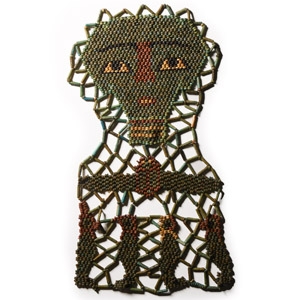
Restrung netted beadwork panel of annular and tubular glazed composition beads in blues, greens, black, cream and red-brown colours, depicting a mummy face-mask with false beard, a scarab with extended wings below, the 'Four Sons of Horus’ beneath the scarab, joined together with areas of open netting of tubular beads; restrung with some later beads. 72 grams, 26 cm
Ex Mariaud de Serres, Paris, France, 1990s. From a London, UK, collection.
The Four Sons of Horus were deities responsible for protecting the internal organs of the deceased. Here, on the left, we can see the jackal-headed Duamutef, who protected the stomach, followed by the falcon-headed Qebehsenuef, protector of the intestines, then the human-headed Imsety, who protected the liver and, finally, the baboon-headed Hapy, protected the lungs, on the right. -
.jpg)
Egyptian Multi-Stranded Mummy Bead Necklace
Late Period, 664-332 B.C.Sold for (Inc. bp): £156
Multi-stranded designer necklace composed of beads of mainly annular and tubular types. 23 grams total, 66 cm long
Acquired before 1979. From the private collection of Mr F. A., South Kensington, London, UK; thence by descent 2014.
For thousands of years, artisans in Egypt created vibrant ceramics to echo the beauty of rare jewels. These ornaments were created with almost every material, colour, and texture imaginable and they come from across Egypt and beyond: vibrant blue lapis lazuli from Afghanistan, glossy black obsidian from Turkey, and aqua-green turquoise from the Sinai. They were worn in life and, after death, they served as precious ornamentation for mummies -
Egyptian Faience Mummy Bead Mask with Netting
Ptolemaic Period, 332-30 B.C.Sold for (Inc. bp): £364
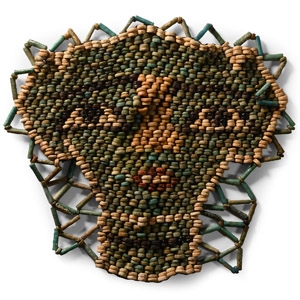
A netted beadwork panel of annular and tubular glazed composition beads in blues, greens, black, cream and red-brown colours, depicting a mummy face-mask with false beard; restrung with some later beads. 52.7 grams, 14.5 cm wide
Ex Mariaud de Serres, Paris, France, 1980-1990s. From a London, UK, collection.
