
Loading, please wait...
LOT 0460
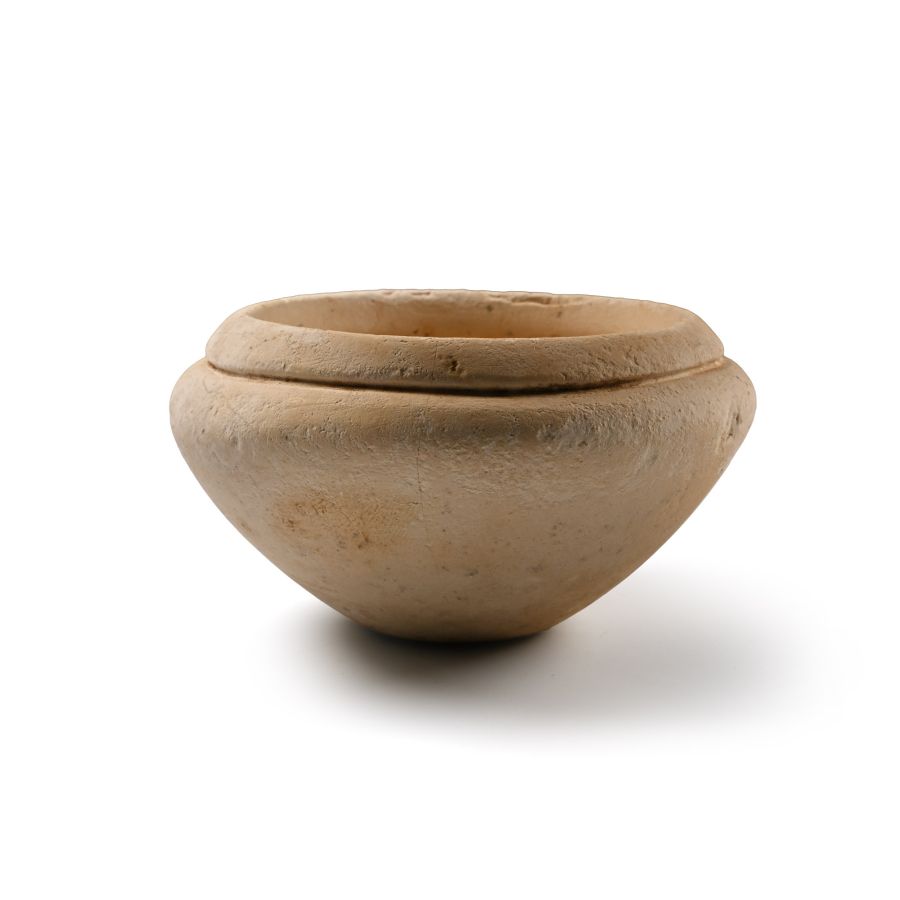
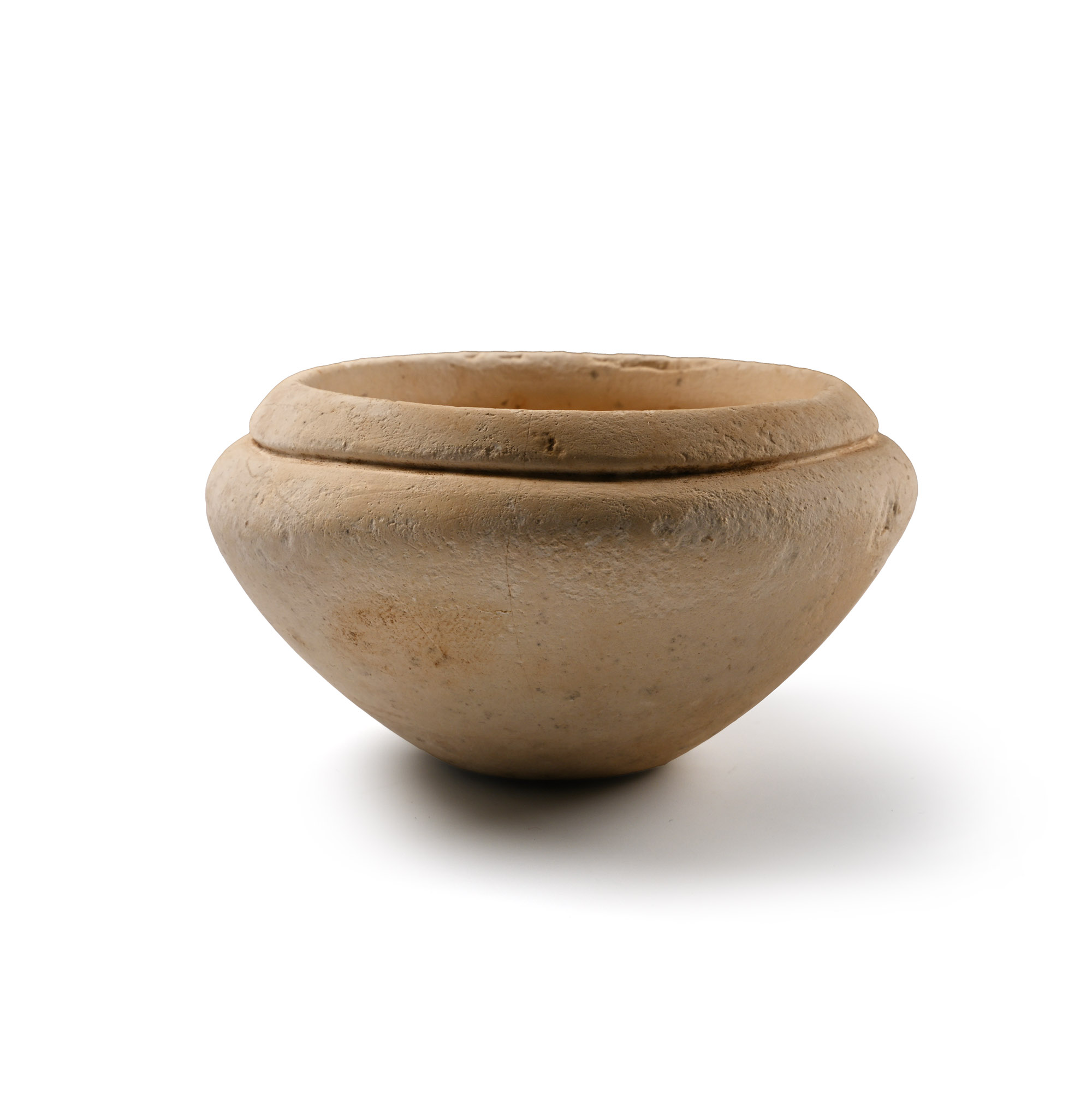
Egyptian Alabaster Bowl with Thickened Rim
3RD MILLENNIUM B.C.
3 1/4 in. (177 grams, 82 mm).
Comprising a squat conical body with narrow foot, groove beneath the thickened rim.
ProvenanceAcquired in the mid 1980s-1990s.
Private collection, Switzerland, thence by descent.
Private collection, since the late 1990s.
This lot is accompanied by an illustrated lot declaration signed by the Head of the Antiquities Department, Dr Raffaele D'Amato.
Cf. El-Khouli, A., Egyptian Stone Vessels: Predynastic Period to Dynasty III, vol.3, London, 1974, pl. 81, no. 2181, for a vessel of similar form.
FootnotesOne of the most prestigious materials the Egyptians extracted was alabaster, more correctly referred to as travertine or calcite-alabaster. From the 1st through 3rd Dynasties, stone vessels were very popular items to include in the burials of pharaohs and nobles. No fewer than 30,000 stone vessels were found in the labyrinthine galleries below Djoser’s Step Pyramid at Saqqara, and Egyptian alabaster was used to make hundreds of those vessels.
CONDITIONTimeLine Auctions follows a vetting process to ensure the authenticity and legality of all items, reinforcing our commitment to integrity and responsible trading. Each antiquity, antique, and coin lot undergoes thorough examination by a vetting committee of at least ten external specialists, professional trade association members, scientists, and archaeologists: Our Vetting Process
AUCTIONS:
TimeLine is a leading auction house specialising in antiquities, ancient art, collectables, natural history, coins, medals, and books. Our auctions offer museums, collectors, historians, and enthusiasts the opportunity to acquire unique and historically significant pieces.
-
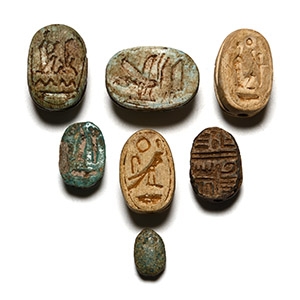
Egyptian Mixed Scarab Collection
2nd-1st millennium B.C.Sold for (Inc. bp): £572
Comprising (from left to right and top to bottom): 1) a scarab with an oval border containing the seated figure of a seated deity with arm raised in adoration before the sign partially resembling the hieroglyphic sign for a ‘thousand’, with the water and signs below; 2) a scarab with a faint oval border containing the honey bee and reed leaf symbols; 3) a scarab with an oval border containing the throne name of the 19th Dynasty pharaoh, Ramesses II (User-Maat-Re) atop a neb sign; 4) a scarab with indeterminate signs; 5) a scarab with an oval border containing the falcon god Ra-Horakhty standing atop a neb sign; 6) a scarab inscribed with numerous geometric designs that incorporate the name Amun-Re; 7) a plain scaraboid. 17.4 grams total, 10-20 mm
From the collection of a gentleman, acquired on the London art market in the 1990s. This lot is accompanied by an illustrated lot declaration signed by the Head of the Antiquities Department, Dr Raffaele D'Amato. -
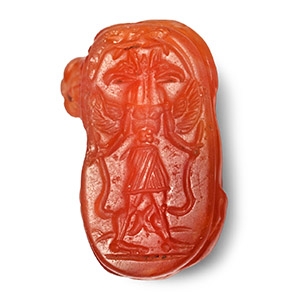
Phoenician Carnelian Scaraboid with Lion
6th-4th century B.C.Sold for (Inc. bp): £2,600
Carved in the half-round as a recumbent lion with head turned, underside with incuse image of a gryphon-headed man holding snakes in his hands. 2.55 grams, 18.65 mm
From the collection of a deceased London gentleman, UK, 1970-1990s. This lot has been checked against the Interpol Database of stolen works of art and is accompanied by a search certificate number no.12636-234419. This lot has been cleared against the Art Loss Register database, and is accompanied by an illustrated lot declaration signed by the Head of the Antiquities Department, Dr Raffaele D'Amato. -
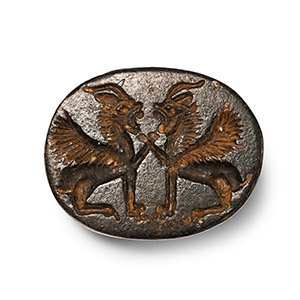
Phoenicio-Egyptian Black Stone Scaraboid with Lions
6th century B.C.Sold for (Inc. bp): £910
With gusset to the sidewall and incuse design to the underside of opposed winged lions each with one forepaw raised. 14.5 grams, 28 mm
Ex collection of the late Mr S. M., London, UK, 1970-1990s. This lot is accompanied by an illustrated lot declaration signed by the Head of the Antiquities Department, Dr Raffaele D'Amato.
Phoenician scarabs with winged lions were often used as guardian figures, much like Mesopotamian lamassu or Egyptian sphinxes. On amulets and seals, they likely served as apotropaic (evil-averting) symbols. In Phoenician and Persian art, hybrid creatures like winged lions reflect a cosmopolitan visual language, blending Egyptian, Assyrian, and Achaemenid motifs. They could symbolise imperial power or transcultural authority. In some cases, winged lions are linked to deities or divine guardianship, especially when shown flanking sacred symbols like trees, thrones, or sun discs.
