
Loading, please wait...
LOT 1082
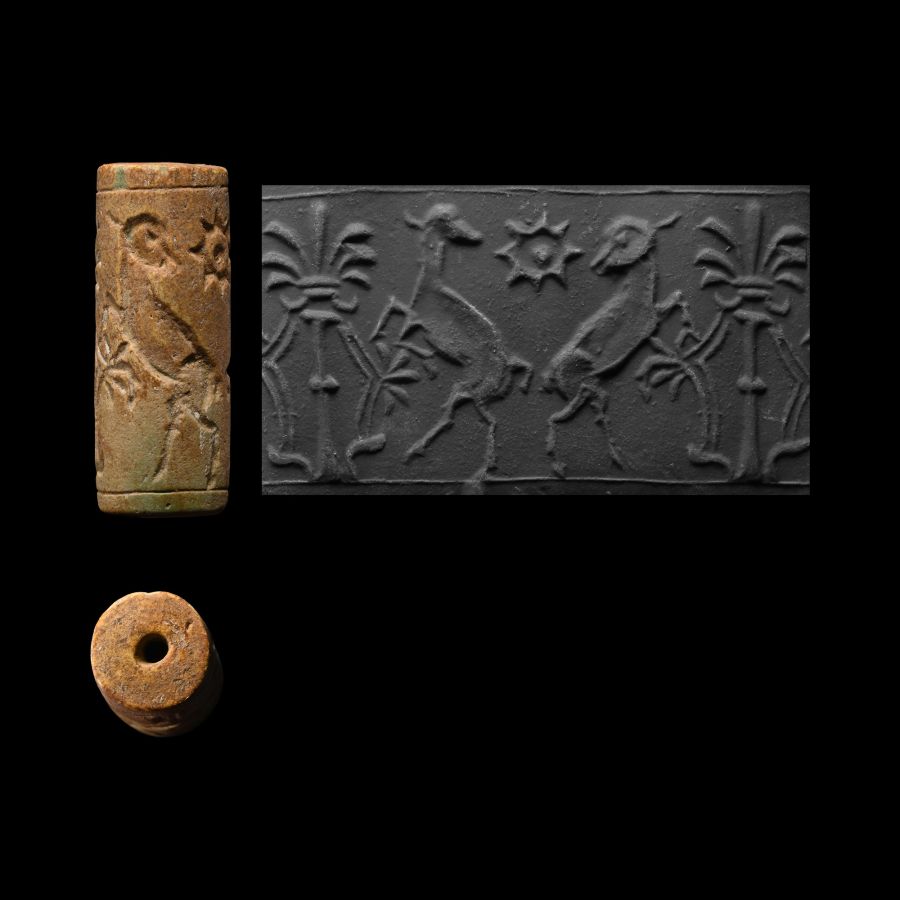
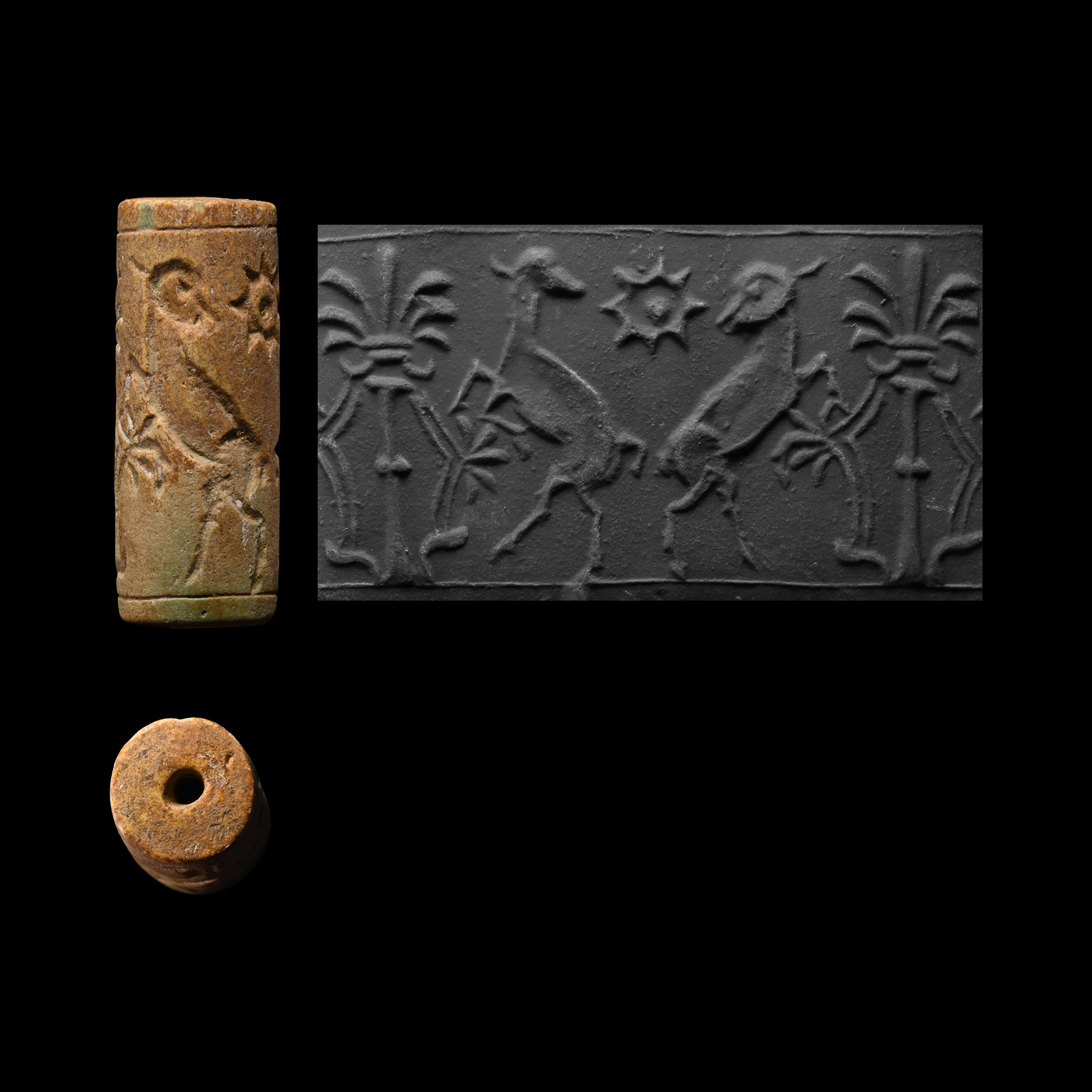
Eastern Syrian Faience Cylinder Seal with Worship Scenes
CIRCA 800-600 B.C.
1 3/8 in. (13.5 grams, 36 mm).
Accompanied by a copy of an old scholarly note, hand written and signed by W.G. Lambert, late Professor of Assyriology, University of Birmingham, 1970-1993, which states: 'Cylinder seal of Green faience, 36x15mm. The design shows a stylized sacred tree and a reared up kid on either side. A stylized solar disc serves as a terminal. This seal is to be dated c. 800-600 B.C. and comes from Mesopotamia or Eastern Syria. For faience it is a large seal in good condition.'; supplied with a museum-quality impression.
ProvenanceFrom the private collection of a North American lady, formed 1970s-early 1990s, with collection reference no.P38.
Accompanied by a copy of a scholarly note, hand written and signed by Professor Wilfrid George Lambert dated December 1990.
This lot has been cleared against the Art Loss Register database, and is accompanied by an illustrated lot declaration signed by the Head of the Antiquities Department, Dr Raffaele D'Amato.
TimeLine Auctions follows a vetting process to ensure the authenticity and legality of all items, reinforcing our commitment to integrity and responsible trading. Each antiquity, antique, and coin lot undergoes thorough examination by a vetting committee of at least ten external specialists, professional trade association members, scientists, and archaeologists: Our Vetting Process
AUCTIONS:
TimeLine is a leading auction house specialising in antiquities, ancient art, collectables, natural history, coins, medals, and books. Our auctions offer museums, collectors, historians, and enthusiasts the opportunity to acquire unique and historically significant pieces.
LOT 1082
Eastern Syrian Faience Cylinder Seal with Worship Scenes
Sold for (Inc. bp): £650
-
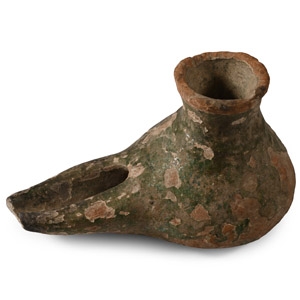
Western Asiatic Green Glazed Oil Lamp
12th-13th century A.D.Sold for (Inc. bp): £65
Rounded body with a long U-shaped nozzle and a wide neck. 267 grams, 13.5 cm
Acquired from older English collections via the UK art market since the mid 1970s. From the private collection of Peran Dachinger, thence by descent. From the family collection of a Maida Vale lady, UK. This lot has been cleared against the Art Loss Register database, and is accompanied by an illustrated lot declaration signed by the Head of the Antiquities Department, Dr Raffaele D'Amato. -
.jpg)
Achaemenid Silver Bowl with Royal Egyptian Inscription for Darius the Great
6th-5th century B.C.Sold for (Inc. bp): £13,000
Bowl fragment including section of the carinated rim, radiating repoussé teardrop bosses with interstitial lotus-flowers motifs and radiating rosette motif below; incised Egyptian hieroglyphic legend below the rim transliterated as 'ı͗nṯry(p sic )wš pr-ꜤꜢ pꜢ ꜤꜢ' (Darius, the Great Pharaoh); mounted on a custom-made stand. 1.23 kg total, 26.7 cm wide including stand
Previously in the private collection of Mr S.A, acquired on the London art market in the 1960s. Accompanied by a copy of a previous illustrated three page cataloguing/report. Accompanied by a copy of an IADAA Interpol search certificate. This lot has been checked against the Interpol Database of stolen works of art and is accompanied by a search certificate number no.12709-235450. This lot has been cleared against the Art Loss Register database, and is accompanied by an illustrated lot declaration signed by the Head of the Antiquities Department, Dr Raffaele D'Amato.
Egyptologist Paul Whelan writes: "The inscription reads: ı͗nṯry(p sic )wš pr-ꜤꜢ pꜢ ꜤꜢ (Darius, the Great Pharaoh). The ancient Egyptians encountered difficulties in rendering the name Darius in hieroglyphs, with at least seventeen known variants. This version differs slightly from those, as it also includes an erroneous ‘p’ hieroglyph. The presence of several cuneiform signs following the hieroglyphs indicates that the phiale likely once featured multilingual versions of the inscription - a practice more commonly found on stone vessels. The epithet ‘the Great Pharaoh’ on this fragment represents one of the earliest examples, appearing more frequently in inscriptions from the reign of Xerxes." A hieroglyphic inscription on an Achaemenid item is very rare, although examples on stone vessels are known. Darius I 'the Great' ruled from 522 to 486 B.C. His predecessor, Cambyses II, conquered Egypt in 525 B.C. and the presence of this inscription is probably linked to the subsequent rule of the dynasty over Egypt and its influence on the Egyptian priestly caste. -
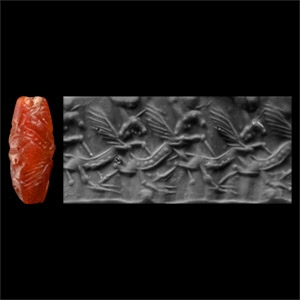
Neo-Babylonian Carnelian Cylinder Seal with Two Winged Quadrupeds
Circa 900-750 B.C.Sold for (Inc. bp): £520
Cylinder with cord and bead handles; accompanied by a copy of an old scholarly note, typed and signed by W.G. Lambert, late Professor of Assyriology, University of Birmingham, 1970-1993, which states: 'Cylinder Seal of Carnelian 19 x 8.5 mm, The scene shows two winged quadrupeds in a frieze. Each has the body of a bull, but with wings. Each is running and the front part of the body is reared up, overlapping the one in front. It is meant as a scene of one animal chasing the other. The seal is engraved mainly with the cutting wheel, but there are dots along the animals' bodies and at other points down with the drill. The seal is convex in shape, like a bead. This is a seal in the Neo-Babylonian style, c. 900-750 B.C., though examples have been found both in Babylonia and in south-west Iran. It is in very good condition and is an attractive piece.'; supplied with a museum-quality impression. 3.18 grams, 19 mm
UK private collection, acquired 1980-1983. Accompanied by a copy of a scholarly note, typed and signed by Professor Wilfrid George Lambert in May 1992. This lot has been cleared against the Art Loss Register database, and is accompanied by an illustrated lot declaration signed by the Head of the Antiquities Department, Dr Raffaele D'Amato.
