
Loading, please wait...
LOT 0115
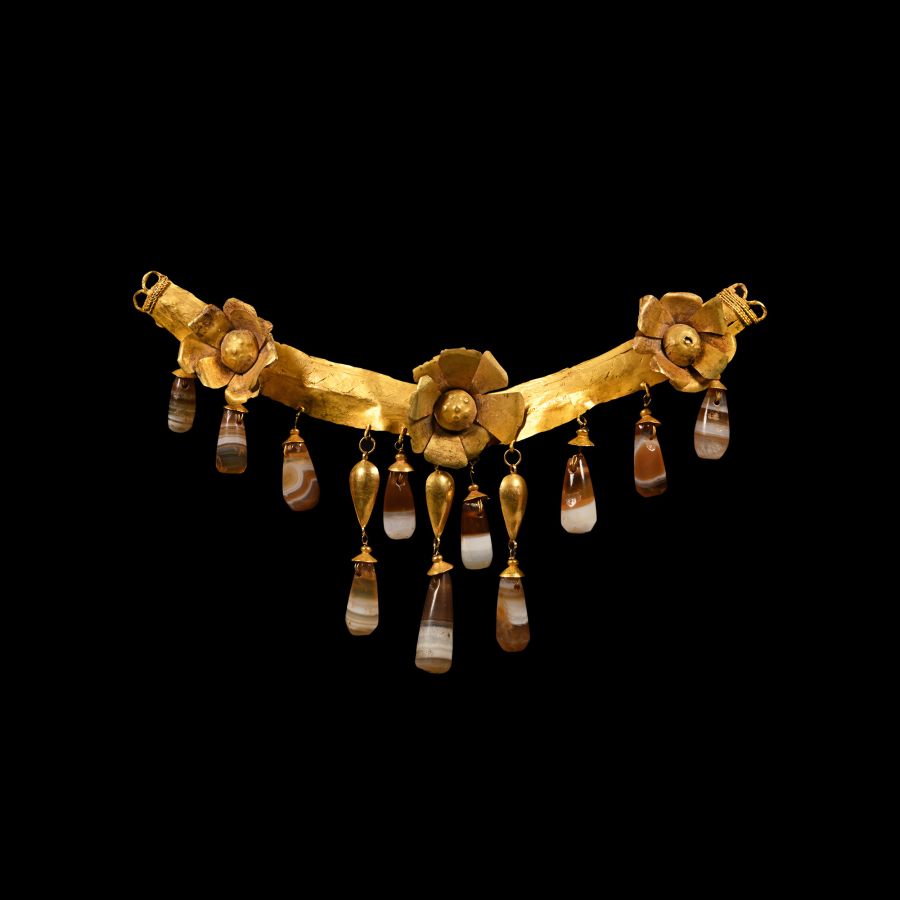
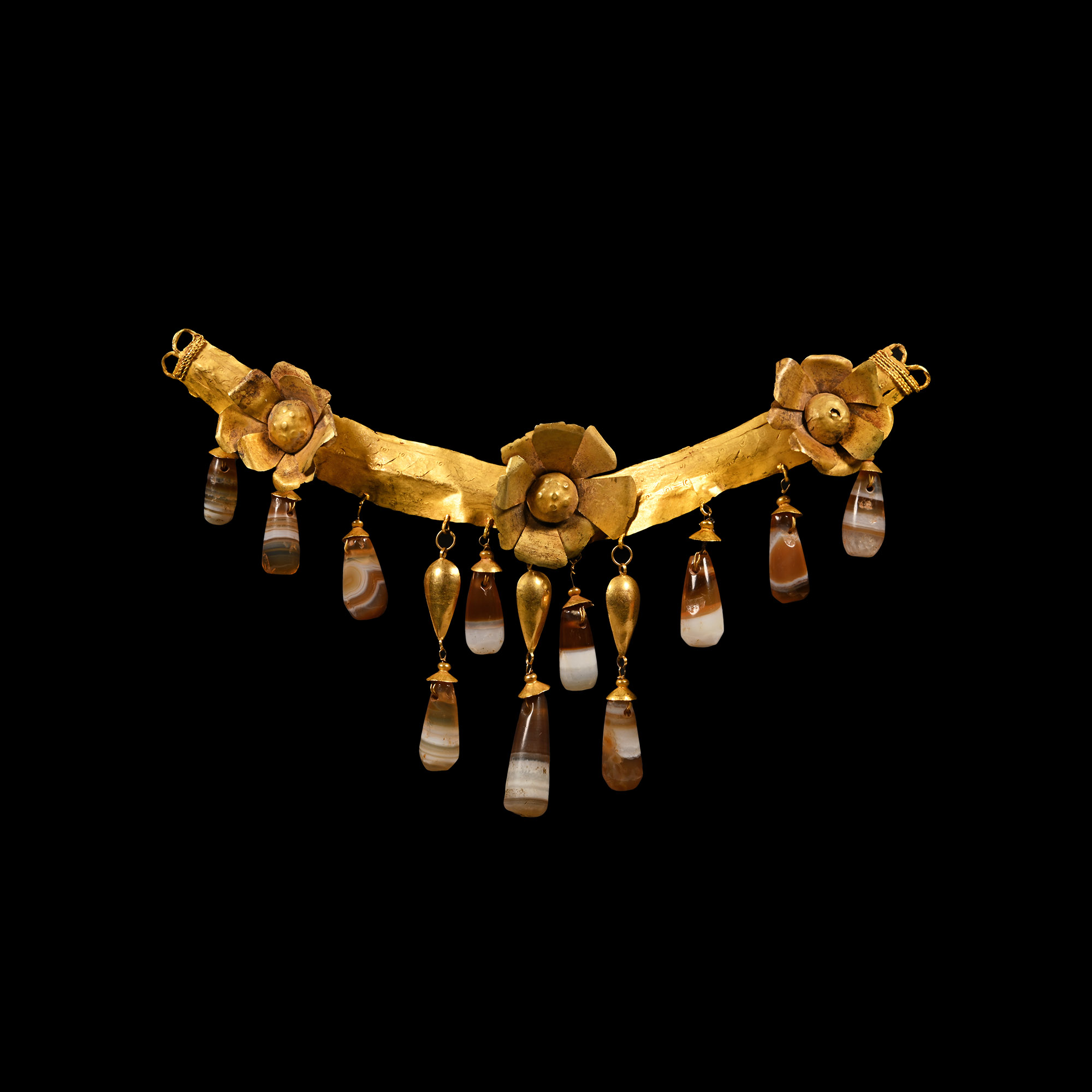
Eastern Greek Gold Necklace Element with Agate Drops
CIRCA 3RD CENTURY B.C.
6 in. (33.84 grams, 15.2 cm).
Crescentic frontal panel from a necklace or collar; sheet gold band with slight carination, lightly incised leaf and berry detailing; applied filigree band to each end with double-loop attachment points; three applied foil rosettes; eleven banded agate dangles to the lower edge with sheet gold suspension; a marriage of ancient parts.
ProvenanceAcquired in the mid 1980s-1990s.
Private collection, Switzerland, thence by descent.
Private collection, since the late 1990s.
Accompanied by an academic report by Dr Raffaele D’Amato.
This lot has been checked against the Interpol Database of stolen works of art and is accompanied by a search certificate number no.12591-232174.
This lot has been cleared against the Art Loss Register database, and is accompanied by an illustrated lot declaration signed by the Head of the Antiquities Department, Dr Raffaele D'Amato.
Cf. Williams, D. and Ogden, J., Greek Gold, Jewelry of the Classical World, MMA, 1994, item 67, for similar rosettes with filigree; Despini, A., Ancient Gold Jewellery, Athens, 1996, no.12, p.57, for a diadem with applied rosettes of c.700 B.C.; cf. also Ogden, J., Gold Jewellery in Ptolemaic, Roman and Byzantine Egypt, Durham, 1990, II Vol., fig.395, for a gold crescentic band ornamented with applied rosettes.
FootnotesRosettes were one of the most desired decorations on jewellery. Diadems with rosettes are attested from the archaic period onwards. One of the rosette types was the so-called flower-head from Madytos, which most closely resembled the common wild or dog rose. The rose was, of course, much prized in ancient times for its wonderful scent and as the favoured flower of Aphrodite, the goddess of love: the lyric poet Anakreon called it ‘the perfume of gods, the joy of men’.
CONDITIONTimeLine Auctions follows a vetting process to ensure the authenticity and legality of all items, reinforcing our commitment to integrity and responsible trading. Each antiquity, antique, and coin lot undergoes thorough examination by a vetting committee of at least ten external specialists, professional trade association members, scientists, and archaeologists: Our Vetting Process
AUCTIONS:
TimeLine is a leading auction house specialising in antiquities, ancient art, collectables, natural history, coins, medals, and books. Our auctions offer museums, collectors, historians, and enthusiasts the opportunity to acquire unique and historically significant pieces.
-
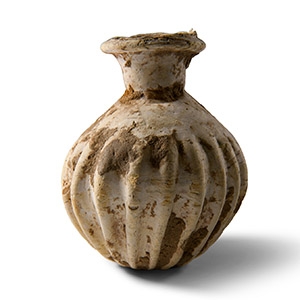
Greek Cream Frit Ribbed Bottle
4th-2nd century B.C.Sold for (Inc. bp): £104
Opaque with vertical ribbing around the globular body, trumpet-style neck and mouth with rolled rim. 76 grams, 73 mm high
Acquired early 1990s. Ex private American collection; thence by descent. Private collection since 1998. This lot is accompanied by an illustrated lot declaration signed by the Head of the Antiquities Department, Dr Raffaele D'Amato. -
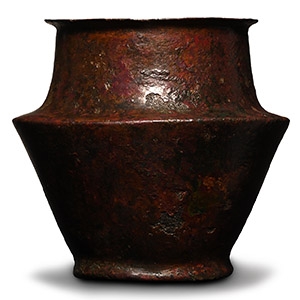
Greek Bronze Cup
5th-4th century B.C.Sold for (Inc. bp): £211
With pronounced shoulder and narrow foot. 154 grams, 80 mm
Acquired in the 1990s. Ex Abelita family collection. This lot is accompanied by an illustrated lot declaration signed by the Head of the Antiquities Department, Dr Raffaele D'Amato. -
.jpg)
Monumental Villanovan Impasto Kyathos
7th century B.C.Estimate: £4,000 - 6,000 (‡+bp*)
Opening Bid: £2,000
Fluted body tapering to a narrow foot, the shoulders decorated with tiered bosses, short neck with flared mouth; wide handle perforated with a triangle. 1.18 kg, 25 cm wide
Estate of Mr Bruno Fellinger (1926-2016), Küsnacht, Switzerland. with Galerie Rhéa, Zurich, Switzerland. This lot has been checked against the Interpol Database of stolen works of art and is accompanied by a search certificate number no.12648-236390. This lot has been cleared against the Art Loss Register database, and is accompanied by an illustrated lot declaration signed by the Head of the Antiquities Department, Dr Raffaele D'Amato.
