
Loading, please wait...
LOT 0321
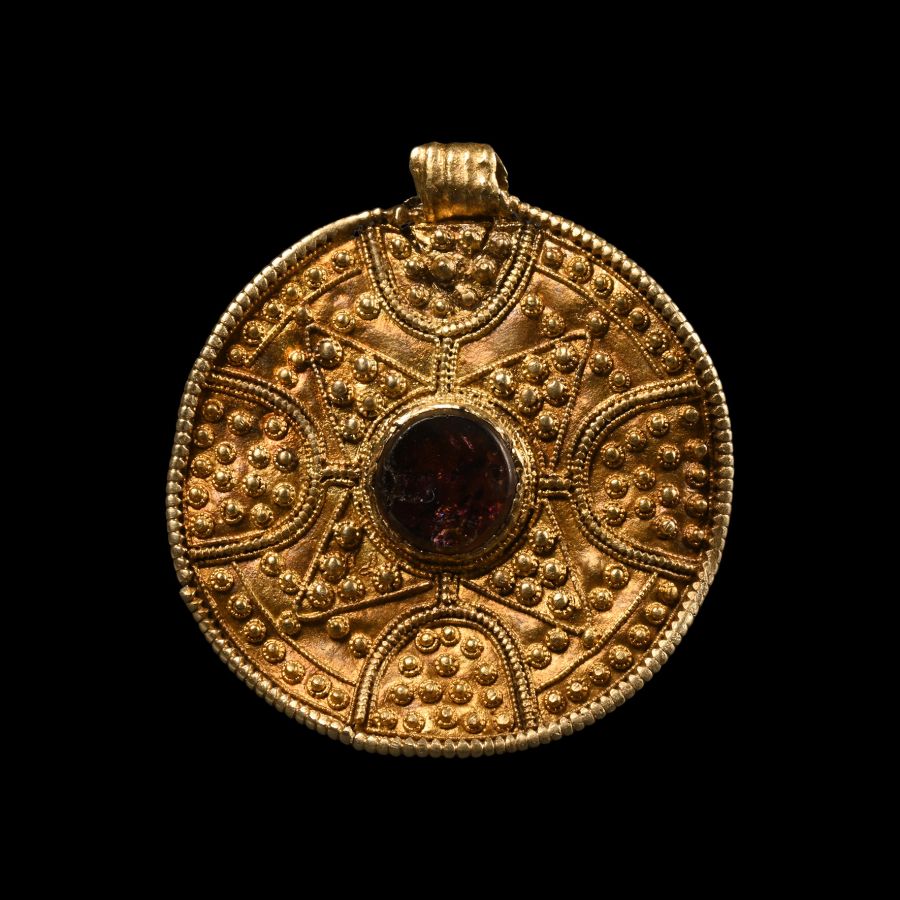
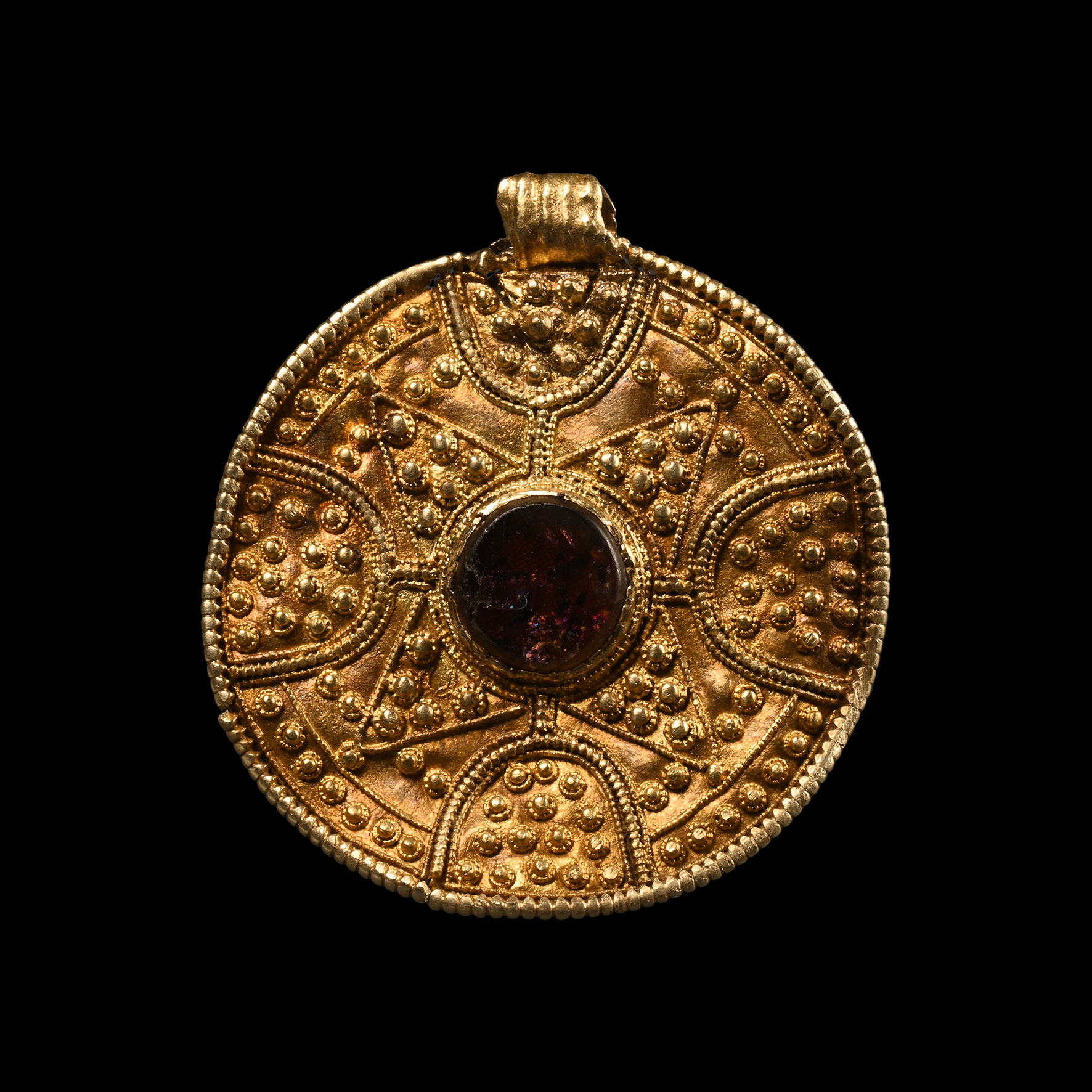
Early Saxon Gold Disc Pendant of Possibly Christian Design
7TH CENTURY A.D.
1 3/8 in. (5.39 grams, 34 mm).
Gusseted suspension loop, beaded-wire border, inset polished garnet at centre of cruciform and quatrefoil design in filigree and granulated ornament; held in a membranous display frame, the prominent cruciform design may well imply a Christian significance at this early date in
the history of Christianity.
Acquired 1990s-early 2000s.
East Anglian private collection.
This lot has been checked against the Interpol Database of stolen works of art and is accompanied by search certificate no.201092.
Cf. MacGregor, A. et al., A Summary Catalogue of the Continental Archaeological Collections, Oxford, 1997, item 24.4; British Museum, accession number 1893,0601.202; cf. The Metropolitan Museum, New York, accession number 1987.90.2, for similar.
CONDITIONTimeLine Auctions follows a vetting process to ensure the authenticity and legality of all items, reinforcing our commitment to integrity and responsible trading. Each antiquity, antique, and coin lot undergoes thorough examination by a vetting committee of at least ten external specialists, professional trade association members, scientists, and archaeologists: Our Vetting Process
AUCTIONS:
TimeLine is a leading auction house specialising in antiquities, ancient art, collectables, natural history, coins, medals, and books. Our auctions offer museums, collectors, historians, and enthusiasts the opportunity to acquire unique and historically significant pieces.
LOT 0321
Early Saxon Gold Disc Pendant of Possibly Christian Design
Estimate £3,500 - 4,500€4,060 - 5,220 (for guidance only)$4,730 - 6,080 (for guidance only)
-
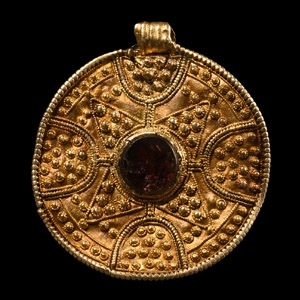
Early Saxon Gold Disc Pendant of Possibly Christian Design
7th century A.D.Estimate: £3,500 - 4,500 (+bp*)
Opening Bid: £1,400
Gusseted suspension loop, beaded-wire border, inset polished garnet at centre of cruciform and quatrefoil design in filigree and granulated ornament; held in a membranous display frame, the prominent cruciform design may well imply a Christian significance at this early date in the history of Christianity. 5.39 grams, 34 mm
Acquired 1990s-early 2000s. East Anglian private collection. This lot has been checked against the Interpol Database of stolen works of art and is accompanied by search certificate no.201092. -
.jpg)
Anglo-Saxon Bronze Strap End with Rivetted Silver Plate with Beast Facing Back
9th century A.D.Sold for (Inc. bp): £598
Of Thomas's Class A, rectangular with convex sides and slit at one end to accept the leather or fabric of the belt or strap; applied sheet silver panel attached with four silver rivets, bearing a Trewhiddle Style regardant beast with its tail looped over its rump; remains of an animal-mask finial beside the panel; reverse marked with PAS reference KENT-112CEC. 5.59 grams, 37 mm
Fine condition.
Found while searching with a metal detector near Romney, Folkestone and Hythe, Kent, UK, in 2018. Accompanied by a copy of the British Museum's Portable Antiquities Scheme (PAS) report no.KENT-112CEC. Disclaimed under treasure reference no.2018T664. -
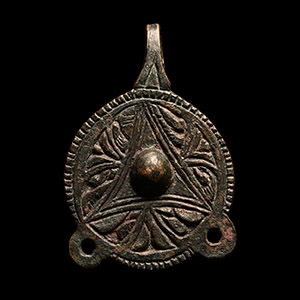
Anglo-Saxon Bronze Clothes Fastener
9th century A.D.Sold for (Inc. bp): £130
Featuring two pierced lugs, recurved garment hook, beaded border, central boss on triangular panel with zoomorphic elements around. 19 grams, 52 mm
Found Norfolk, UK. Ex property of a UK gentleman.
