
Loading, please wait...
LOT 0260
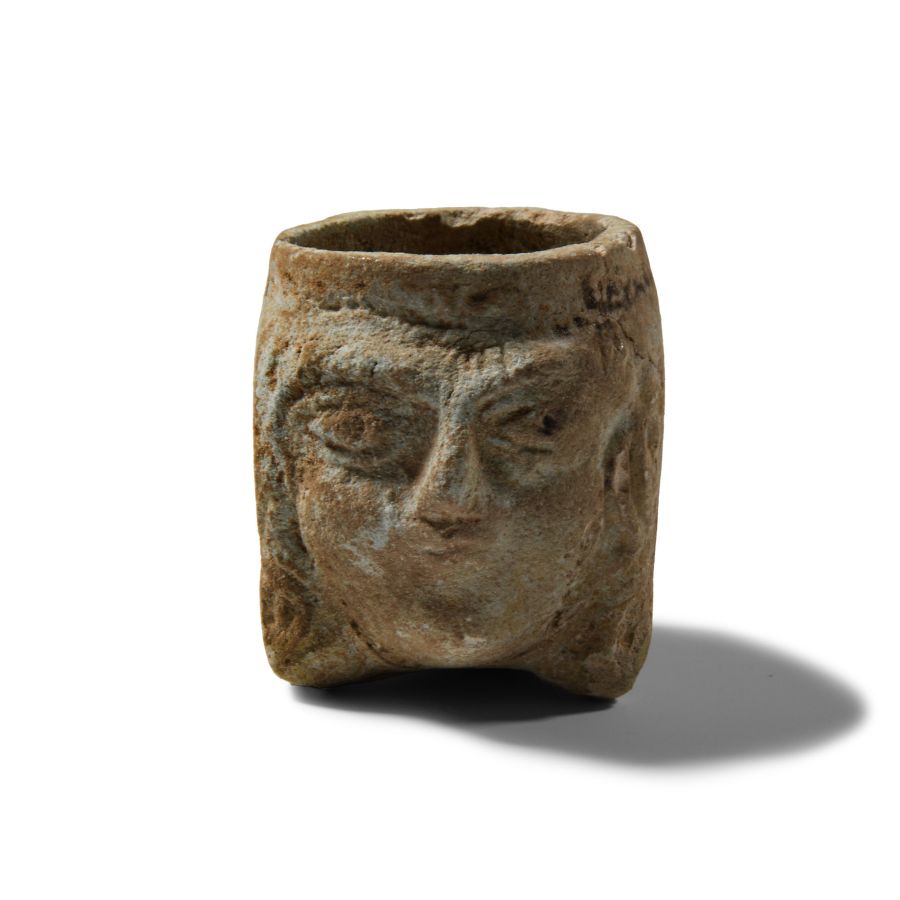
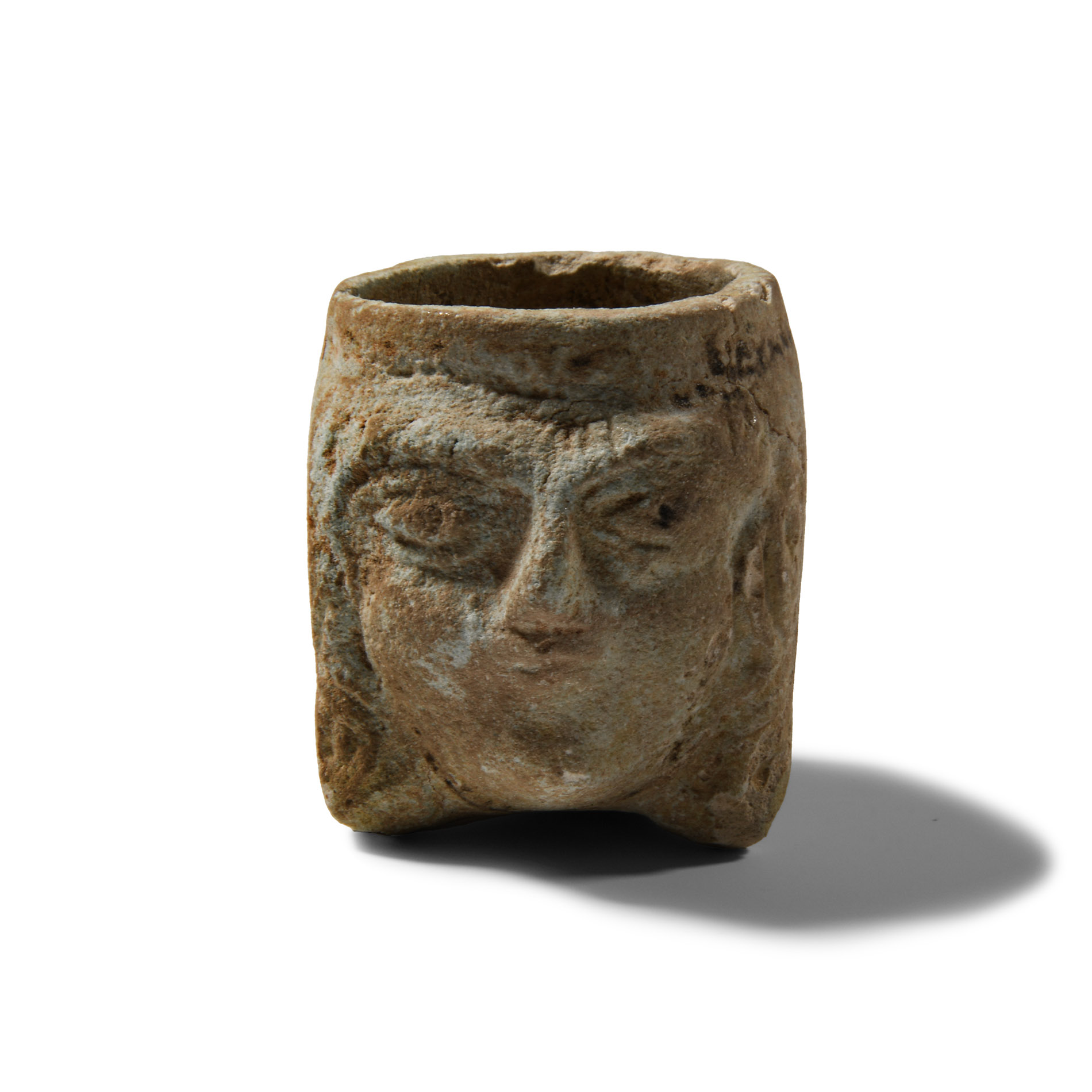
Early Parthian Faience Face Cup
1ST MILLENNIUM B.C.
2 3/8 in. (71 grams, 60 mm).
Formed as a small circular vessel, the frontal part shaped as a female face, with well-defined nose, eyes and mouth, long hair on the sides framing the face, traces of colour still present on the upper edge.
ProvenanceCollected from 1969-1999.
From the collection of the late Mr S.M., London, UK.
Cf. a similar style of head in Aruz, J., Seymour, M., Assyria to Iberia, Art and Culture in the Iron Age, p.58, fig.5.
FootnotesFaience objects have been discovered in great numbers at various Middle Assyrian and later sites, including the capitals, provincial and administrative centres as well as small settlements. Functionally, the faience objects can be assigned to a variety of categories, among which vessels, fragments thereof, and jewellery are the most numerous. The vessels are predominantly open-shaped, such as bowls and cups, but miniature bottles, beakers and other types of vessels were also found. Our small cup was probably intended for female toilette usage.
CONDITIONTimeLine Auctions follows a vetting process to ensure the authenticity and legality of all items, reinforcing our commitment to integrity and responsible trading. Each antiquity, antique, and coin lot undergoes thorough examination by a vetting committee of at least ten external specialists, professional trade association members, scientists, and archaeologists: Our Vetting Process
AUCTIONS:
TimeLine is a leading auction house specialising in antiquities, ancient art, collectables, natural history, coins, medals, and books. Our auctions offer museums, collectors, historians, and enthusiasts the opportunity to acquire unique and historically significant pieces.
LOT 0260
Early Parthian Faience Face Cup
Estimate £800 - 1,000€930 - 1,160 (for guidance only)$1,080 - 1,350 (for guidance only)
-
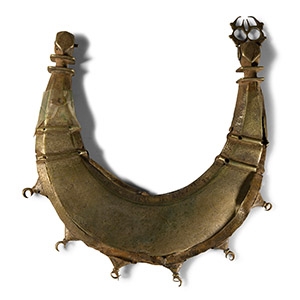
Seljuk Silver Inscribed Pectoral
11th-12th century A.D.Sold for (Inc. bp): £338
Crescent-shaped with balustered finials; openwork reverse with intricate knot and foliate design, six loops on the lower edge; the obverse with chased knot and foliate design with an inscription to the upper and lower edge. 174 grams, 17.5 cm
with a London, UK gallery 1971-early 2000s. -
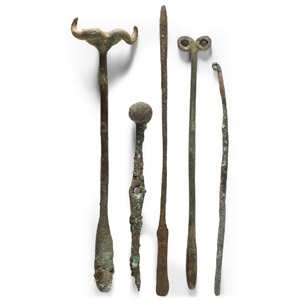
Luristan Bronze Implement Collection
Bronze Age, 13th-7th century B.C.Sold for (Inc. bp): £59
Including a net-needle with pierced centre and ball finial, applicator with bull's head finial, dress-pin with scrolled finial and other items. 47 grams total, 8.5-12.5 cm
From a collection acquired on the UK art market from various auction houses and collections mostly before 2000. From an important Cambridgeshire estate; thence by descent. -
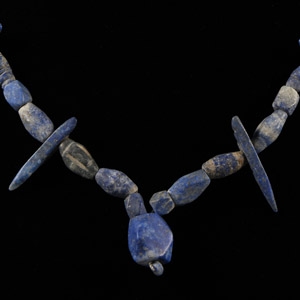
Bactrian Style Lapis Lazuli Bead Necklace
20th century A.D.Sold for (Inc. bp): £72
Mainly tubular, square-section and fusiform types. 30 grams, 41 cm
Acquired 1980-2015. Ex Abelita family collection.
