
Loading, please wait...
LOT 0246
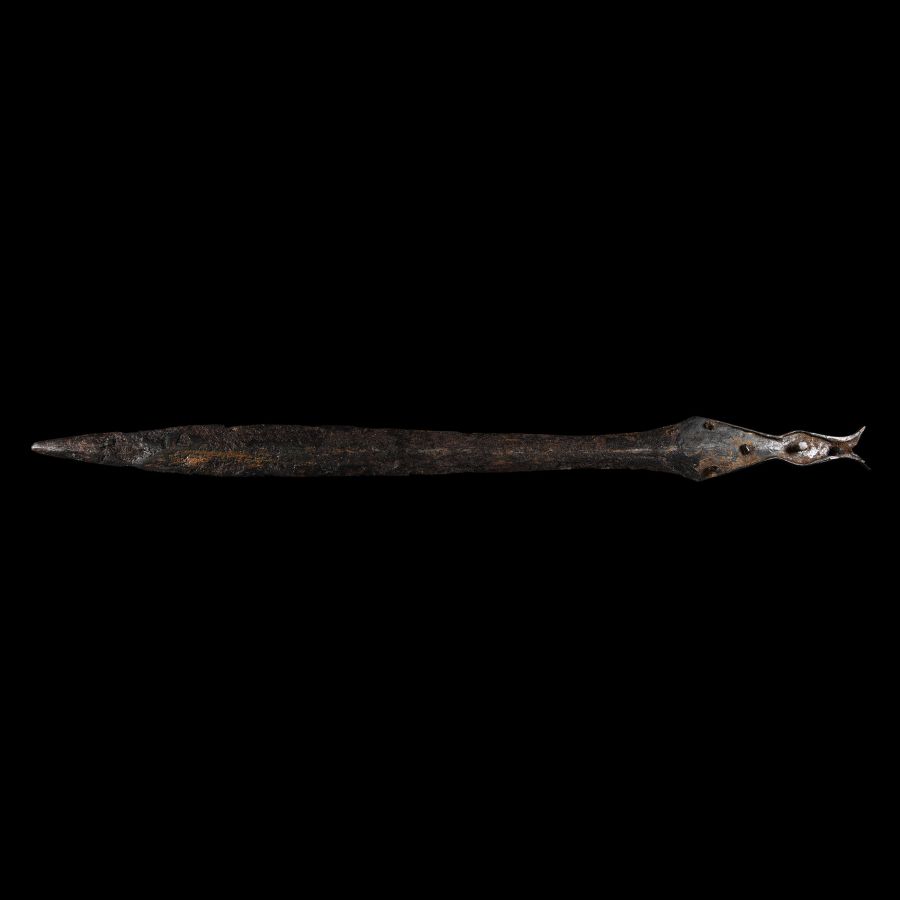
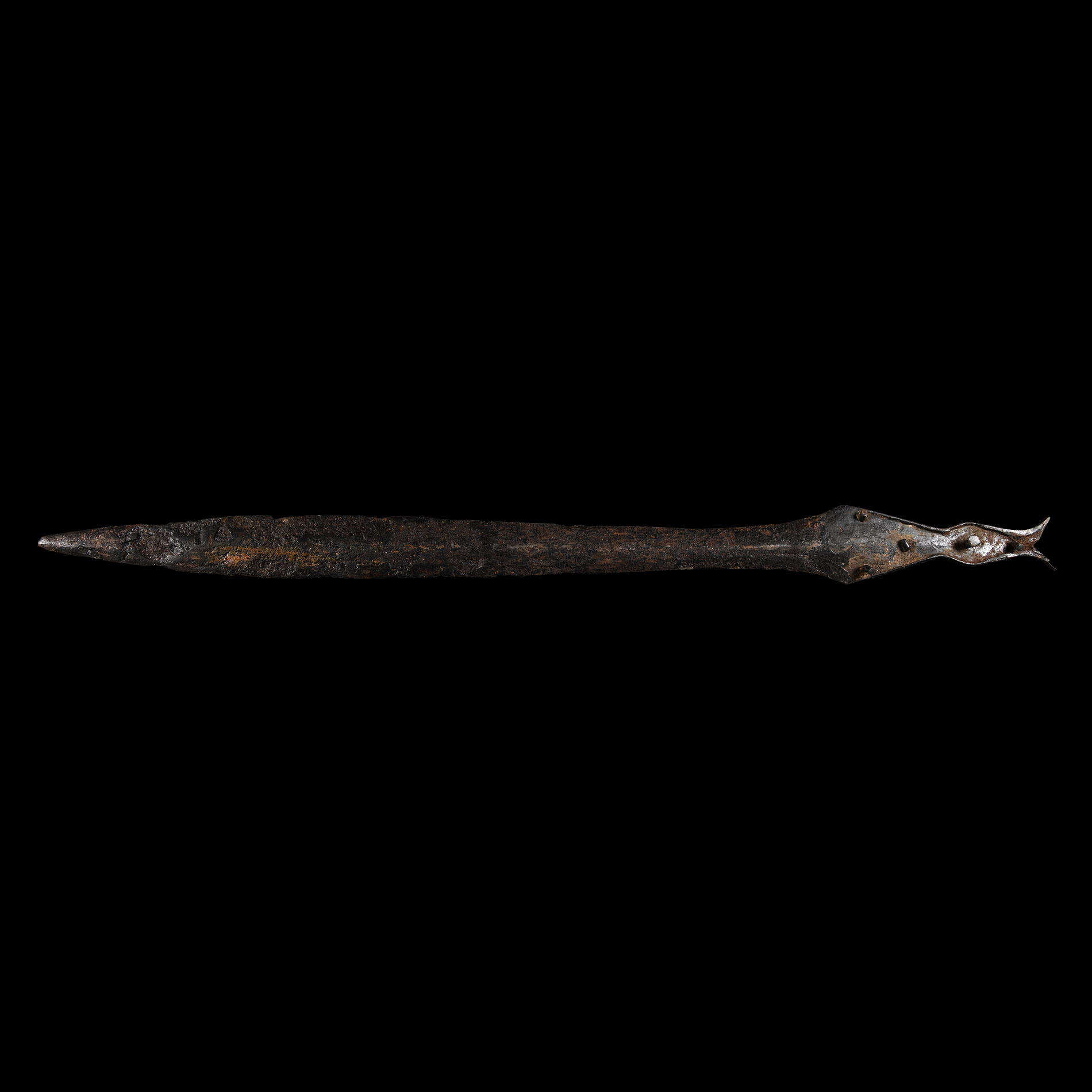
Early Iron Age 'Griffzungenschwert' Sword
10TH-9TH CENTURY B.C.
17 1/8 in. (245 grams, 43.5 cm).
Of Naue II Type, with broad flattened midrib to both faces of the iron blade, the blade gently broadening below the tip, serrated edges at the base, flanged rivetted guard and hilt for the insertion of the organic handle and rhomboid-section grip.
ProvenanceAcquired 1960s-1990s.
Late Alison Barker collection, a retired London barrister.
See D'Amato, R., Salimbeti, A., Early Iron Age Greek Warrior 1100-700 BC, Oxford, 2016, p.24, nos.G,L, for similar short swords of group A from the Aegean area; see also Kilian-Dirlmeier, I., Die Schwerter in Griechenland (außerhalb der Peloponnes), Bulgarien und Albanen, Stuttgart, 1993, no.291, from Archanes.
FootnotesThe Naue II, also known as the grip-tongue sword, was one of the longest lasting of all sword types. First appearing in the late Bronze Age it lasted well into the Iron Age, a span of 500-700 years, and it was made both in bronze and iron. As early as 1450 B.C., in northern Italy, smiths came up with an early type of a sword now known as the Naue II. It spread first into central Europe, Scandinavia and the British Isles. By 1200 B.C. it had spread to Greece, Crete, the Aegean Islands, the Levant, Palestine and Egypt. It was quite popular in Greece and the Aegean, but it is in Central Europe that the greatest number has been found. In all these areas it was the standard sword until the 7th century B.C. with iron replacing bronze, but still the same basic design.
CONDITIONTimeLine Auctions follows a vetting process to ensure the authenticity and legality of all items, reinforcing our commitment to integrity and responsible trading. Each antiquity, antique, and coin lot undergoes thorough examination by a vetting committee of at least ten external specialists, professional trade association members, scientists, and archaeologists: Our Vetting Process
AUCTIONS:
TimeLine is a leading auction house specialising in antiquities, ancient art, collectables, natural history, coins, medals, and books. Our auctions offer museums, collectors, historians, and enthusiasts the opportunity to acquire unique and historically significant pieces.
-
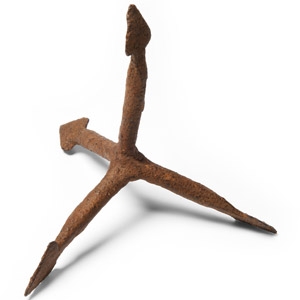
Roman Iron Anti-Cavalry Caltrop
3rd-4th century A.D. or laterSold for (Inc. bp): £195
Composed of four arms tipped with triangular spikes. 29 grams, 86 mm
Acquired on the German art market around 2000. From the collection of Surrey, UK, gentleman.
Caltrops were scattered on battlefields in an effort to stop or slow advancing enemy cavalry or foot soldiers; regardless of how a caltrop lands, one spike is always facing upwards. Caesar used widely them at Alesia (Caes., BG 7.73; 82): 'Stakes a foot long, with iron hooks attached to them, were entirely sunk in the ground before these, and were planted in every place at small intervals; these they called spurs'. -
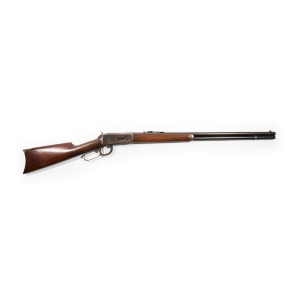
Winchester Repeating Rifle
19th century A.D.Sold for (Inc. bp): £2,600
Lever action 32/40 calibre Model 1894 with 66cm (26") round rifled barrel with buckhorn sights and full length tubular magazine; two piece wood stock with steel butt plate and fore-end; serial No. 446786 to underside of action, model, calibre and other details stamped; action working crisply. 3.55 kg, 113 cm
40 1/2 in.
Acquired from M J Noble Ltd, UK, 2015. The Kusmirek Collection, UK. Accompanied by copies of invoice and listing and original NI Police Service Certificate.
Sold as an exempt item under Section 58 (2) of the Firearms Act, 1968, to be held as a curiosity or ornament. No license required but buyer must be over 18 years of age. Overseas bidders should note that, due to UK regulations governing export of all firearms, overseas buyers will need to make arrangements for shipping this lot out of the UK directly, by air freight, with a specialist company or agent. -
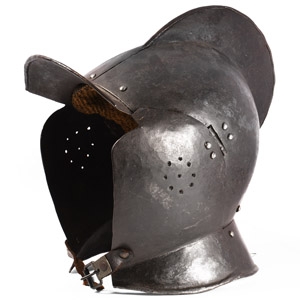
South German Burgonet Helm
Circa 1580-1610 A.D.Sold for (Inc. bp): £2,340
The rounded two-piece skull joined along the crest with a high medial comb, internally fitted with a quilted canvas lining sewn to a leather lining-band, the brow with a fixed rounded peak, outward-flanged rear edge with a matching one-piece neck guard, hinged cheek-pieces flanged outwards at the lower edge to serve as a continuation of the neck-guard. 1.7 kg, 29 cm
with Thomas Del Mar Ltd, 7th December 2017, lot 542. The Kusmirek Collection, UK. Accompanied by a copy of the Thomas Del Mar invoice. Accompanied by an academic report by Dr Raffaele D'Amato. This lot has been checked against the Interpol Database of stolen works of art and is accompanied by search certificate number no.11762-203983.
The burgonet (Italian borgognotta) had developed at the beginning of the 16th century from the sallet and soon became a very popular helmet worn in many parts of Europe (especially in Germany and Northern Italy) by infantry and later cavalry units. A clear advantage of this helmet was the unifying a good protective function against cut and thrust weapons with a unhindered field of sight, good ventilation and user comfort due to the small weight and the fact it could be worn independently without an armour.
