
Loading, please wait...
_900x900.jpg "Early Dynastic Cylinder Seal with Worshipping Parade")
_200x200.jpg "Early Dynastic Cylinder Seal with Worshipping Parade")
.jpg "Early Dynastic Cylinder Seal with Worshipping Parade")
LOT 0211
Early Dynastic Cylinder Seal with Worshipping Parade
CIRCA 2550-2350 B.C.
1 1/4 in. (5.26 grams, 32 mm).
Haematite cylinder seal featuring two horizontal registers with worshipping parades comprising long-robed male priests wearing ankle-length garments, seated on the stool-shaped throne, elegantly raising their left hands to hold a cup; other male priests in long garments either holding a vessel containing holy water or oil, or standing in a solemn gesture with hands raised or clasped in front of their chests.
ProvenanceAcquired in the 1990s.
Ex West London family collection.
Property of a Bristol, UK, gentleman.
Iconographies and religious scenes seen on Early Dynastic seals are renowned for the further elaborations that depict contesting scenes, usually portraying nude heroes confronting bull-men or rampant, roaring lions. However, animals and heroes were not employed as the favourite motifs during the last part of the Early Dynastic period. Increased popularity of funerary art and banquets were richly practised in Ur, given an ample amount of royal cylinder seals that bear banquet or seated-king related scenes. On Early Dynastic cylinder seals, the image of a seated male figure holding a cup cannot always be interpreted with an extender divinity. It might have suggested a ruler's identity within a royal banquet scene. However, on this seal, the holy vessel and the representations of male worshippers indicate a clear religious significance. Within the traditional Mesopotamian religion, secular kings would have obtained divine power if they had engaged with the goddess Inanna during a sacred marriage. The cup, containing holy ointment or oil, held in the king's hand, might have been as an emblem to signify the elevated rank of a deified king. It might also have been used as an alternative religious practice, connecting the secular authority and the divine power during the Early Dynastic period.
CONDITIONTimeLine Auctions follows a vetting process to ensure the authenticity and legality of all items, reinforcing our commitment to integrity and responsible trading. Each antiquity, antique, and coin lot undergoes thorough examination by a vetting committee of at least ten external specialists, professional trade association members, scientists, and archaeologists: Our Vetting Process
AUCTIONS:
TimeLine is a leading auction house specialising in antiquities, ancient art, collectables, natural history, coins, medals, and books. Our auctions offer museums, collectors, historians, and enthusiasts the opportunity to acquire unique and historically significant pieces.
-
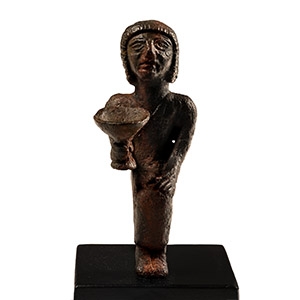
Phoenician Bronze Seated Figure Holding an Offering Cup
Circa 6th century B.C.Sold for (Inc. bp): £1,040
Modelled in the round with tight-fitting robe and carefully detailed tiered hairstyle; right hand raised to support a chalice; peg beneath the feet; mounted on a custom-made display stand. 301 grams total, 11 cm including stand
Acquired on the French art market. From a collection acquired on the UK art market from various auction houses and collections mostly before 2000. From an important Cambridgeshire estate; thence by descent.
Iberian statuettes from 6th century B.C. were produced under the influence of Greeks and Phoenicians. Small votive offerings of priests, priestesses, and deities in bronze, were found everywhere in Spain. The body of these figurines is often reduced to a rectangular plaque, but the head, as in all these types, is of plastic work, a process which reminds the prehistoric terracottas from the Argive Heraeum and elsewhere. The curve of the nose, which gives the face a Semitic appearance, is not accidental, and underlines the Phoenician influence. -
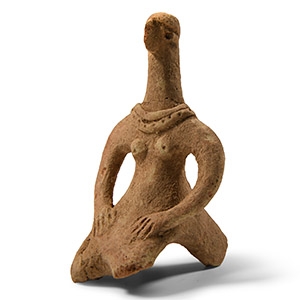
Chalcolithic Terracotta Female Figure
3rd millennium B.C.Sold for (Inc. bp): £338
Modelled in the round kneeling female figure with hands placed on the hips, applied breasts and hair, pinched facial features, impressed eyes and detailing to the collars; flared legs to the reverse. 130 grams, 12.5 cm
Acquired 1979-1999. From the collection of a late London, UK, gentleman. -
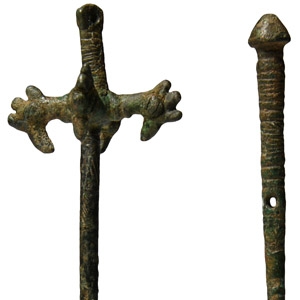
Amlash Bronze Cloak Pin Collection
1st millennium B.C.Sold for (Inc. bp): £65
Comprising: Amlash bronze cloak pin, the top of the shank decorated with encircling bands of various widths and surmounted by a conical head, a piercing in the shaft allowed for the attachment of a crescentic slip-ring, the surface with areas of corrosion, the very tip broken away; similar with pierced lug finial and four radiating birds' heads; each with old collector's label '10633' and '10689'; each mounted on a custom-made display stand. 113 grams total, 15.2-15.5 cm including stand
Acquired on the UK art market 1970s-1980s. Private collection, London, UK.
