
Loading, please wait...
LOT 1312
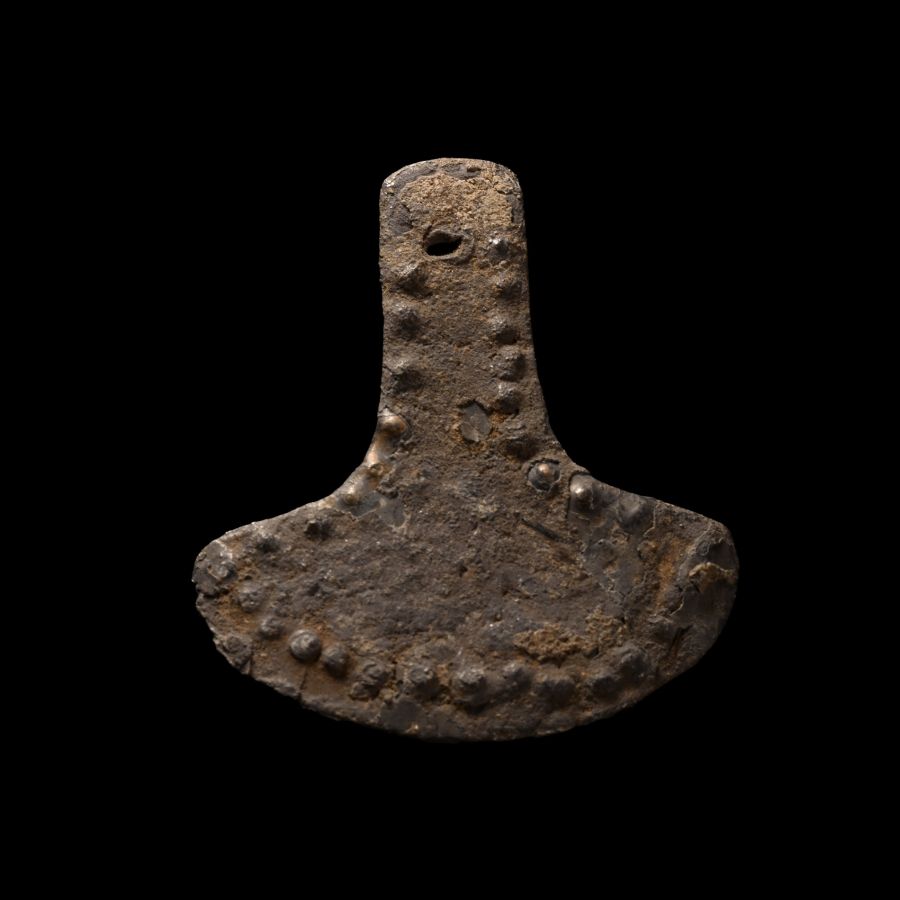
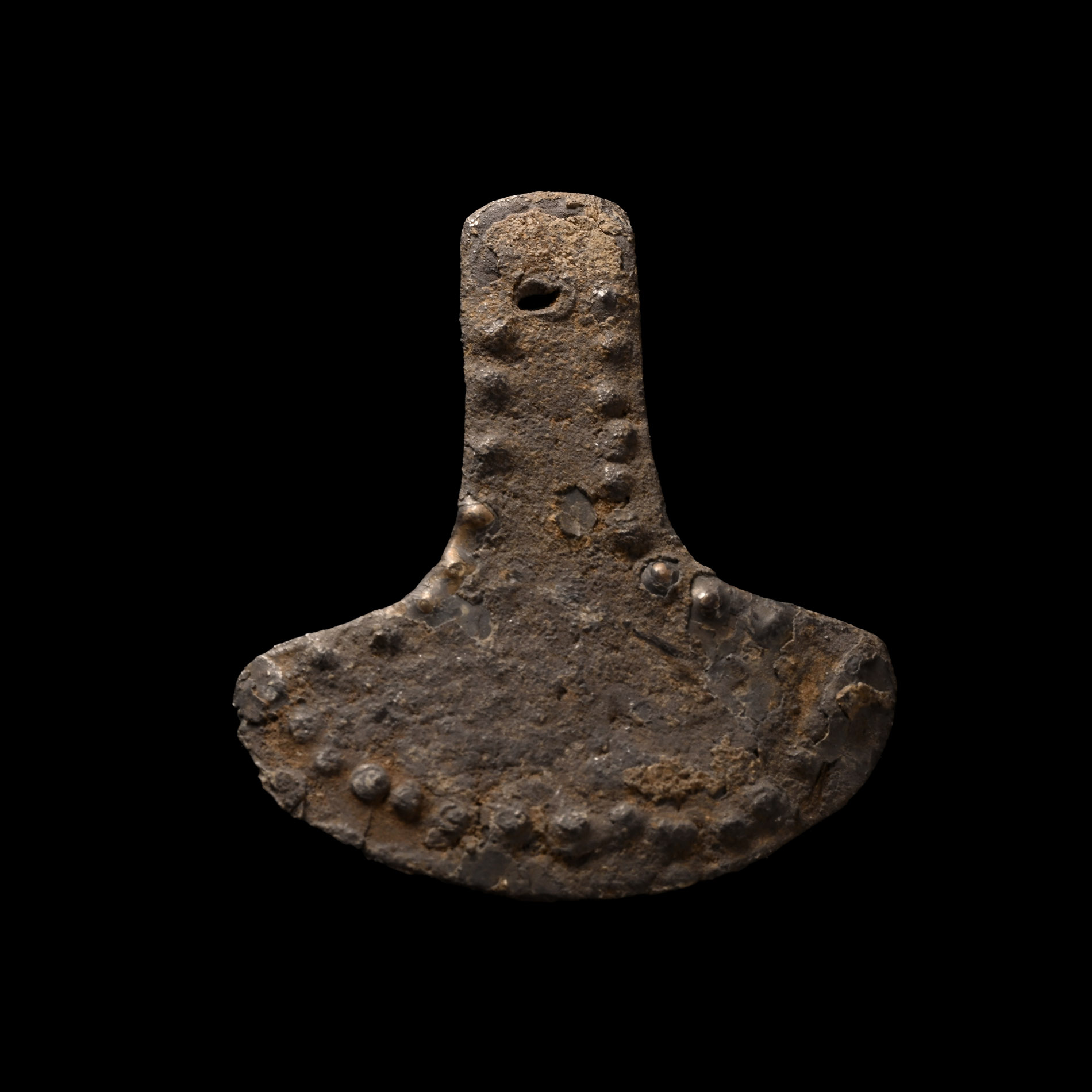
Early Bronze Age Silver Idol
CIRCA 2400-2100 B.C.
1 3/4 in. (2.75 grams, 44 mm).
Axe-shaped with crescentic body and long neck, symbolising a female body, perforated through the top with embossed perimeter. [No Reserve]
ProvenanceFrom a private family collection formed since the early 19th century, thence by descent.
Property of a New Zealand legal professional.
Accompanied by an academic report by Dr Raffaele D’Amato.
This lot has been checked against the Interpol Database of stolen works of art and is accompanied by search certificate number no.12320-223722.
This lot has been cleared against the Art Loss Register database, and is accompanied by an illustrated lot declaration signed by the Head of the Antiquities Department, Dr Raffaele D'Amato.
Cf. for similar idols but in stone and clay, Bilgi, Ö., Anthropomorphic Representations in Anatolia before the Classical Age, Istanbul, 2014, figs.743, 792, 793; for metallic idols of very similar (although not completely identical) shape see idem, fig.782, p.273; see also Hoddinott, R.F., The Thracians, London, 1981, p.37, fig.19, especially nos.1-7, in clay.
CONDITIONTimeLine Auctions follows a vetting process to ensure the authenticity and legality of all items, reinforcing our commitment to integrity and responsible trading. Each antiquity, antique, and coin lot undergoes thorough examination by a vetting committee of at least ten external specialists, professional trade association members, scientists, and archaeologists: Our Vetting Process
AUCTIONS:
TimeLine is a leading auction house specialising in antiquities, ancient art, collectables, natural history, coins, medals, and books. Our auctions offer museums, collectors, historians, and enthusiasts the opportunity to acquire unique and historically significant pieces.
-
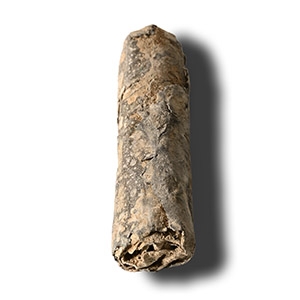
Western Asiatic Aramaic Lead Scroll with Magical Text
2nd-8th century A.D.Sold for (Inc. bp): £293
A rectangular lead sheet rolled into a tight scroll with the text to the inner face. 31 grams, 58 mm
Collected from 1970-1999. From the collection of the late Mr S.M., London, UK. This lot has been cleared against the Art Loss Register database, and is accompanied by an illustrated lot declaration signed by the Head of the Antiquities Department, Dr Raffaele D'Amato.
The item was possibly meant to be what the Romans called a defixio or 'curse tablet', on which the magical malediction was recorded and then shut away (by being tightly rolled up) so that the victim could not find it or change it. -
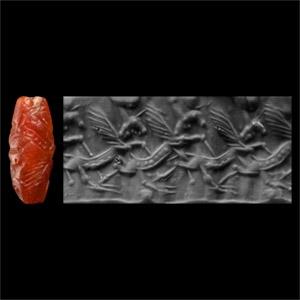
Neo-Babylonian Carnelian Cylinder Seal with Two Winged Quadrupeds
Circa 900-750 B.C.Sold for (Inc. bp): £520
Cylinder with cord and bead handles; accompanied by a copy of an old scholarly note, typed and signed by W.G. Lambert, late Professor of Assyriology, University of Birmingham, 1970-1993, which states: 'Cylinder Seal of Carnelian 19 x 8.5 mm, The scene shows two winged quadrupeds in a frieze. Each has the body of a bull, but with wings. Each is running and the front part of the body is reared up, overlapping the one in front. It is meant as a scene of one animal chasing the other. The seal is engraved mainly with the cutting wheel, but there are dots along the animals' bodies and at other points down with the drill. The seal is convex in shape, like a bead. This is a seal in the Neo-Babylonian style, c. 900-750 B.C., though examples have been found both in Babylonia and in south-west Iran. It is in very good condition and is an attractive piece.'; supplied with a museum-quality impression. 3.18 grams, 19 mm
UK private collection, acquired 1980-1983. Accompanied by a copy of a scholarly note, typed and signed by Professor Wilfrid George Lambert in May 1992. This lot has been cleared against the Art Loss Register database, and is accompanied by an illustrated lot declaration signed by the Head of the Antiquities Department, Dr Raffaele D'Amato. -
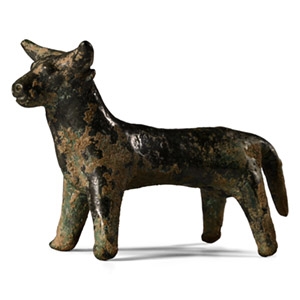
Large Western Asiatic Bronze Figure of a Bull
Circa 10th century B.C.Estimate: £10,000 - 14,000 (‡+bp*)
Opening Bid: £5,000
A heavy example modelled in the round with slender elongated trunk, thick neck and prominent horns, vestigial ears below; Anatolian workmanship. 1.32 kg, 19.2 cm
with Christie's, New York, 8 June 2001, no.363. Private collection, Europe. Accompanied by copies of the relevant Christie's catalogue pages. Accompanied by an academic report by Dr Raffaele D’Amato. This lot has been checked against the Interpol Database of stolen works of art and is accompanied by a search certificate number no.12414-226675. This lot has been cleared against the Art Loss Register database, and is accompanied by an illustrated lot declaration signed by the Head of the Antiquities Department, Dr Raffaele D'Amato.
Bulls with raised horns have been found in central Anatolian royal burials. Among the sacred animals found in the royal graves of Alacahöyük, the bull and the deer are always present. This simplified figure of a young and spritely standing bull recalls the Baltimore bull and other two examples in the Cleveland Museum of Art. Images of bulls were mounted on standards, used in battlefields or in religious processions, or like in the royal graves of Alacahöyük, they were used to decorate cult furniture or shrines.
