
Loading, please wait...
_900x900.jpg "Cypro-Archaic Terracotta Bird Askos")
_200x200.jpg "Cypro-Archaic Terracotta Bird Askos")
.jpg "Cypro-Archaic Terracotta Bird Askos")
LOT 0567
Cypro-Archaic Terracotta Bird Askos
LATE BRONZE AGE, 1100-1000 B.C.
9 1/2 in. (670 grams, 24 cm).
Hollow-formed as a bird, possibly a duck, with its beak acting as a spout, small lateral flanges for wings and painted geometric detailing; strap handle from funicular filler tube with a strainer inside to the fan-shaped tail. [No Reserve]
ProvenanceFrom a collection acquired on the UK art market from various auction houses and collections mostly before 2000.
From an important Cambridgeshire estate; thence by descent.
Cf. an askos in the Metropolitan Museum of Art, New York, under accession no.1970.11.12.
CONDITIONTimeLine Auctions follows a vetting process to ensure the authenticity and legality of all items, reinforcing our commitment to integrity and responsible trading. Each antiquity, antique, and coin lot undergoes thorough examination by a vetting committee of at least ten external specialists, professional trade association members, scientists, and archaeologists: Our Vetting Process
AUCTIONS:
TimeLine is a leading auction house specialising in antiquities, ancient art, collectables, natural history, coins, medals, and books. Our auctions offer museums, collectors, historians, and enthusiasts the opportunity to acquire unique and historically significant pieces.
-
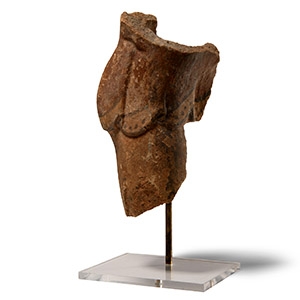
Etruscan Terracotta Warrior Statue Leg Fragment
Circa 6th century B.C.Sold for (Inc. bp): £338
Fragment of a hollow-formed statue of a warrior, the thigh and hip area with painted armour detailing; mounted on a custom-made stand. 535 grams total, 16 cm high (20.5 cm high including stand)
Ex private collection L.G., The Netherlands. Acquired from Treasuregate Art of the Ancients, Brussels, Belgium, in 2015. Property of a South Australian private collector, with collection reference 15.10. Accompanied by a copy of a Treasuregate Art of the Ancients certificate of authenticity with ref no.2015-11-22-03. Accompanied by detailed collector's catalogue pages including description and photographs.
The armour on the figure is the short-sleeved chitoniskos which was worn under the cuirass and protected the flexing areas around the groin and buttocks. The figure probably formed part of a frieze on a temple. -
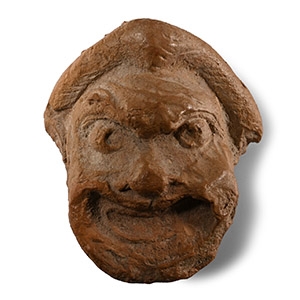
Hellenistic Terracotta Theatre Mask
2nd-1st century B.C.Sold for (Inc. bp): £325
Modelled as a grotesque male head with gaping crescent-shaped mouth, pointed nose, furrowed brow and thick mop of hair around the head; pierced at the upper face. 45 grams, 60 mm
Acquired in the mid 1980s-1990s. Private collection, Switzerland, thence by descent. Private collection, since the late 1990s. -
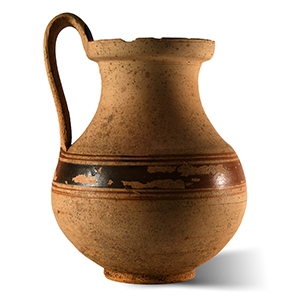
South Italian Terracotta Painted Jug
4th-2nd century B.C.Estimate: £350 - 450 (‡+bp*)
Opening Bid: £180
Piriform with convex rim, lentoid-section handle and discoid foot; polychrome painted bands and lines decorating the equator and inner mouth, dash to handle. 227 grams, 13.5 cm high
Acquired in Europe before 1994.
