
Loading, please wait...
LOT 0585
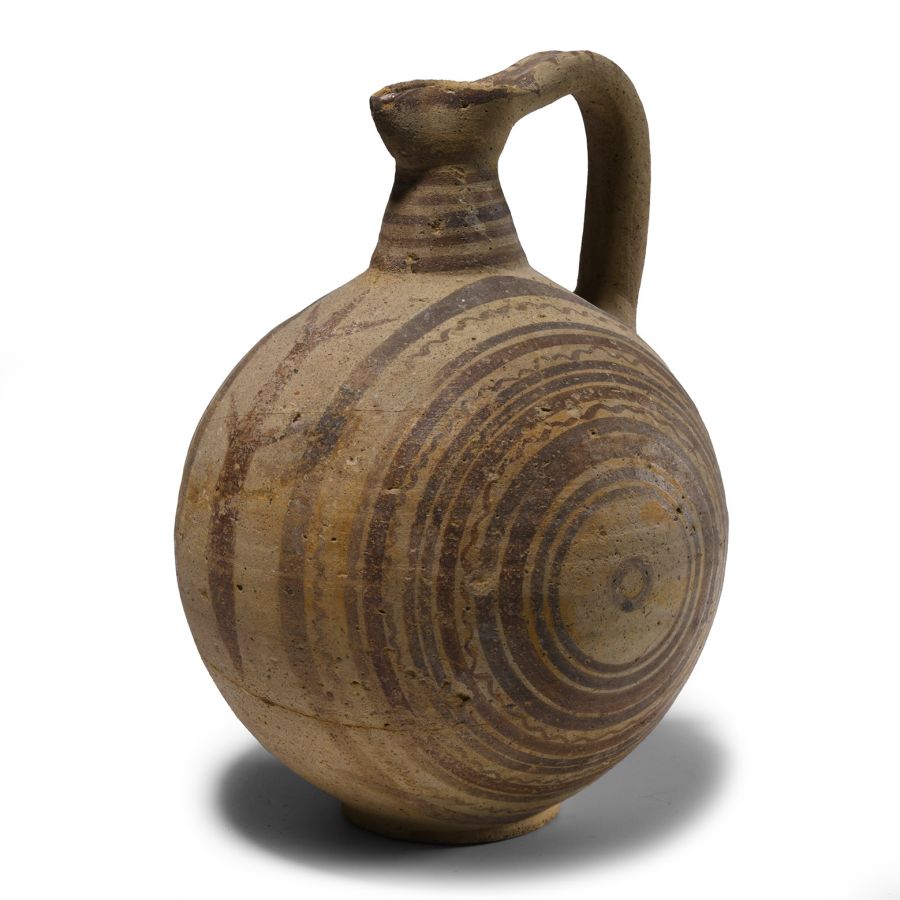
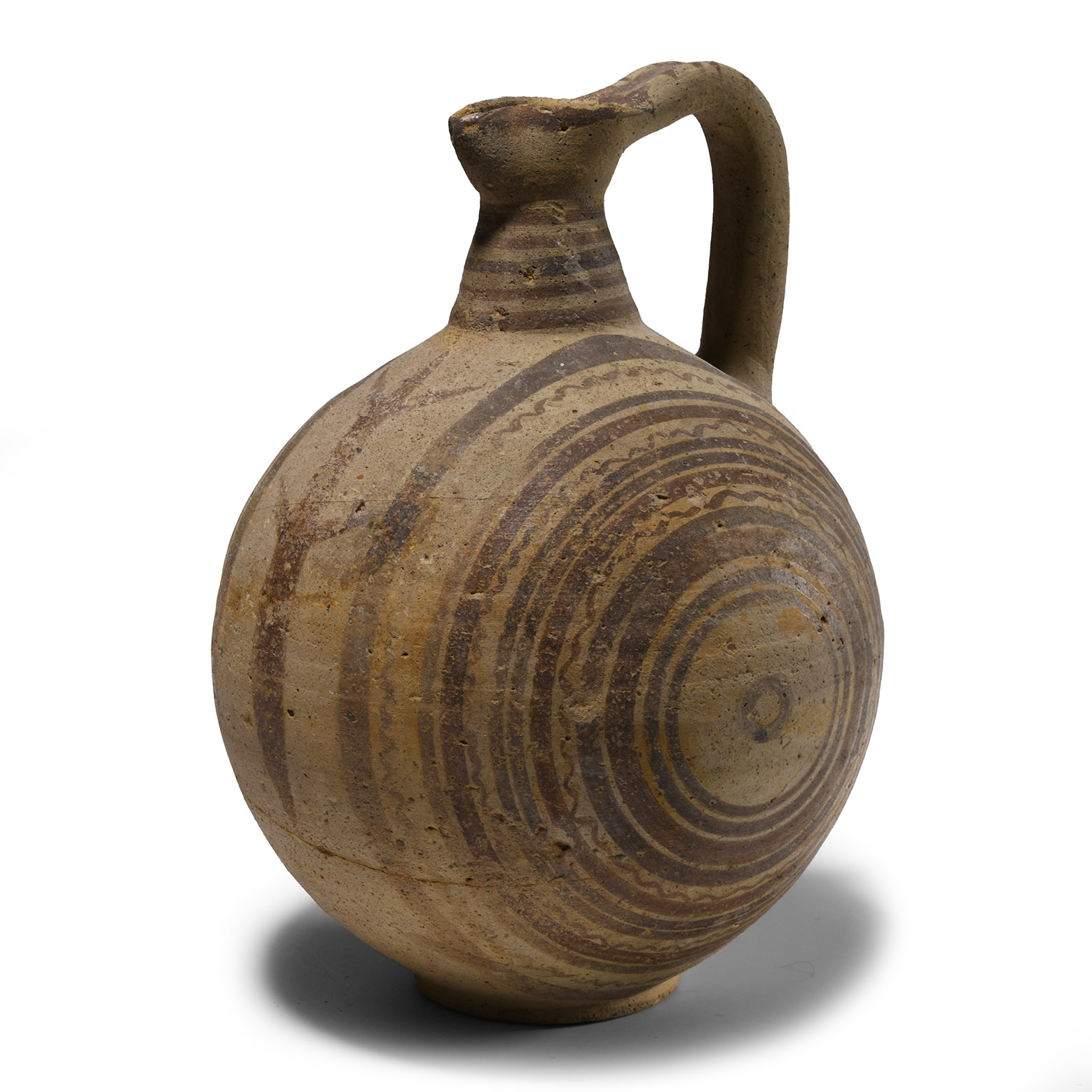
Cypriot Trefoil-Mouthed Pottery Jug with Geometric Motif
IRON AGE, CIRCA 900-700 B.C.
8 1/2 in. (495 grams, 21.2 cm high).
With spherical body, conical neck and pinched trefoil mouth, gusseted strap handle; concentric painted circles to each lateral face and to the neck, fish motif beneath the spout and trefoil beneath the handle; repaired. [No Reserve]
ProvenanceFrom a collection acquired on the UK art market from various auction houses and collections mostly before 2000.
From an important Cambridgeshire estate; thence by descent.
Cf. Morris, D., The Art of ancient Cyprus, Oxford, 1985, figs.19 p.42, pl.34a and pl.52 p.52, for the type.
FootnotesIn the Bichrome Ware, at the early Iron Age of Cyprus, patches of lines of reddish-brown paint were added to the black, on the pale background. Two styles of painting are prevalent: the rectilinear and the circle. The rectilinear style was more diffused in the eastern and southern regions of Cyprus, the circle one is found mainly in the western and northern areas.
CONDITIONTimeLine Auctions follows a vetting process to ensure the authenticity and legality of all items, reinforcing our commitment to integrity and responsible trading. Each antiquity, antique, and coin lot undergoes thorough examination by a vetting committee of at least ten external specialists, professional trade association members, scientists, and archaeologists: Our Vetting Process
AUCTIONS:
TimeLine is a leading auction house specialising in antiquities, ancient art, collectables, natural history, coins, medals, and books. Our auctions offer museums, collectors, historians, and enthusiasts the opportunity to acquire unique and historically significant pieces.
LOT 0585
Cypriot Trefoil-Mouthed Pottery Jug with Geometric Motif
Sold for (Inc. bp): £546
-
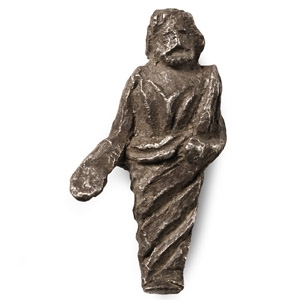
Hellenistic Silver Standing Figure
2nd-1st century B.C.Sold for (Inc. bp): £78
Bearded male wearing a himation held with his left hand, right hand open flat to support a patera (absent). 4.65 grams, 24 mm
Acquired 1960s-1990s. From the late Alison Barker collection, a retired London barrister. -
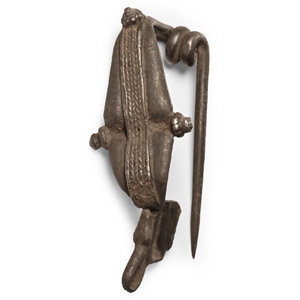
Greek Silver Fibula
5th-4th century B.C.Estimate: £180 - 240 (‡+bp*)
Opening Bid: £100
Comprising an ellipsoid bow with lateral knops (one absent) and applied collars, longitudinal band of applied filigree braid, knop finial with collar, perpendicular two-coil spring and long pin; footplate with incised saltire with reversed-loop finial, square catchplate with pointillé gammadion and frame. 6.86 grams, 42 mm
Private European collection, 1994, thence by descent. -
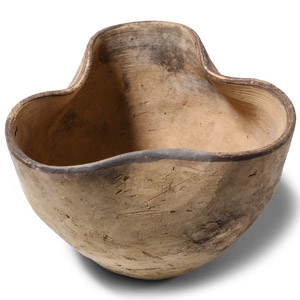
Greek Painted Terracotta Trefoil Cup
1st millennium B.C.Sold for (Inc. bp): £91
Hemispherical in profile with pinched trefoil format, applied pigment to the rounded rim. 421 grams, 14 cm wide
From a collection acquired on the UK art market from various auction houses and collections mostly before 2000. From an important Cambridgeshire estate; thence by descent.
In many ancient houses a special domestic sacrifice was offered: the remains of burned offering of a chicken or small bird were deposited on the floor of the courtyard, along with certain characteristic small vessels: shallow saucers and plates, covered dishes, wine cups and lamps.
