
Loading, please wait...
_900x900.jpg "Cypriot Terracotta Votive Horn")
_200x200.jpg "Cypriot Terracotta Votive Horn")
.jpg "Cypriot Terracotta Votive Horn")
LOT 0596
Cypriot Terracotta Votive Horn
2100-1850 B.C.
5 1/2 in. (70 grams total, 14 cm high including stand).
Tapering round-section votive with reserved zigzag bands of dense linear hatching; remains of an old base including label. [No Reserve]
ProvenanceFrom the celebrated personal collection of art formed by the famous anthropologist, artist, and television presenter Desmond Morris.
with Christie’s, South Kensington, 14 May 2002, no.19 (part).
From a collection acquired on the UK art market from various auction houses and collections mostly before 2000.
From an important Cambridgeshire estate; thence by descent.
Accompanied by copies of the relevant Christie's catalogue pages.
TimeLine Auctions follows a vetting process to ensure the authenticity and legality of all items, reinforcing our commitment to integrity and responsible trading. Each antiquity, antique, and coin lot undergoes thorough examination by a vetting committee of at least ten external specialists, professional trade association members, scientists, and archaeologists: Our Vetting Process
AUCTIONS:
TimeLine is a leading auction house specialising in antiquities, ancient art, collectables, natural history, coins, medals, and books. Our auctions offer museums, collectors, historians, and enthusiasts the opportunity to acquire unique and historically significant pieces.
-
.jpg)
Etruscan Bucchero Ware Pottery Handle Depicting a Warrior
Archaic Period, 6th century B.C.Estimate: £1,000 - 1,400 (+bp*)
Opening Bid: £444
Broad, gently curved strap handle with raised lateral borders, low-relief image of a hoplite wearing a crested Corinthian helmet and gripping a tall spear, belt with kopis; mounted on a custom-made stand. 333 grams total, 23.7 cm including stand
Private collection, New York, thence by descent. with Antiquarium Limited, New York, 1981. -
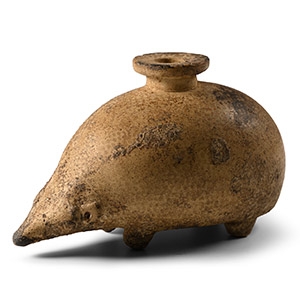
Corinthian Hedgehog Aryballos
6th century B.C.Estimate: £1,800 - 2,400 (‡+bp*)
Opening Bid: £833
Hollow-formed with textured body and four stub legs, conical nose and lateral flanges with impressed point eyes; discoid flange rim to the neck with incised petal detailing. 55 grams, 98 mm
Ex Mrs IM, nr 18 (Widow of Leo Mildenberg), formed in Zurich, gift from her husband between 1975-2000. Acquired by the present owner from the above. This lot has been checked against the Interpol Database of stolen works of art and is accompanied by search certificate number no.12208-222174. -
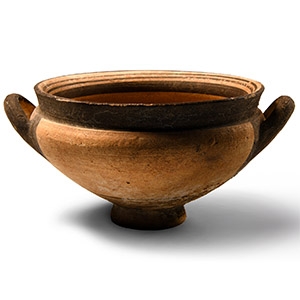
Greek Archaic Painted Terracotta Skyphos
7th-early 6th century B.C.Estimate: £400 - 600 (‡+bp*)
Opening Bid: £222
Conical in form with rounded shoulder, everted rim and two round-section handles; painted with concentric bands around the interior and exterior. 243 grams, 15.5 cm wide
Acquired in Europe before 1992. European collection.
The skyphos was already well known in Greece since the age of the Achaeans. In Homer, Eumaeus, the swineherd, prepares for his guest Ulysses a cyssibium filled with wine which the hero drinks during the meal and, when he is full, Eumaeus makes him drink from the cup in which he himself was using, a skyphos. Ulysses also offers Polyphemus a drink in a skyphos.
