
Loading, please wait...
LOT 0039
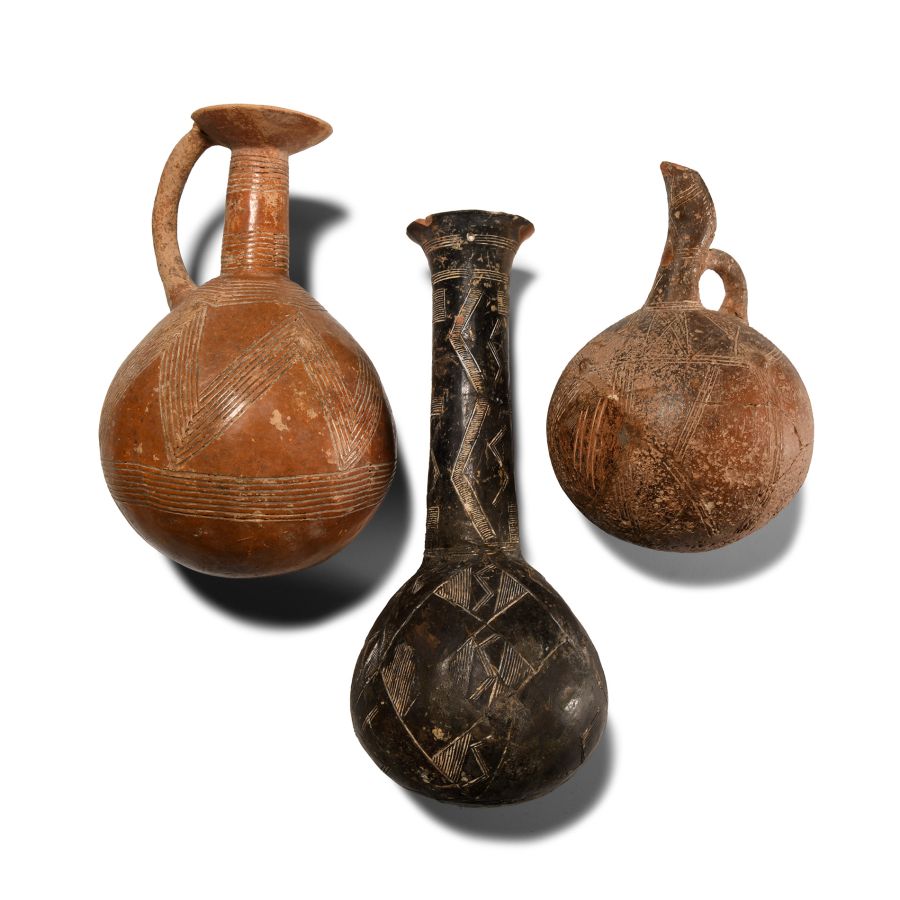
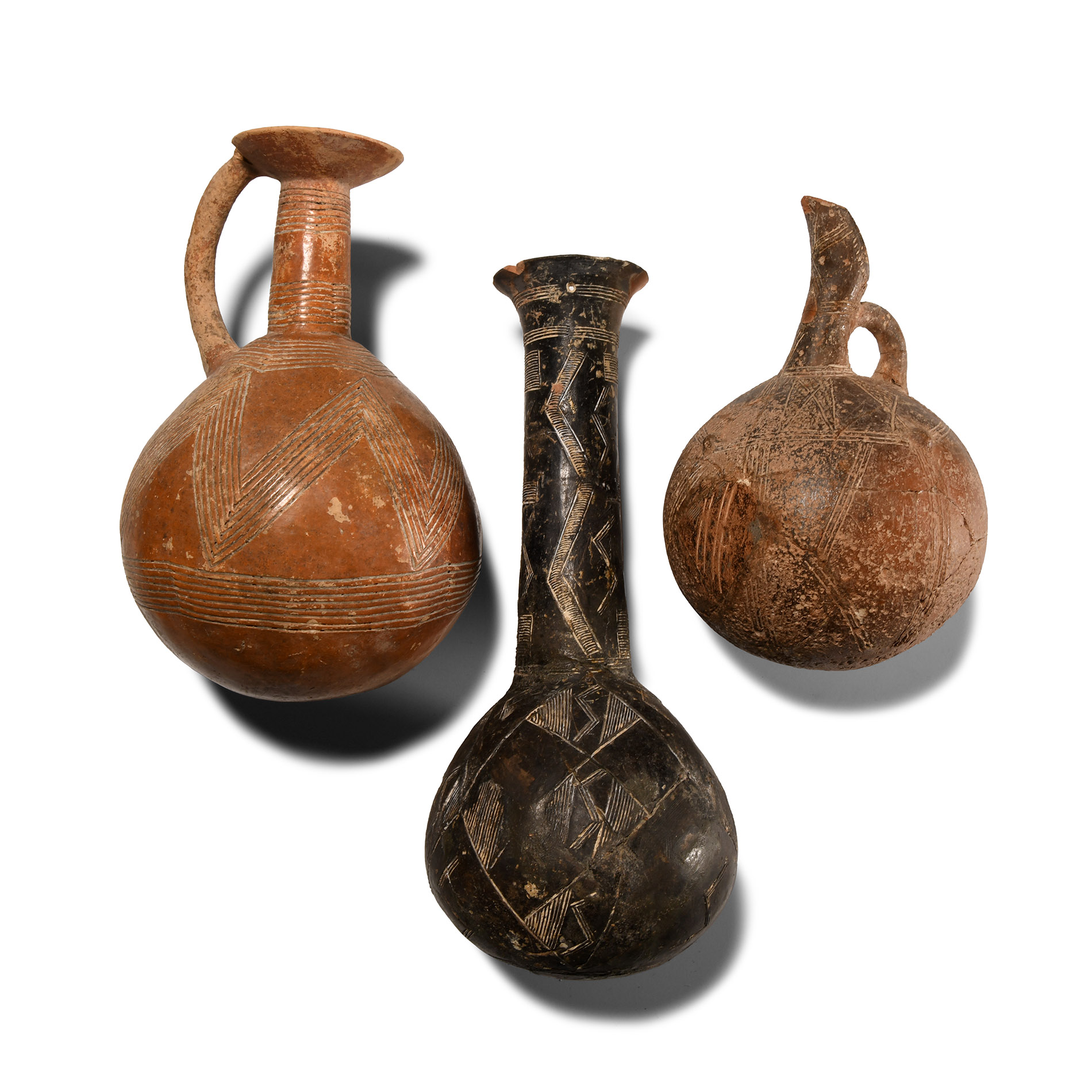
Cypriot Red Polished Ware Vessel Group
MIDDLE BRONZE AGE, CIRCA 2000-1800 B.C.
5 7/8 - 8 7/8 in. (1.1 kg total, 15-22.5 cm).
Comprising a tall vase with trumpet-shaped mouth, a bulbous ewer with curved spout and loop handle, and a similar jar with flared mouth and incised chevrons to the shoulders; repaired. [3, No Reserve]
ProvenanceFrom a collection acquired on the UK art market from various auction houses and collections mostly before 2000.
From an important Cambridgeshire estate; thence by descent.
Cf. Morris, D., The Art of ancient Cyprus, Oxford, 1985, fig. p.23, pl.14, for similar.
CONDITIONTimeLine Auctions follows a vetting process to ensure the authenticity and legality of all items, reinforcing our commitment to integrity and responsible trading. Each antiquity, antique, and coin lot undergoes thorough examination by a vetting committee of at least ten external specialists, professional trade association members, scientists, and archaeologists: Our Vetting Process
AUCTIONS:
TimeLine is a leading auction house specialising in antiquities, ancient art, collectables, natural history, coins, medals, and books. Our auctions offer museums, collectors, historians, and enthusiasts the opportunity to acquire unique and historically significant pieces.
-
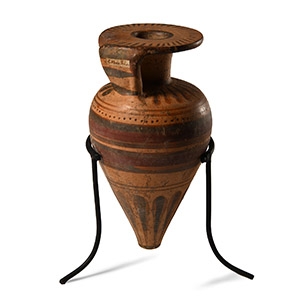
Etrusco-Corinthian Terracotta Piriform Aryballos
Circa 600-550 B.C.Sold for (Inc. bp): £572
With piriform body, narrow neck and broad rim to the mouth, broad strap handle; painted with radiating strokes to the mouth and shoulder, band or pellets and tongue pattern to the foot; old collector's label 'C Vecchia', probably Civita Vecchia, a seaport serving Rome. 96 grams total, 10 cm high (10.5 cm high including stand)
Private collection Hertfordshire, England. with Ancient Resource Auctions, 2 December 2013, no.124A (US$ 2,500-4,000). Property of a South Australian private collector, with collection reference 14.04. Accompanied by detailed collector's catalogue pages including description and image. -
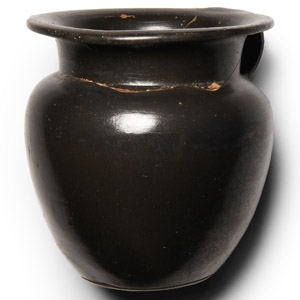
Greek Apulian Black-Glazed Mug
Circa 4th-3rd century B.C.Estimate: £250 - 350 (+bp*)
Opening Bid: £125
With a high-gloss black slip, ovoid body and a short wide neck with a flaring rim, a wide strap handle and a flat base. 144 grams, 95 mm wide
Ex P. A., Hertfordshire, UK, specialist collection of Greek art, 1980-1990s.
The black glaze technique uses the same glaze used by the Greeks on the red-figure and black-figure ceramics, but covering the entire piece, without figurative decoration. It was a transparent raw glaze, which took on its characteristic intense, glossy black tone after firing. -
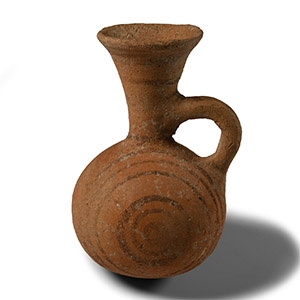
Cypro-Archaic Buff Pottery Flask
Levant, circa 1050-700 B.C.Sold for (Inc. bp): £124
Spherical body with trumpet-shaped mouth and loop handle to the shoulder, painted spirals to each face. 124 grams, 99 mm
From an old Lebanese family collection moved to Germany in the middle of the 1970s. Acquired from Bonhams, London, 20 October 2005, no.424 (part). From an important Cambridgeshire estate; thence by descent. Accompanied by copies of the relevant Bonhams catalogue pages and the original Bonhams lot tag.
