
Loading, please wait...
LOT 0568
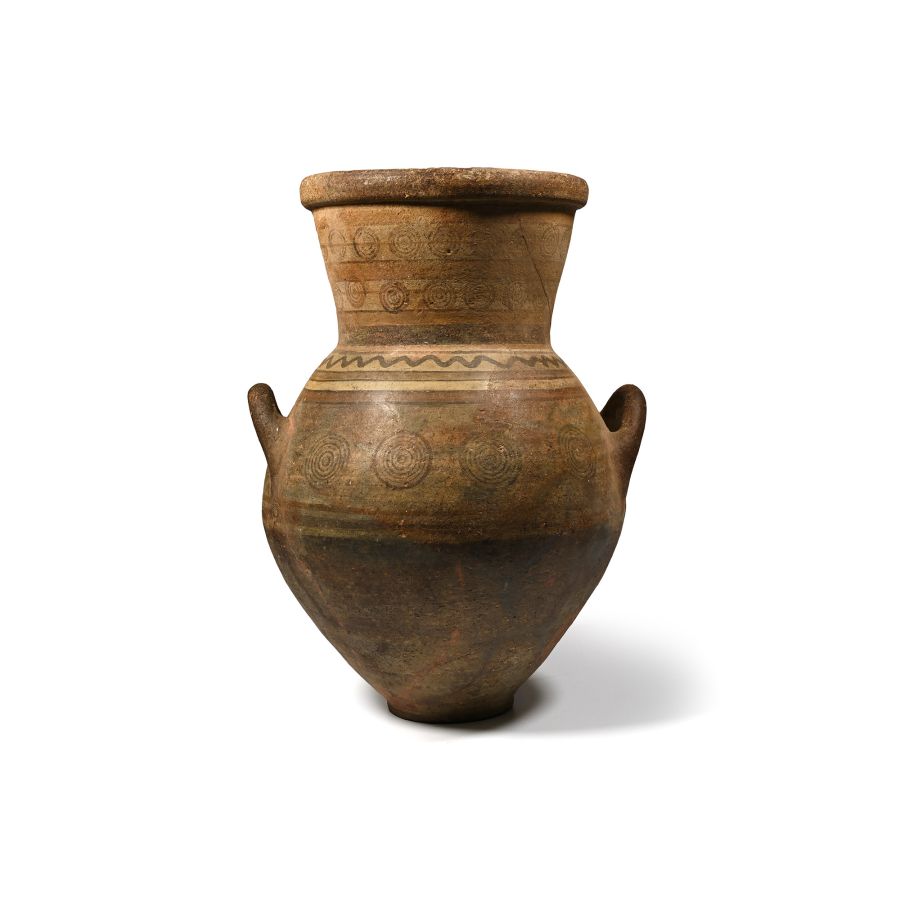
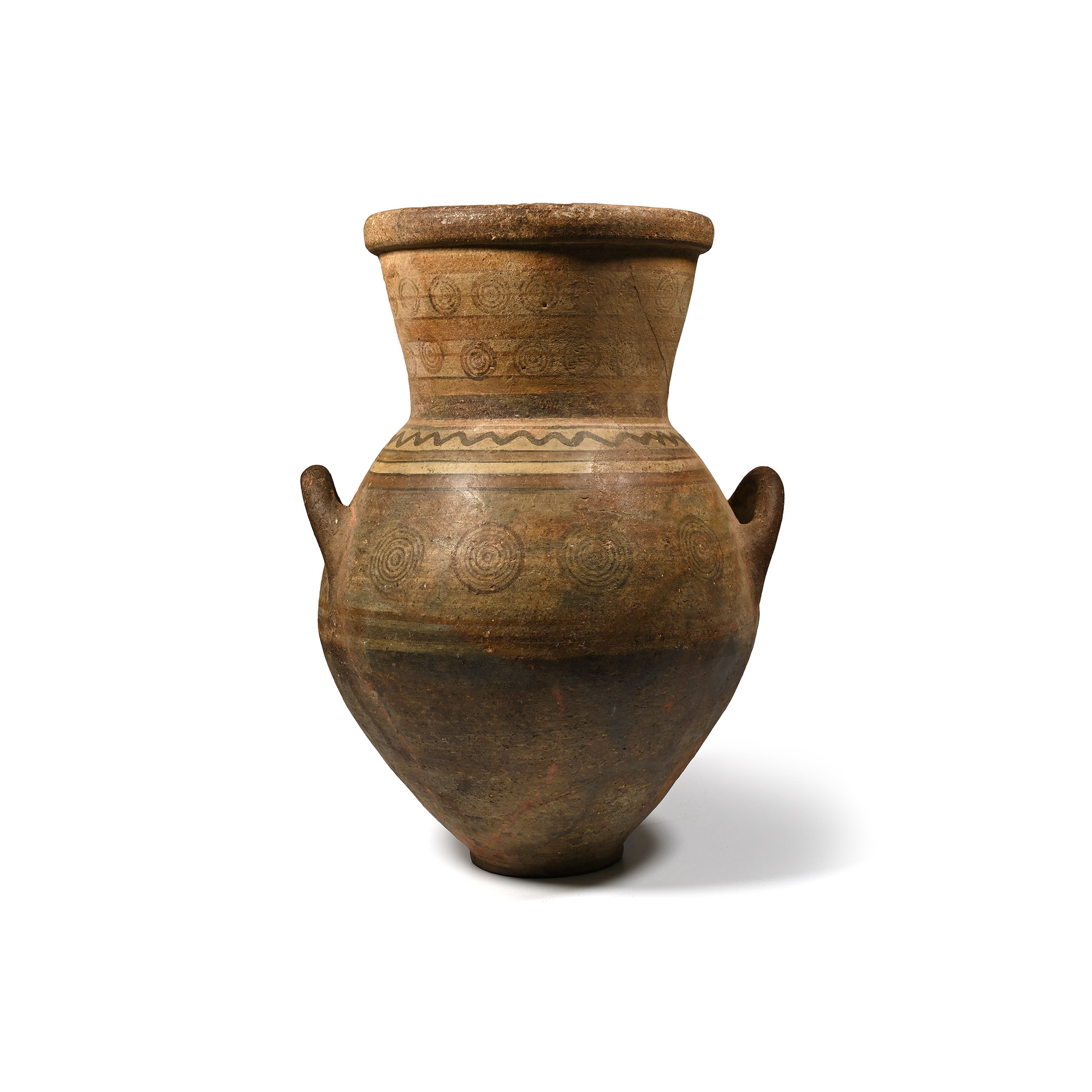
Cypriot Painted Terracotta Amphora
CYPRO-ARCHAIC I, CIRCA 750-600 B.C.
17 1/8 in. (3.8 kg, 43.5 cm).
Tall unglazed ceramic comprising a biconical body and low basal ring, rounded shoulder and broad funicular neck with rolled rim, two strap handles to the equator; painted with bands of ring-and-dot motifs to neck and shoulder, interstitial horizontal bands; repaired. [No Reserve]
ProvenanceProperty of a Cambridgeshire collector.
From his private collection since the 1970s; thence by descent circa 2000.
Ex private collection of a Bedfordshire gentleman.
This lot is accompanied by an illustrated lot declaration signed by the Head of the Antiquities Department, Dr Raffaele D'Amato.
Cf. Gjerstad, E., The Swedish Cyprus Expedition. Volume IV, Part 2. The Cypro-Geometric, Cypro-Archaic and Cypro-Classical periods, Stockholm, 1948; Peck, W.H., and Slough, P., The Marko Collection: Antiquities, Detroit, 1990, no. 4, for similar; Artzy, M., 2001, ‘A study of the Cypriote Bichrome ware: Past, present and future’, in Åström, P., (ed.), The chronology of Base-ring ware and Bichrome Wheel-made ware. Proceedings of a Colloquium held in the Royal Academy of Letters, History and Antiquities, Stockholm, May 18-19 2000, (Vitterhets Historie och Antikvitets Akademiem, Konferenser 54), Stockholm, 2001, pp.157–74; Karageorghis, V., Cipro, Crocevia del Mediterraneo Orientale, 1500-500 d.C., Milano, 2002, p.179, figs.367-370, for similar pottery.
CONDITIONTimeLine Auctions follows a vetting process to ensure the authenticity and legality of all items, reinforcing our commitment to integrity and responsible trading. Each antiquity, antique, and coin lot undergoes thorough examination by a vetting committee of at least ten external specialists, professional trade association members, scientists, and archaeologists: Our Vetting Process
AUCTIONS:
TimeLine is a leading auction house specialising in antiquities, ancient art, collectables, natural history, coins, medals, and books. Our auctions offer museums, collectors, historians, and enthusiasts the opportunity to acquire unique and historically significant pieces.
-
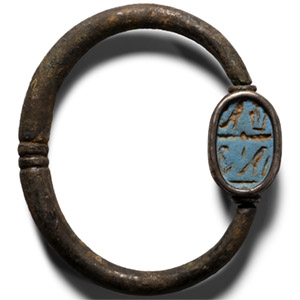
Etruscan Silver Bracelet with Mounted Scarab
6th century B.C.Sold for (Inc. bp): £1,820
Hollow-formed tapering shank with rotating cell containing a scarab with hieroglyphs to the underside. 24.8 grams, 57.6 mm
Acquired in the mid 1980s-1990s. Private collection, Switzerland, thence by descent. Private collection, since the late 1990s. This lot has been checked against the Interpol Database of stolen works of art and is accompanied by a search certificate number no.12660-234644. This lot has been cleared against the Art Loss Register database, and is accompanied by an illustrated lot declaration signed by the Head of the Antiquities Department, Dr Raffaele D'Amato. -
.jpg)
Iberian Bronze Statuette
6th-4th century B.C.Estimate: £4,000 - 6,000 (‡+bp*)
Opening Bid: £1,800
Youthful male standing wearing a belted tunic with apron, arms spread wide, barefoot, bare-headed with short textured hair; mounted on a custom-made base. 215 grams total, 11.8 cm high including stand
Private collection, Paris, France, assembled in the 1950s-1960s. with Tessier-Sarrou & Associés, Paris, 2015. European private collection. Accompanied by a copy of an Art Loss Register certificate, no.S00107108. Accompanied by a copy of French cultural export passport no.167803. This lot has been checked against the Interpol Database of stolen works of art and is accompanied by a search certificate number no.12650-264612. This lot has been cleared against the Art Loss Register database, and is accompanied by an illustrated lot declaration signed by the Head of the Antiquities Department, Dr Raffaele D'Amato. -
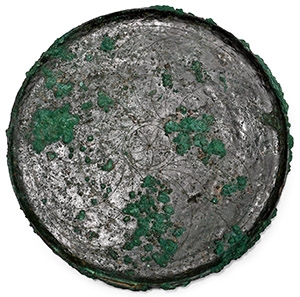
Greek Bronze Mirror with Floral Pattern
Circa 6th century B.C.Sold for (Inc. bp): £936
Discoid with raised beaded rim, obverse slightly convex with a guilloche border; the reverse with a central five-petalled flower and three pairs of concentric circles, crescentic lines radiating from the innermost pair and extending to the outermost pair. 258 grams 15.2 cm wide
Private collection Dr L.M., Zurich, Switzerland. with Galerie Rhéa, Zurich, Switzerland. This lot is accompanied by an illustrated lot declaration signed by the Head of the Antiquities Department, Dr Raffaele D'Amato.
