
Loading, please wait...
LOT 0545
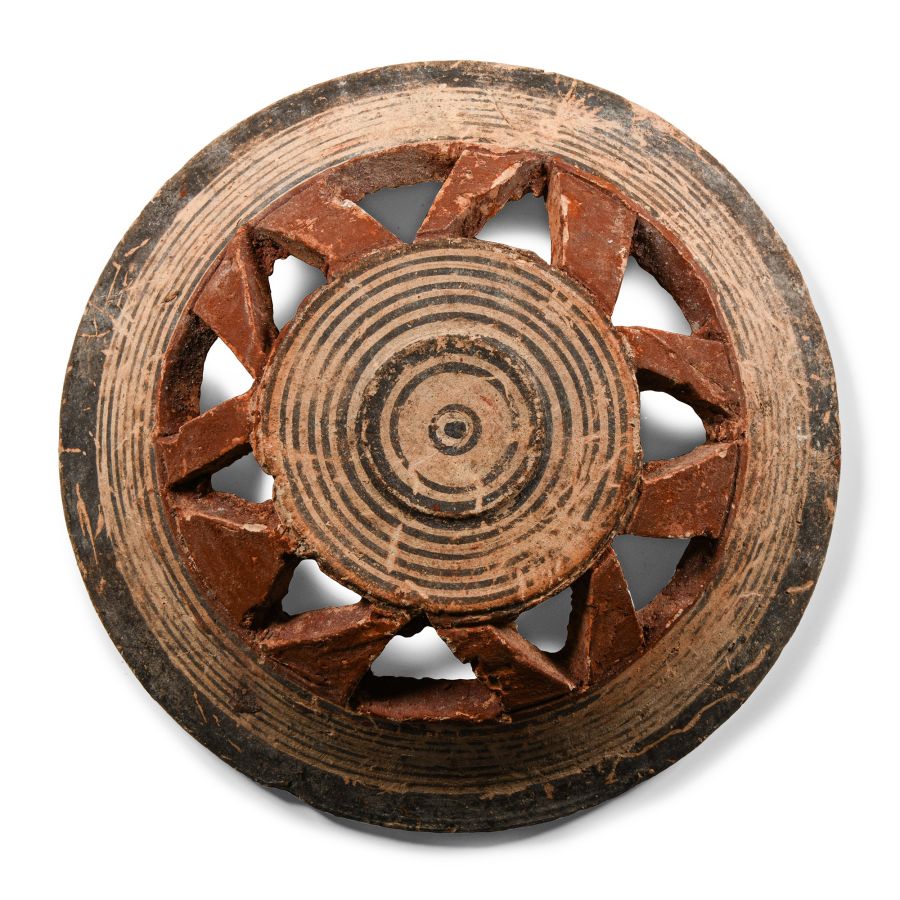
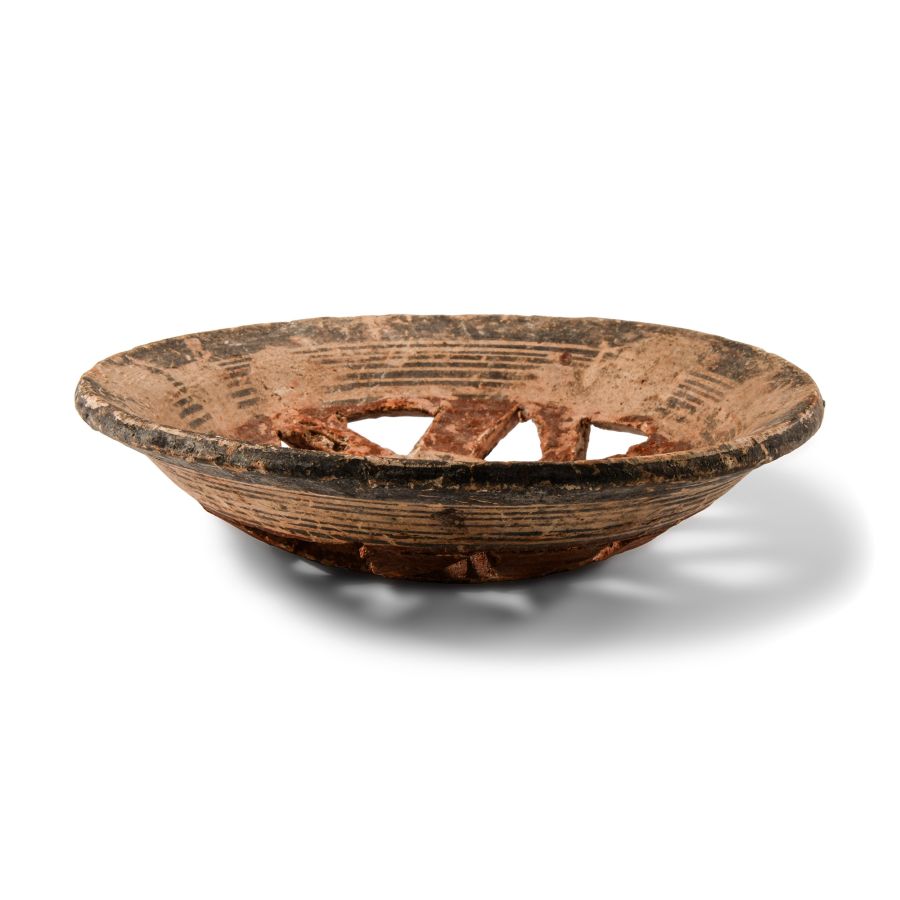
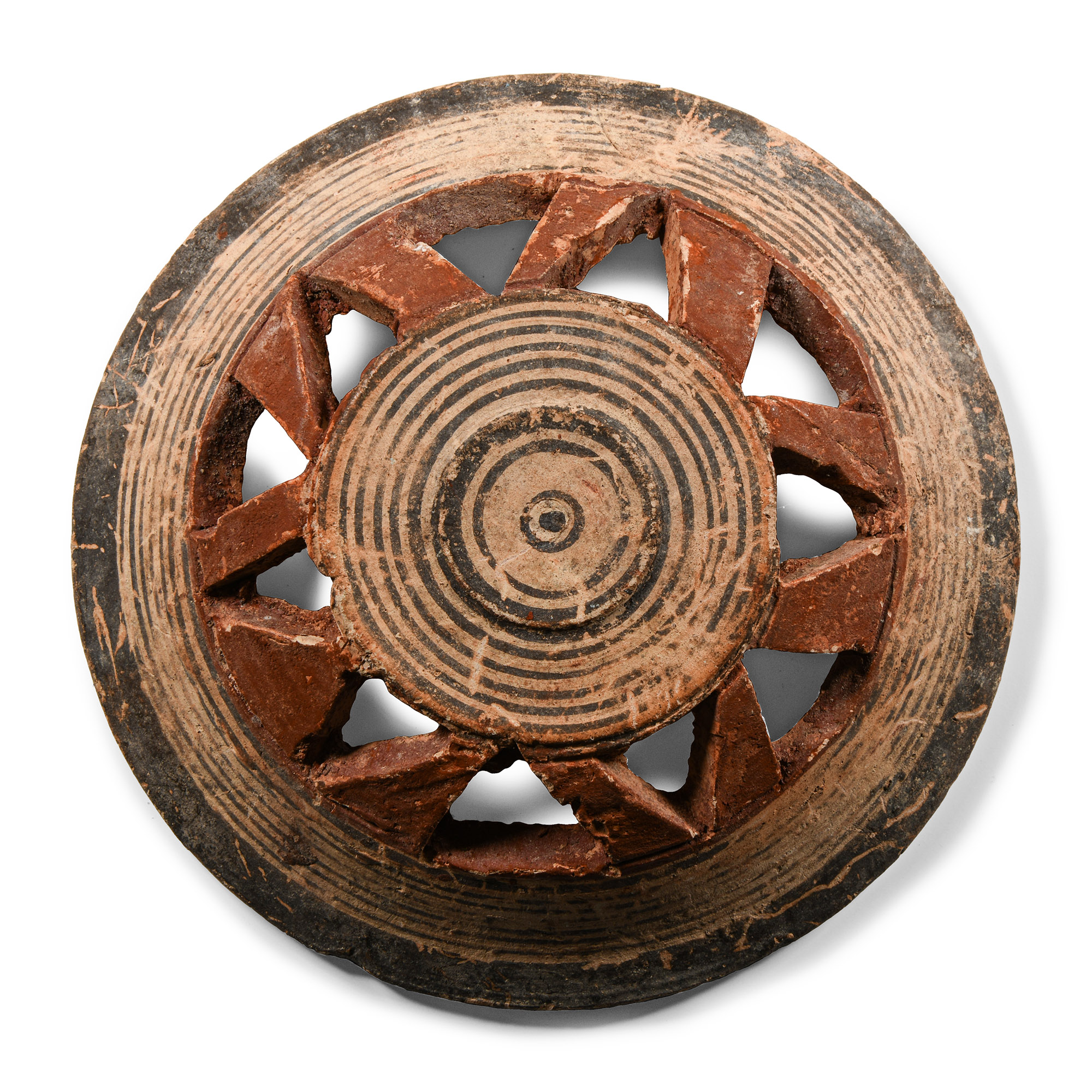
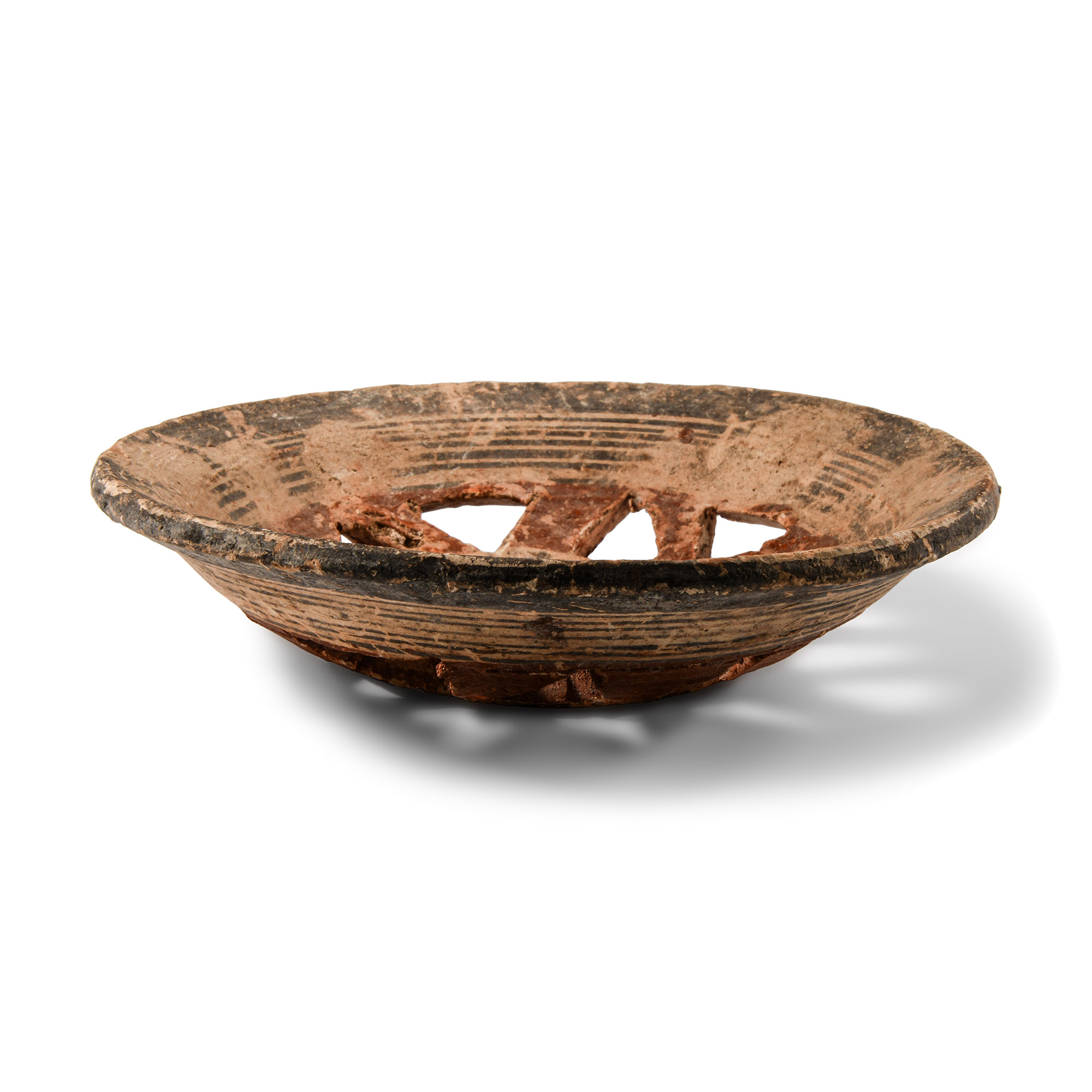
Cypriot Bichrome Ware Openwork Dish
IRON AGE, CIRCA 1200-600 B.C.
5 7/8 in. (190 grams, 15 cm).
Broad dish with band of openwork triangles to the lower sidewall, flat base; painted with black concentric rings, black rim, red band to the openwork. [No Reserve]
ProvenancePeter Cran collection, Scotland, who worked as an engineer for the Cypriot public works department 1931-1946; thence by descent.
Acquired from Bonhams, London, 23 May 2012, no.6 (part).
From an important Cambridgeshire estate; thence by descent.
Accompanied by copies of the relevant Christie's catalogue pages.
Accompanied by copies of the relevant Bonhams catalogue pages and original lot tag.
Cf. similar item in the Metropolitan Museum of Art, New York, under accession no.74.51.996, for type.
CONDITIONTimeLine Auctions follows a vetting process to ensure the authenticity and legality of all items, reinforcing our commitment to integrity and responsible trading. Each antiquity, antique, and coin lot undergoes thorough examination by a vetting committee of at least ten external specialists, professional trade association members, scientists, and archaeologists: Our Vetting Process
AUCTIONS:
TimeLine is a leading auction house specialising in antiquities, ancient art, collectables, natural history, coins, medals, and books. Our auctions offer museums, collectors, historians, and enthusiasts the opportunity to acquire unique and historically significant pieces.
-
Hellenistic Painted Terracotta Figure of Aphrodite
Mid 4th-mid 3rd century B.C.Estimate: £3,000 - 4,000 (‡+bp*)
Opening Bid: £1,111
Bearing the weight of her body on her left leg, wearing a himation draped over her left and right arms, the right arm bent to grasp a part of the himation that falls behind her, leaving her shoulders uncovered and revealing her naked body; the head turned slightly to the left; the hair arranged in the typical flattering melon coiffure, parted into six large sections and gathered into a low bun; oval face with a small, fleshy mouth and a fine nose; wearing large circular earrings; her right hand resting on top of a small pillar, covered by the cloak; the lower part of the himation embroidered with volutes; the back flat with a square hole for attachment; red-brown pigment on the hair, white coating, traces of pink on the himation and red on the edges of the feet. 493 grams, 22.5 cm high
Collected in the 1950s-1990s. Ex R. Liechti collection (1934-2010), acquired in Geneva. Accompanied by an academic report by Raffaele D'Amato. This lot has been checked against the Interpol Database of stolen works of art and is accompanied by search certificate no.11999-211931.
In particular in South Italy, two types of female statuettes leaning on small pillars were widespread, derived from Tanagra prototypes: the first type dressed in a high-belted chiton with crowned head, the second consisting of partially draped or nude female figures identified as Aphrodite, like our specimen. The Tanagra production ended in about 200 B.C., but the models created by the Boeotian workshops would continue to be produced until the end of the 1st century B.C. The statuette shows extensive traces of the original polychromy, characterised by strongly contrasting hues in keeping with the local style. The Tanagrine elements are mainly identifiable in the ‘melon coiffure’, the intense red colour of the hair and the pose characterised by the turned hip. -
Very Large Greek Stone Jeweller's Mould
Bronze Age, 13th-11th century B.C.Sold for (Inc. bp): £208
Of square shape, used for making various jewellery elements: small circles, ear-drop pendants, rosettes with striated lines and locating holes on the surface. 114 grams, 63 mm
Collected from 1969-1999. From the collection of the late Mr S.M., London, UK.
Plaques of this type were half of a mould for small objects such as ribbed bobbin-shaped or spherical beads or crescent-shaped pendants. They must have been made for casting, judging by the pouring channels and the circular holes for fixing it to another corresponding half. Ribbed globular and ‘grain of wheat’ gold beads were common in Cyprus and Crete. Similar moulds with pouring channels have been found in the Near East, while open moulds intended for glass ornaments with flat backs have been found in the Aegean. -
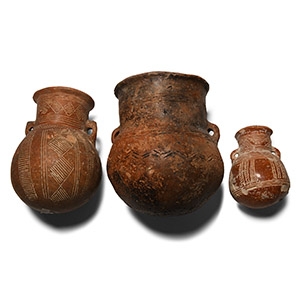
Cypriot Red Polished Ware Jar Group
Middle Bronze Age, circa 2000-1600 B.C.Sold for (Inc. bp): £1,040
Comprising: two with globular body, broad neck and flared rim, pierced lugs to the shoulders, bands of incised hatching; one with rounded underside, broad neck and everted rim, pierced lugs to the shoulder, horizontal broken lines and zigzags. 1.27 kg total, 9.7-15 cm
From a collection acquired on the UK art market from various auction houses and collections mostly before 2000. From an important Cambridgeshire estate; thence by descent.
In the Early Bronze Age, the most common form of Cypriot jars was the round-based, two-handled variety, with the handles attached on the vertical plane.
