
Loading, please wait...
LOT 0552
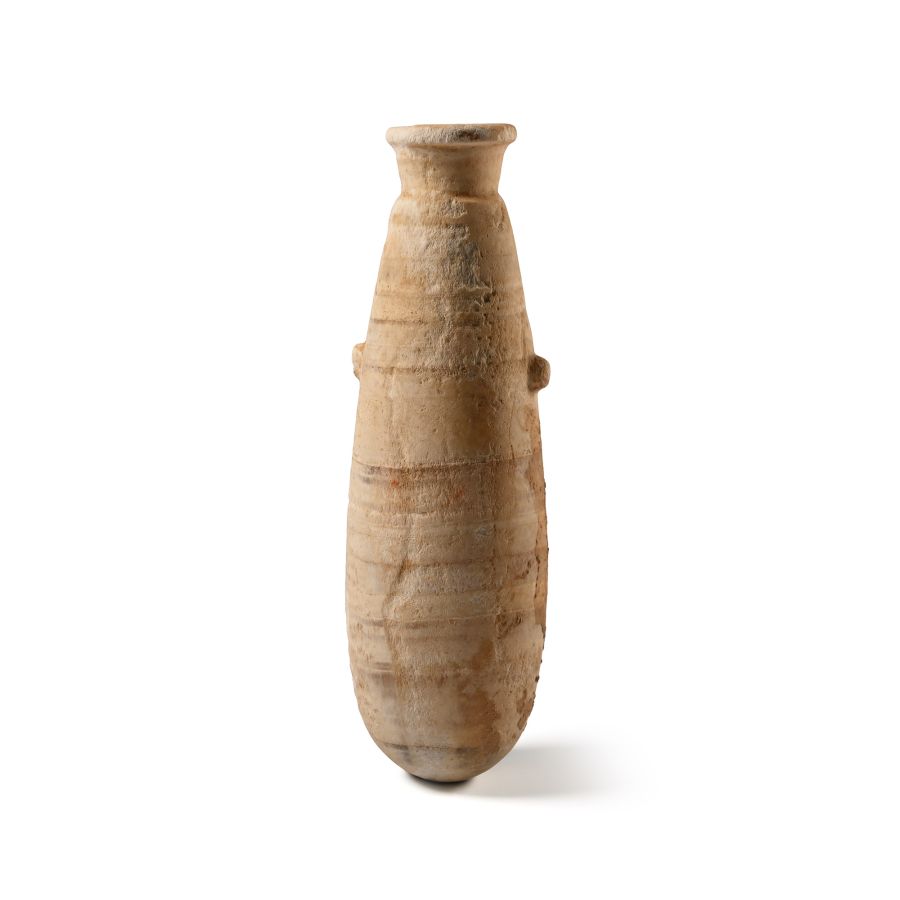
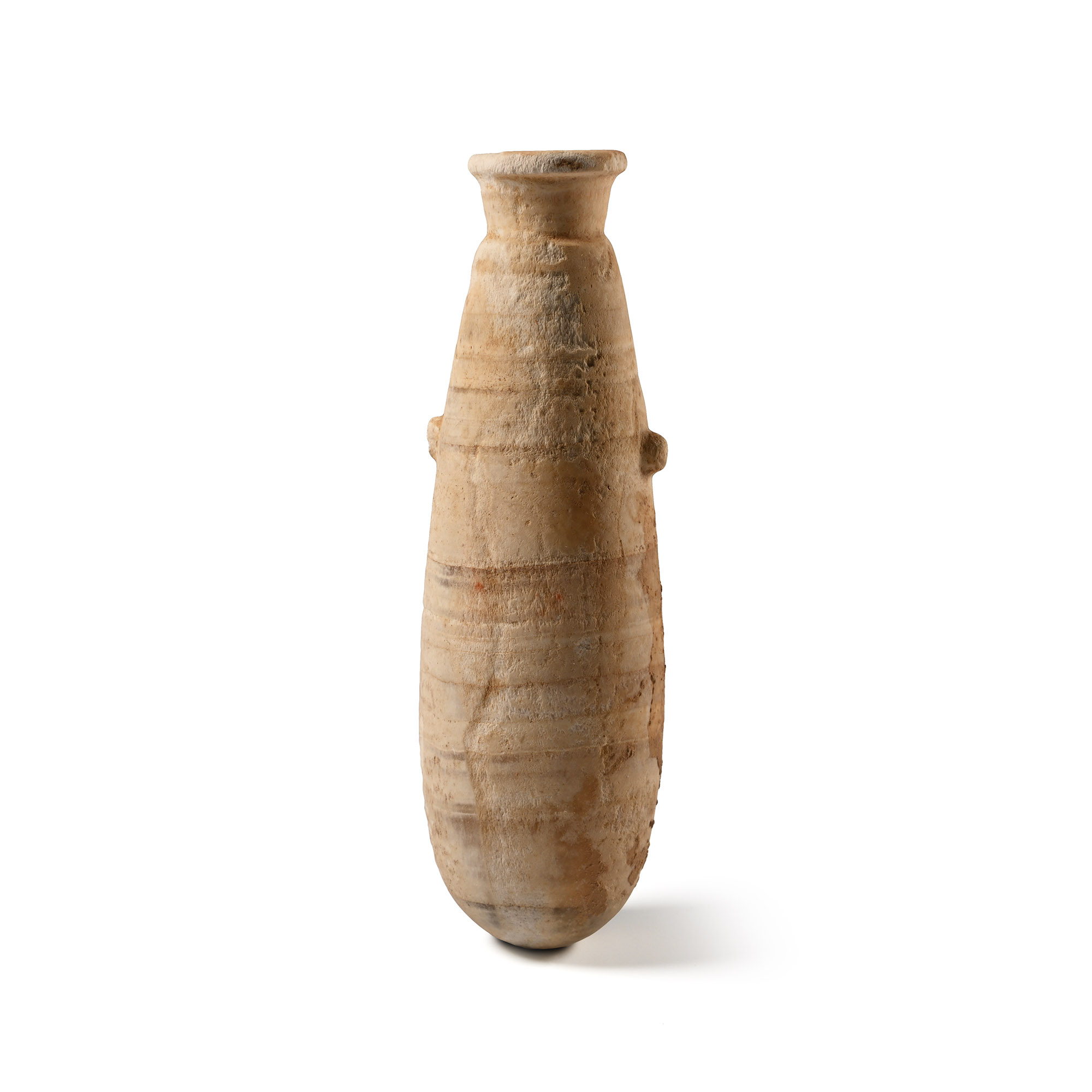
Cypriot Alabaster Alabastron
6TH-4TH CENTURY B.C.
4 3/8 in. (72 grams, 11 cm).
With a slender piriform body and two lug handles, conical neck with everted rim.
ProvenanceAcquired in the mid 1980s-1990s.
Private collection, Switzerland, thence by descent.
Private collection, since the late 1990s.
This lot is accompanied by an illustrated lot declaration signed by the Head of the Antiquities Department, Dr Raffaele D'Amato.
Cf. The Metropolitan Museum of Art, New York, accession no.74.51.5120, for similar; cf. also Bissing, F.W., Studien zur ältesten Kultur Italiens. IV. Alabastra. Studi Etruschi 13, pp. 131– 78, pls.XII-XIII for similar examples.
FootnotesAn example of the greater variability in form is the stone type with alabastron body and anthropomorphic top, sculpted with the upper body of a female. These types have been found in the eastern Mediterranean and Italy dating from the 7th century to the mid to late 6th century and can be divided into two groups: an eastern group beginning in the seventh century, based on Mesopotamian prototypes, and probably produced on Cyprus, as evidenced by its close relation to contemporary Cypriot sculpture; and a western group dating to the first half of the sixth century and produced in Etruria, probably in imitation of eastern examples.
CONDITIONTimeLine Auctions follows a vetting process to ensure the authenticity and legality of all items, reinforcing our commitment to integrity and responsible trading. Each antiquity, antique, and coin lot undergoes thorough examination by a vetting committee of at least ten external specialists, professional trade association members, scientists, and archaeologists: Our Vetting Process
AUCTIONS:
TimeLine is a leading auction house specialising in antiquities, ancient art, collectables, natural history, coins, medals, and books. Our auctions offer museums, collectors, historians, and enthusiasts the opportunity to acquire unique and historically significant pieces.
-
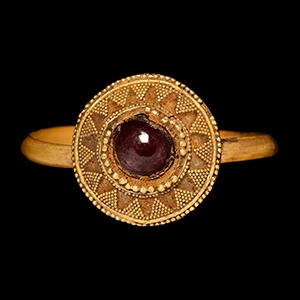
Greek Gold Ring with Garnet Cabochon
5th-3rd century B.C.Sold for (Inc. bp): £1,560
Comprising a slender hoop and an applied granulated bezel set with a garnet cabochon, the granules forming a radiating star motif around the cabochon. 2.80 grams, 21.53 mm overall, 19.67 mm internal diameter (approximate size British L, USA 5 3/4, Europe 11.24, Japan 10)
Ex German art market, 2000s. Acquired from an EU collector living in London. From the collection of a Surrey, UK, gentleman. This lot is accompanied by an illustrated lot declaration signed by the Head of the Antiquities Department, Dr Raffaele D'Amato. -
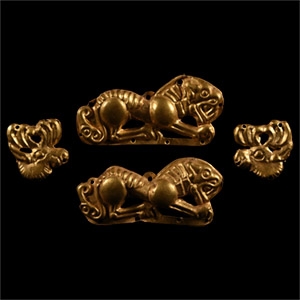
Scythian Gold Appliqué Collection
5th-3rd century B.C.Sold for (Inc. bp): £4,680
Group of sheet-gold appliqué mounts with repoussé detailing comprising a pair of advancing lions with coiled tail and open mouth; a pair of elk heads with curved antlers; supplied with a custom-made presentation mount. 5.28 grams total, 19-47 mm (124 grams total, mount: 11.5 cm high)
German art market. European private collection, 1970s-early 2000s. Acquired from the above; thence by descent. Private collection, London, UK. This lot has been checked against the Interpol Database of stolen works of art and is accompanied by a search certificate number no.12670-234552. This lot has been cleared against the Art Loss Register database, and is accompanied by an illustrated lot declaration signed by the Head of the Antiquities Department, Dr Raffaele D'Amato. -
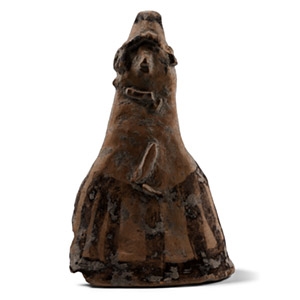
Daunian Ceramic Bell-Shaped Idol
7th-6th century B.C.Estimate: £500 - 700 (‡+bp*)
Opening Bid: £250
A male figure with a bell-shaped lower body painted with horizontal stripes, an applied phallus above; column-like upper body and head with stylised facial features, tall conical headdress. 140 grams, 12.5 cm
Private collection of Mrs R.K., Basel, Switzerland. with Galerie Rhéa, Zurich, Switzerland. This lot is accompanied by an illustrated lot declaration signed by the Head of the Antiquities Department, Dr Raffaele D'Amato.
