
Loading, please wait...

LOT 1393
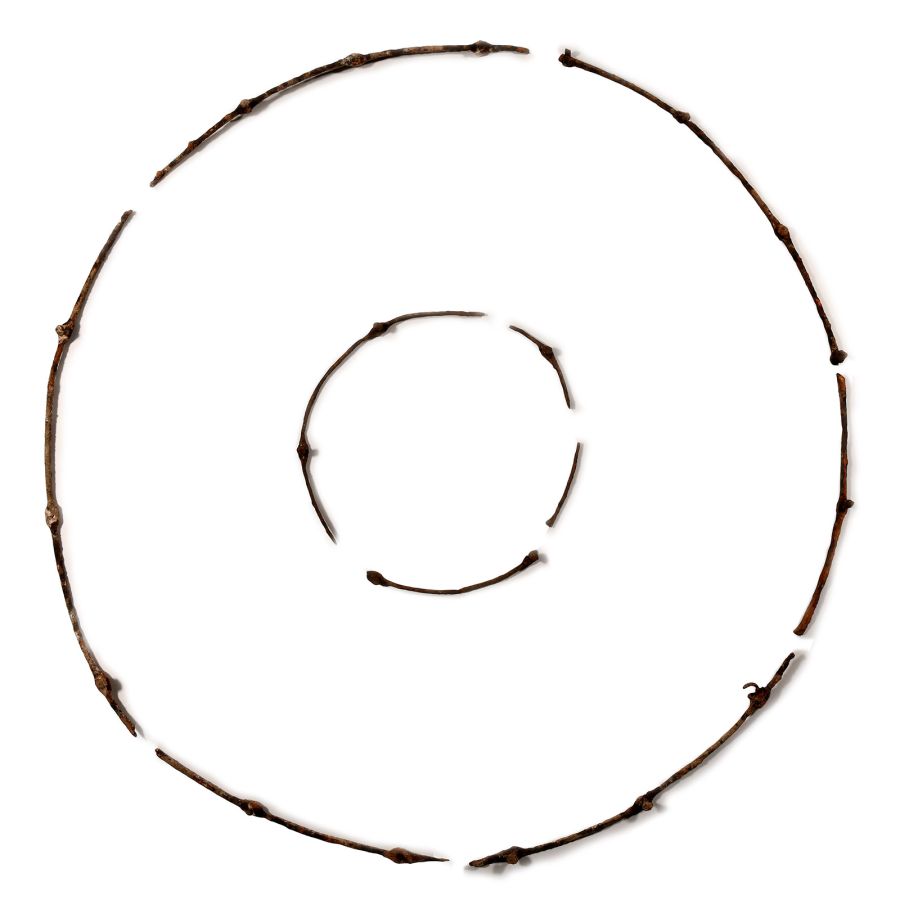
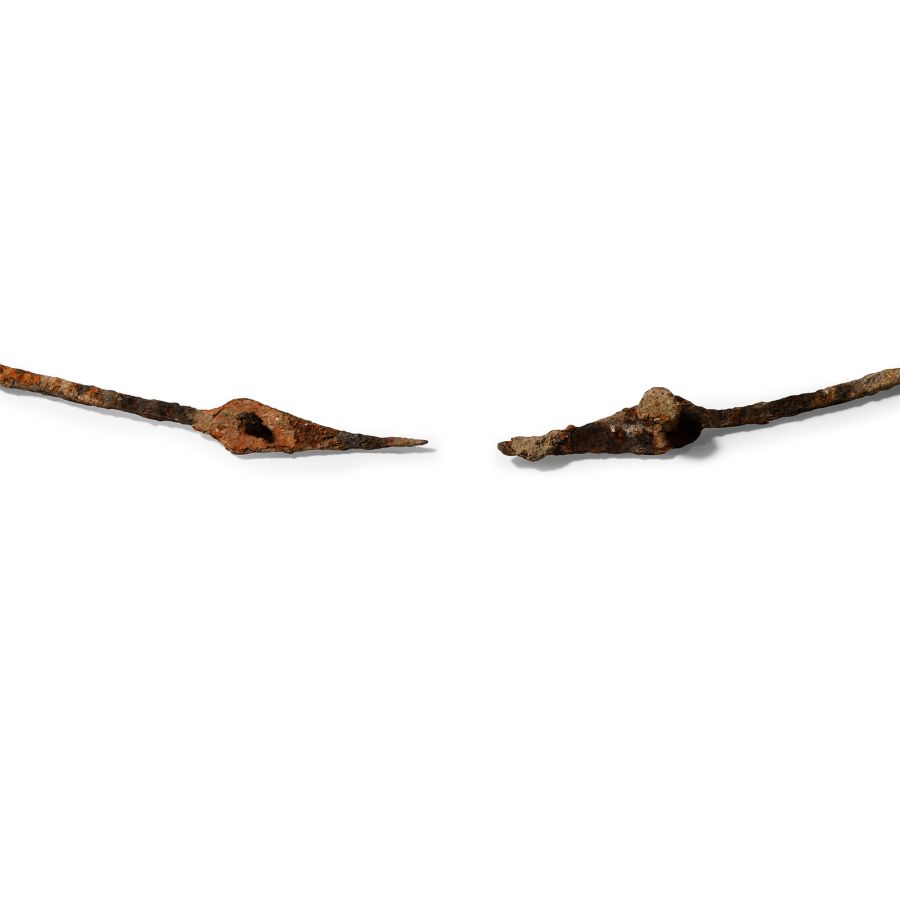
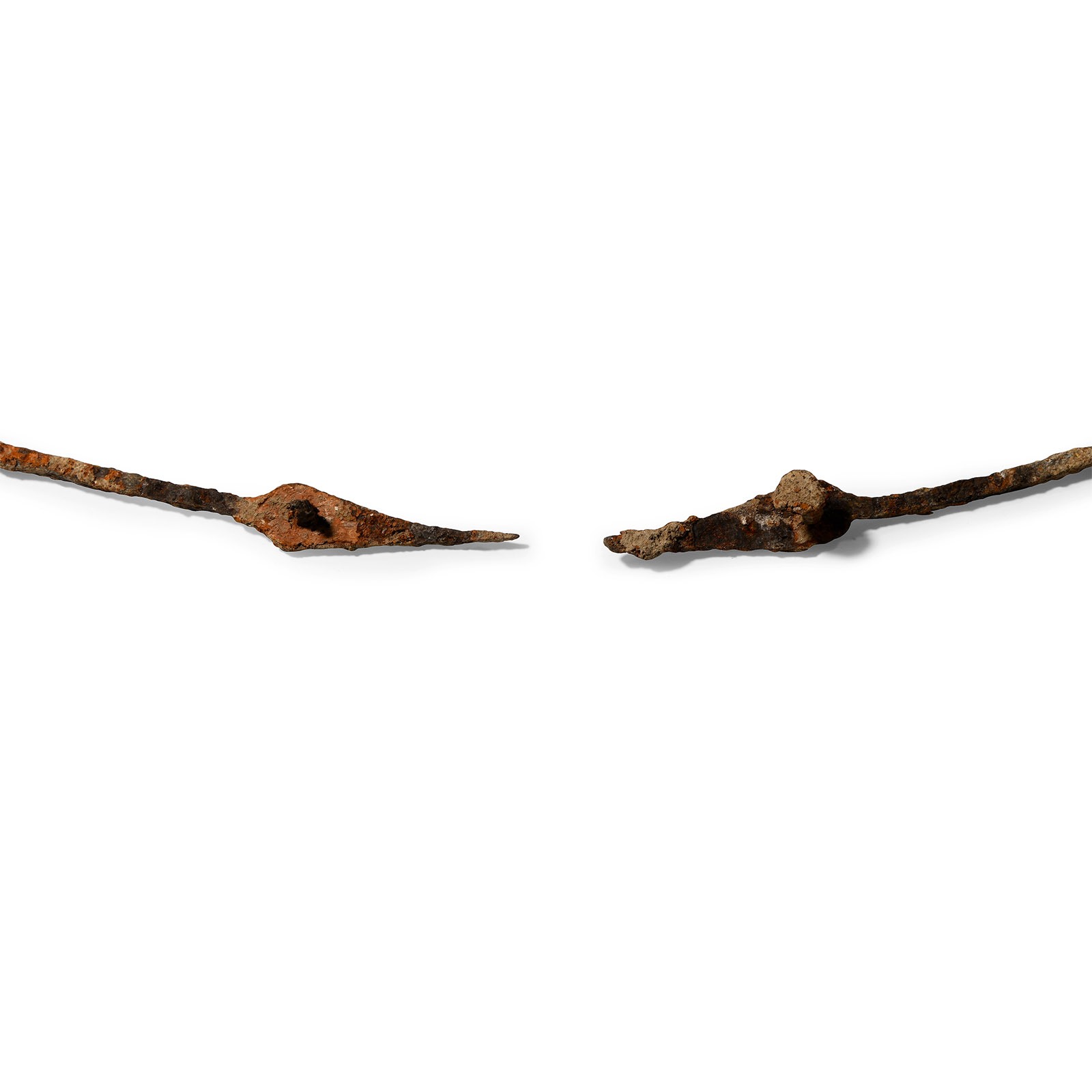
Cuman-Qipchak Iron Shield Rim Group
12TH-13TH CENTURY A.D.
2 6/7 - 17 in. (252 grams total, 7.2-43 cm).
Square in section and curved in profile with pierced lobes and attachment rivets. [10, No Reserve]
ProvenanceUK gallery, early 2000s.
LiteratureCf. in Dmitriev, A.V., Narozhniy E.I., 'Two Burials of Nomadic Warriors of the 13th-14th Centuries from the North-Eastern Black Sea Region (to the history of the formation of the complex of weapons of the Golden Horde' in Bocharova S.G. and Sitdikova A.G. The Genoese Gazaria and the Golden Horde, Vol.2 (in Russian),Kazan — Kishinev, 2019, fig.12, for identical shield
FootnotesThese kind of shields are often found in the burials of nomadic warriors of Eastern Europe accompanied by certain sets of weapons — four-part helmets, quiver kits, sabers and a spearhead. Such graves contained the remains of similar wooden shields with metal parts. Determining the dating of these burial complexes in the framework of the Golden Horde time, the Archaeologists dwell in detail on the attribution of the helmets and the remnants of the shields, linking their appearance in the Northeast Black Sea Coast with the resettlement here of the black hoods from Southern Russia in 1260s.
CONDITIONTimeLine Auctions follows a vetting process to ensure the authenticity and legality of all items, reinforcing our commitment to integrity and responsible trading. Each antiquity, antique, and coin lot undergoes thorough examination by a vetting committee of at least ten external specialists, professional trade association members, scientists, and archaeologists: Our Vetting Process
AUCTIONS:
TimeLine is a leading auction house specialising in antiquities, ancient art, collectables, natural history, coins, medals, and books. Our auctions offer museums, collectors, historians, and enthusiasts the opportunity to acquire unique and historically significant pieces.
-
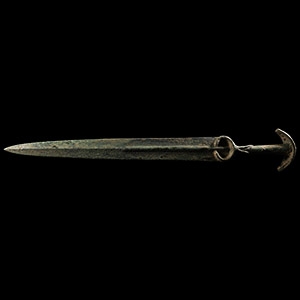
Luristan Bronze Sword
14th-10th century B.C.Sold for (Inc. bp): £975
Of type II with crescentic pommel, the grip with V-shaped collar and penannular guard, blade with a broad, raised midrib. 684 grams, 56 cm
Ex Abelita family collection, 1988.
The crescentic pommel and the penannular guard were probably cast in a one piece-mould. These kinds of pommels are typical of the iron swords of type 2 from Luristan. A certain number of Luristan daggers and swords have bronze or iron blades with cast-on bronze hilts. The typology of winged pommel bronze grip is visible on examples in the British Museum and the National Museum of Iran. -
.jpg)
Western Asiatic Bronze Arrowheads, Javelin Heads and Daggers
3rd millennium-7th century B.C.Sold for (Inc. bp): £195
Comprising ten slender tanged arrowheads, javelin heads and daggers, some lozenge-section and some with raised midribs. 329 grams total, 14-21.5 cm
Acquired 1980-2015. Ex Abelita family collection.
Most of these blades are bipartite, but the definition of the bipartite type is not absolute as it brings together weapons of very different and unrelated designs. In fact, some weapons do not have a sufficiently characteristic shape to be interpreted as a spear, dagger, or long arrowhead. The javelin heads classified by Gernez as type Type L 3 are characterized by the simplicity of their design. They have a sharp and/or pointed active part, a flat, elliptical or rhomboidal cross-section and an elongated tang with a rectangular, square or circular section, ending in a pointed, widened, curved or folded blade. -
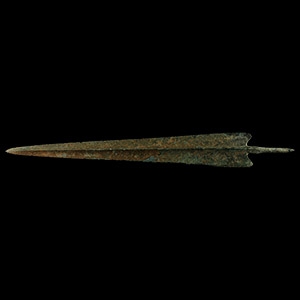
Large North-Western Persian Bronze Sword Blade
11h-7th century B.C.Estimate: £180 - 240 (+bp*)
Opening Bid: £90
With prominently curved guard extending out from the ricasso partly framing the hilt, thick midrib extending slightly above the ricasso. 385 grams, 44 cm
Acquired 1980-2015. Ex Abelita family collection.
The hilt of such swords was made separately and unfortunately is nearly always missing from the archaeological records. Similar daggers had a northern Iranian background and excavated examples have been recorded from the South Caspian area from Tomadjan and Ghalekuti. Their chronology ranges from the late 2nd millennium B.C. to the 7th century B.C.
