
Loading, please wait...
LOT 0438
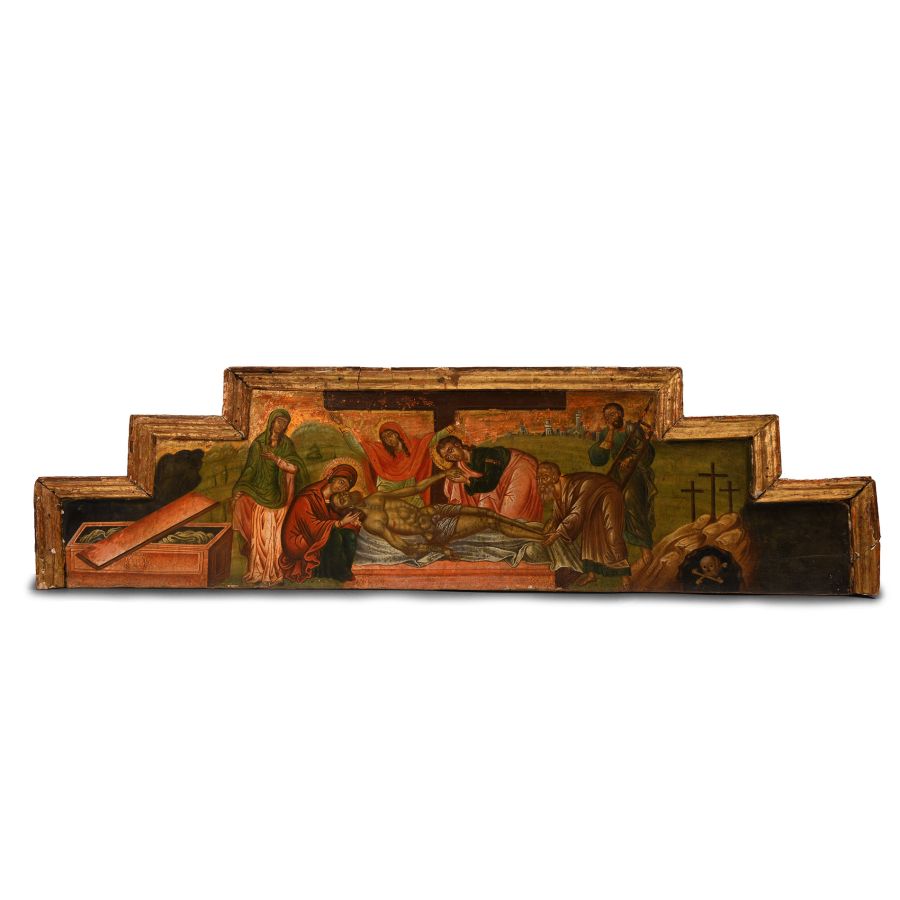
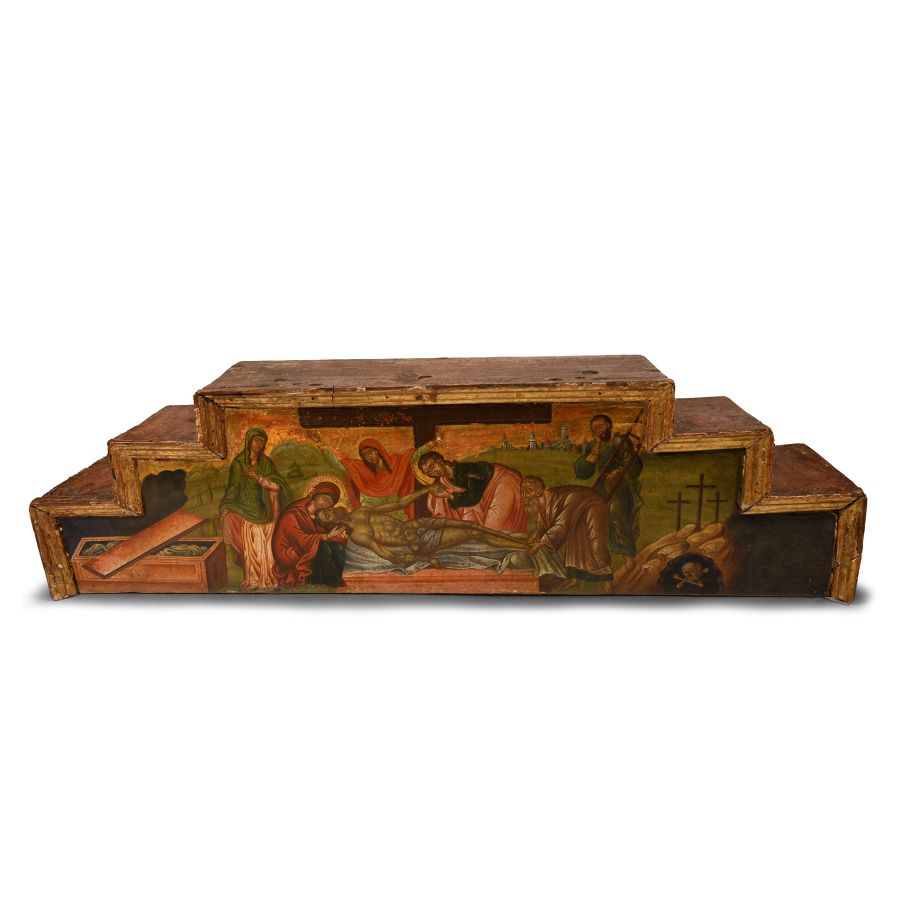
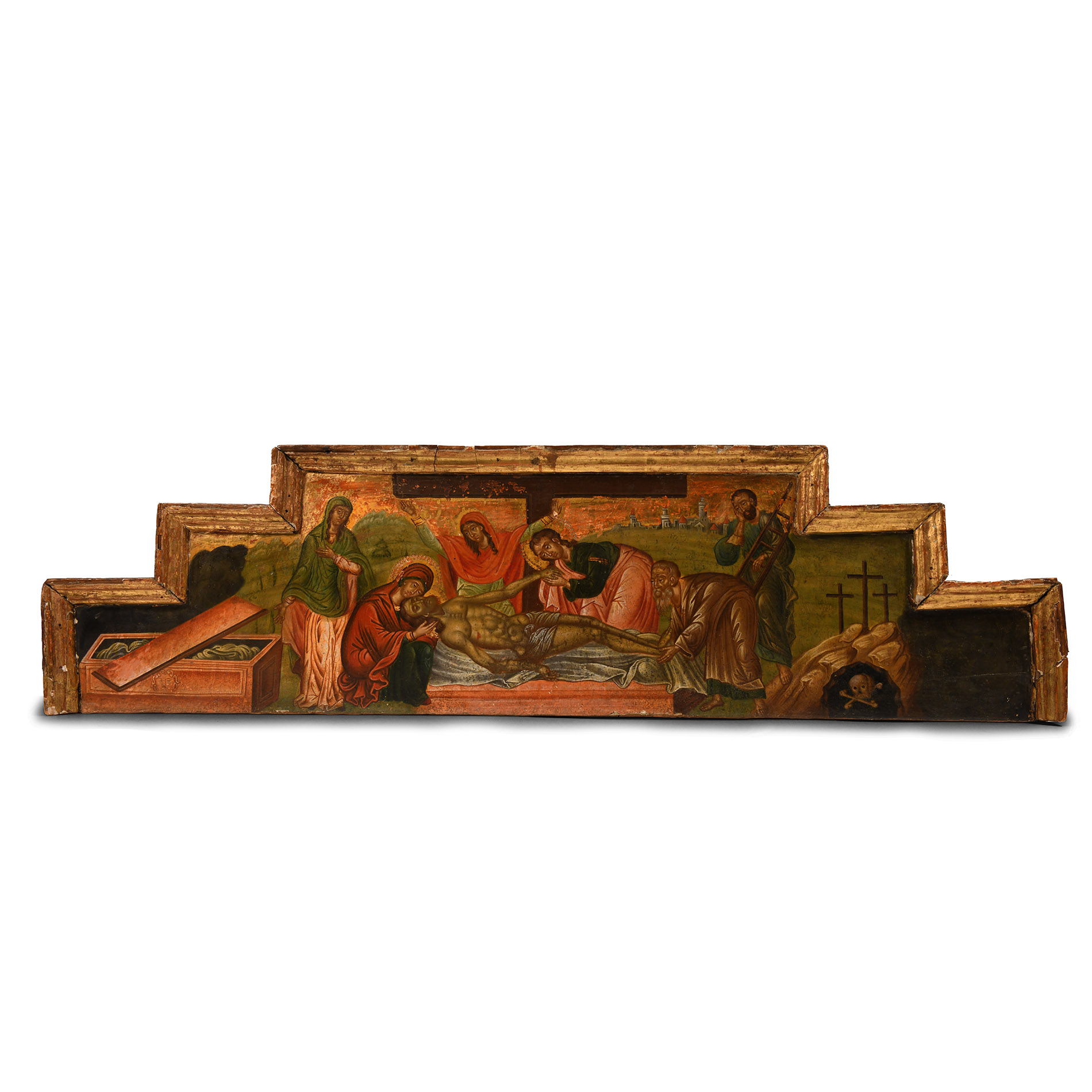
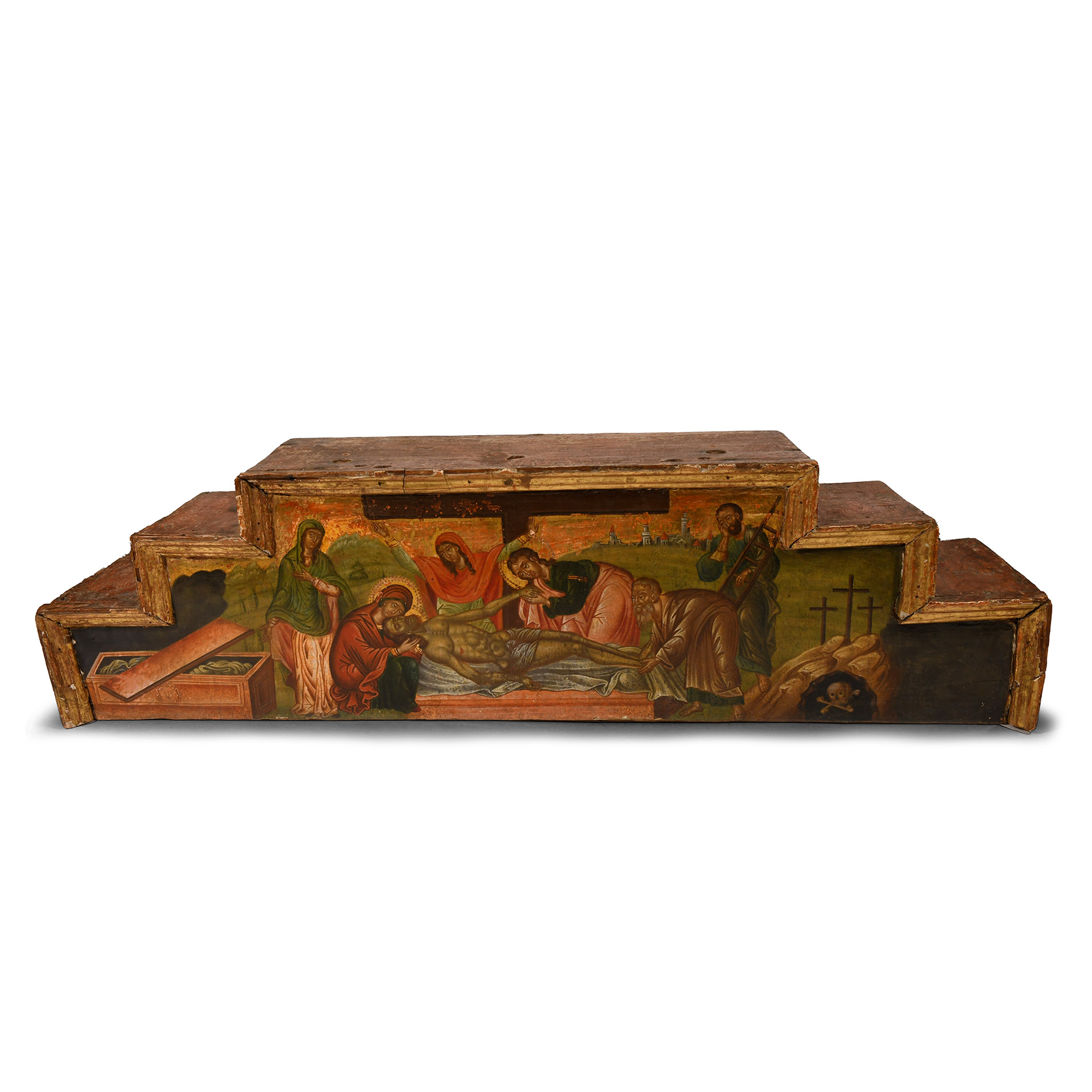
Cretan School Wooden Pedestal Cross Base with 'Descent from the Cross' Gilt Painted Scene
CIRCA 17TH CENTURY A.D.
41 in. (8 kg, 104 cm wide).
Hollow-constructed stepped pedestal with socket to accept a devotional cross; gesso surface with moulded edging and gilt finish; painted scene of the 'descent from the cross' and 'lamentation of the Christ' with Christ laid out on the Holy Shroud surrounded by sorrowful Mary Magdalene, Virgin Mary, Mary of Clopas, St John the Evangelist, St Joseph of Arimathea and Nicodemus holding a ladder in the background; coffin with open cover to the left, cave of Golgotha to the right with skull, landscape with city of Jerusalem in the background.
ProvenanceEx property of a London lady, part of her family's collection.
Accompanied by an academic report by Dr Raffaele D’Amato.
This lot has been checked against the Interpol Database of stolen works of art and is accompanied by search certificate no. 11542-196369.
Cf. Popescu, G.A., Cristiani d'Oriente, spiritualità, arte e potere nell'Europa Post-Bizantina, Milano, 1999, figs.109,111; Sinkević, I., Windows to the Heaven, treasures from the Museum of Russian Icons, Easton, 2017, no.R2003.12; see Lazarev, V. N., Russian icon painting from the origins to the beginning of the 16th century, Moscow, 2000.
FootnotesIn the Orthodox world, single wooden crosses representing the Stavrosis (Crucifixion) were positioned as icons in their own right, with candles placed in front of them as offering for the dead. It is a tradition that dates back to Byzantium, and was continued in the Slavic Orthodox world with the creation of splendid painted wooden crucifixes placed on equally beautifully painted pedestals. In this case the complex representation includes all the elements of the Gospel that recall the passion, death and resurrection of Christ. Christ has been taken down from the cross and is surrounded by his loved ones. His muscular body highlights the wound in his right side procured by Longinus' spear. The pain of the mother, the piety of Mary, is expressed here with the mute silence of the Madonna, who holds her son's head, which contrasts with the pain manifested by the other bystanders. Saint Joseph of Arimathea, who procured the tomb and the sacred sheet, devoutly holds the feet of Christ. The right side of the scene shows the Golgotha, symbol of the human death of Christ. The left of the scene shows the open tomb, symbol of the human and divine Resurrection of Christ. The sacred sheet, loose inside the sepulchre with open lid, appears as a symbol of the saving grace of the Resurrection. The city in the background represents ancient Jerusalem transformed into its heavenly equivalent through the Resurrection of Christ.
CONDITIONTimeLine Auctions follows a vetting process to ensure the authenticity and legality of all items, reinforcing our commitment to integrity and responsible trading. Each antiquity, antique, and coin lot undergoes thorough examination by a vetting committee of at least ten external specialists, professional trade association members, scientists, and archaeologists: Our Vetting Process
AUCTIONS:
TimeLine is a leading auction house specialising in antiquities, ancient art, collectables, natural history, coins, medals, and books. Our auctions offer museums, collectors, historians, and enthusiasts the opportunity to acquire unique and historically significant pieces.
LOT 0438
Cretan School Wooden Pedestal Cross Base with 'Descent from the Cross' Gilt Painted Scene
Sold for (Inc. bp): £13,000
-
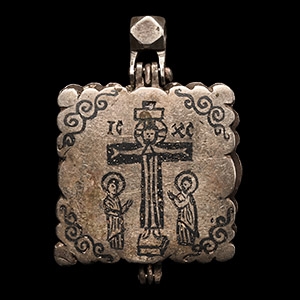
Silver Reliquary Pendant
17th century A.D. or earlierSold for (Inc. bp): £514
Presenting a scalloped frame and bifacial black enamelled detailing: one side with the Crucifixion scene, niello 'IC XC' in the field, two saints at the foot of the cross, scrolling borders; the reverse with 'IC XC / NI KA' over two lines with cross between; articulate and facetted loop. 30.9 grams, 51 mm
From the collection of a North American gentleman, formed in the 1990s.
A small reliquary pendant, possibly containing the remains of cloth or bone of a saint. The relics had to be kept in containers that expressed the dignity of their contents: chests, cases and, of course, reliquaries. This also applied to personal relics, often in the form of pendants, which were sometimes made in gold and silver. -
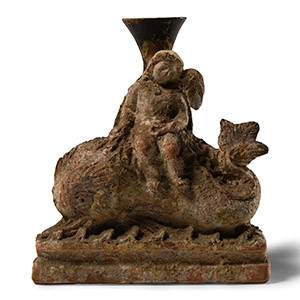
Greek Style Plastic Vase
20th century A.D.Sold for (Inc. bp): £78
Comprising a D-shaped base and trumpet-shaped spout with loop handle, figure of a winged putto sitting on the back of a dolphin; after the antique. 102 grams, 10.5 cm
Ex Paris collection, early 20th century. -
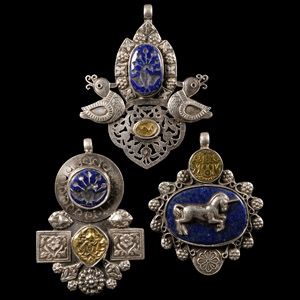
Mixed Pendant Group
20th century A.D.Sold for (Inc. bp): £46
Mixed group of silver-coloured metal pendants each with a lapis lazuli insert, one with a unicorn appliqué, one with intaglio peacock, one with incuse floral motif. 147 grams total, 81-92 mm
Property of a South West London gentleman.
