
Loading, please wait...
_900x900.jpg "Coptic Marble Liturgical Vessel Fragment with Inscription")
_200x200.jpg "Coptic Marble Liturgical Vessel Fragment with Inscription")
_900x900.jpg "Coptic Marble Liturgical Vessel Fragment with Inscription")
_200x200.jpg "Coptic Marble Liturgical Vessel Fragment with Inscription")
.jpg "Coptic Marble Liturgical Vessel Fragment with Inscription")
.jpg "Coptic Marble Liturgical Vessel Fragment with Inscription")
LOT 0026
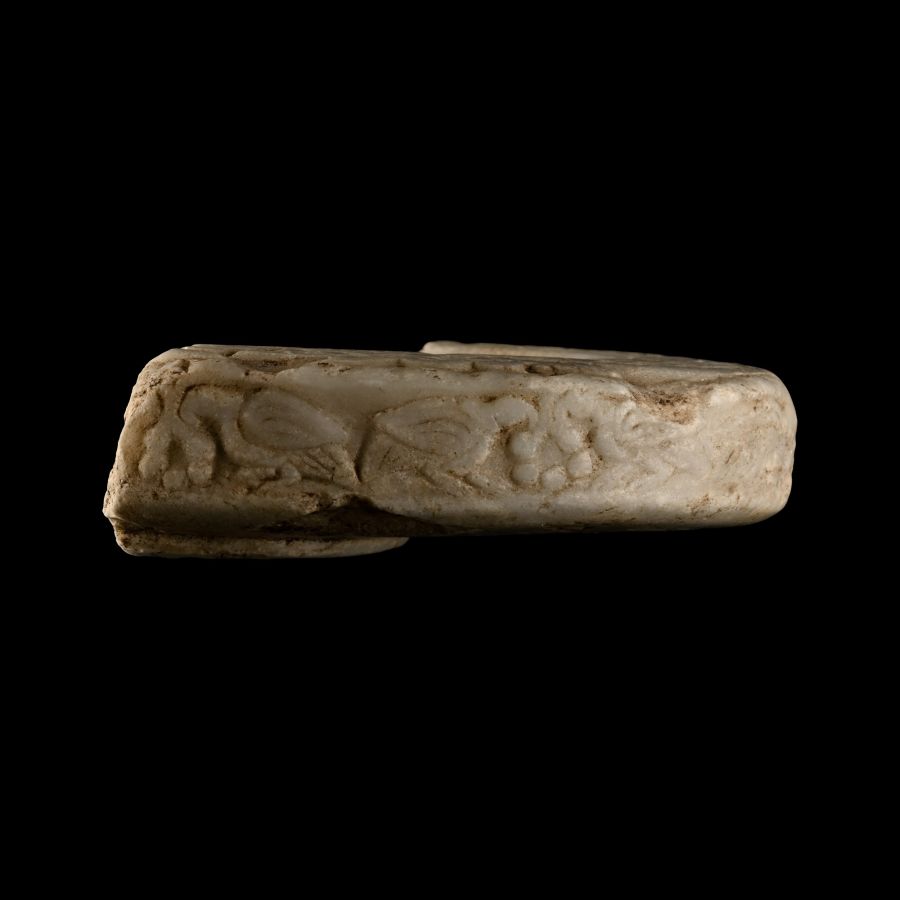
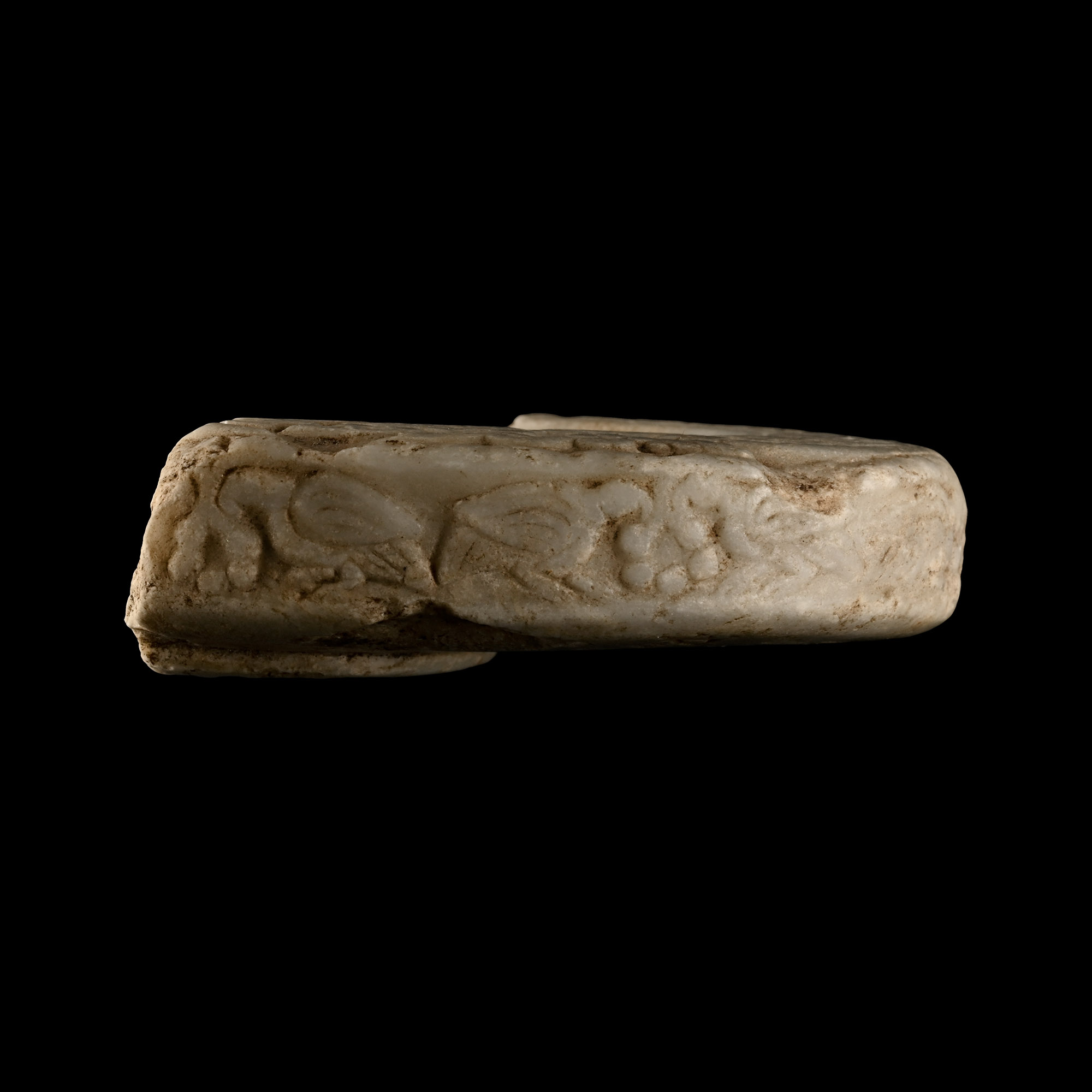
Coptic Marble Liturgical Vessel Fragment with Inscription
6TH CENTURY A.D.
2 1/8 in. (87 grams, 55 mm).
Tongue-shaped with low rounded pad on the underside, raised edge with low-relief decoration of grape vines and leaves, the edge with pairs of opposing doves eating grapes; dedicatory Demotic inscription on the underside.
ProvenanceAcquired in the mid 1980s-1990s.
Private collection, Switzerland, thence by descent.
Private collection, since the late 1990s.
Accompanied by an academic report by Dr Raffaele D'Amato.
This lot has been checked against the Interpol Database of stolen works of art and is accompanied by a search certificate number no.12575-232108.
This lot has been cleared against the Art Loss Register database, and is accompanied by an illustrated lot declaration signed by the Head of the Antiquities Department, Dr Raffaele D'Amato.
See Atalla, N.S., Coptic Art, Sculptures, Architecture, L'Art Copte, II, Cairo, 1989, figs. pp.109ff., for similar carved interlaces; Rutschowscaya, M.H., Benazeth, D., L’Art Copte en Égypte, 2000 ans de Christianisme, Paris, 2000, figs.109-118; Poupaki, E., ‘Early Byzantine Marble Vases from Kos Island, Dodecanese, Greece’ in Diamanti, C., Vassiliou A. (eds.), Eν Σοφίᾳ μαθητεύσαντες, Essays in Byzantine Material Culture and Society in Honour of Sophia Kalopissi-Verti, Oxford, 2019, figs.2-3, for a possible parallel.
FootnotesThese vessels were used as liturgical objects for church offerings or ritual cult and were extensively employed from late antiquity in ecclesiastical contexts.
CONDITIONTimeLine Auctions follows a vetting process to ensure the authenticity and legality of all items, reinforcing our commitment to integrity and responsible trading. Each antiquity, antique, and coin lot undergoes thorough examination by a vetting committee of at least ten external specialists, professional trade association members, scientists, and archaeologists: Our Vetting Process
AUCTIONS:
TimeLine is a leading auction house specialising in antiquities, ancient art, collectables, natural history, coins, medals, and books. Our auctions offer museums, collectors, historians, and enthusiasts the opportunity to acquire unique and historically significant pieces.
LOT 0026
Coptic Marble Liturgical Vessel Fragment with Inscription
Estimate £1,800 - 2,400€2,090 - 2,780 (for guidance only)$2,430 - 3,240 (for guidance only)
-
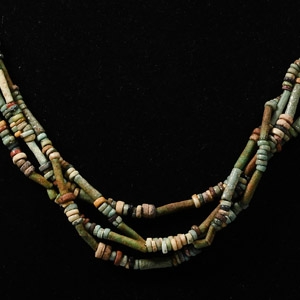
Egyptian Multi-Stranded Mummy Bead Necklace
Late Period, 664-332 B.C.Sold for (Inc. bp): £312
Four-stranded designer necklace composed of beads of mainly annular and tubular types. 21 grams, 67 cm
Acquired before 1979. From the private collection of Mr F.A., South Kensington, London, UK; thence by descent 2014. This lot is accompanied by an illustrated lot declaration signed by the Head of the Antiquities Department, Dr Raffaele D'Amato.
For thousands of years, artisans in Egypt created vibrant ceramics to echo the beauty of rare jewels. These ornaments were created with almost every material, colour, and texture imaginable and they come from across Egypt and beyond: vibrant blue lapis lazuli from Afghanistan, glossy black obsidian from Turkey, and aqua-green turquoise from the Sinai. They were worn in life and, after death, they served as precious ornamentation for mummies. -
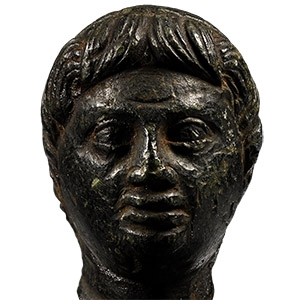
Egyptian Steatite Portrait of a Ptolemaic Prince
2nd-1st century B.C.Estimate: £3,000 - 4,000 (‡+bp*)
Opening Bid: £1,500
With a round face featuring large eyes, a narrow nose that broadens at the end, and full lips downturned at the corners, the forehead has a distinctive deep furrow above the brow; a narrow, twisted diadem encircling his wavy hair; mounted on a custom-made display stand. 84 grams total, 10 cm including stand
Private collection, Bern, Switzerland. with Galerie Rhéa, Zurich, Switzerland. This lot has been checked against the Interpol Database of stolen works of art and is accompanied by a search certificate number no.12631-236408. This lot has been cleared against the Art Loss Register database, and is accompanied by an illustrated lot declaration signed by the Head of the Antiquities Department, Dr Raffaele D'Amato.
The Greek hairstyle is a characteristic feature of Ptolemaic royal portraiture, as is the twisted diadem - a Greek interpretation of the Egyptian headband (the sšd) - which appears on several portrait heads of Ptolemaic boy-kings and princes. The distinctive furrow is intriguing, as it contrasts with the typically blemish-free physiognomy of most Ptolemaic royal sculpture. However, a similar furrow can be seen on the portrait head of a provincial governor from Dendera, dated to the 2nd century B.C. (Bothmer, B.V., Egyptian Sculpture of the Late Period 700 B.C. to A.D. 100, New York, 1960, pp. 144-143, pl. 112, nos. 301-302), which may indicate an artistic trend employed in high-status sculpture at that time. It has been suggested that small royal portrait heads, such as this example, may have served as votives. The lack of an Egyptian-style back pillar on this and similar pieces supports the possibility that they were inserted into statues made of different materials (Ashton, S.-A., Ptolemaic Royal Sculpture from Egypt, BAR International Series 923, Oxford, 2001, p.12). -
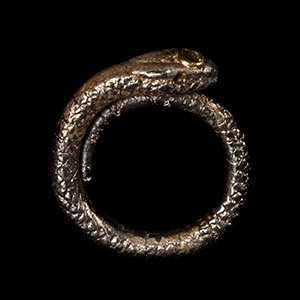
Egyptian Silver Snake Ring
1st millennium B.C.Sold for (Inc. bp): £910
Comprising a round-section tapering body with intricate scale detailing, the head resting on the body, detailed face with closed mouth and rounded eyes, an applied gold annulet with two granules above the head; part of the tail absent. 6.79 grams, 26.03 mm overall, 15.77 mm internal diameter (approximate size British J, USA 4 3/4, Europe 8.69, Japan 8)
Ex Dr Leo Mildenberg, Zurich, 1990s. Acquired by Galerie Rhéa, Zurich, from the above in 1999. This lot is accompanied by an illustrated lot declaration signed by the Head of the Antiquities Department, Dr Raffaele D'Amato.
Snake rings were not originally a traditional form in Egypt and only became common during the Ptolemaic and Roman Periods. Animal-shaped rings, including those with snake motifs, originated in Western Asia around the eighth century BC, spread to Greece by the fifth century BC, and were introduced to Egypt primarily through the Ptolemaic Period. In Greek culture, snakes were often linked to healing, though they likely carried other symbolic meanings as well.
