
Loading, please wait...
_900x900.jpg "Civil War Starr Percussion 1858 Army Revolver")
_200x200.jpg "Civil War Starr Percussion 1858 Army Revolver")
.jpg "Civil War Starr Percussion 1858 Army Revolver")
LOT 0302
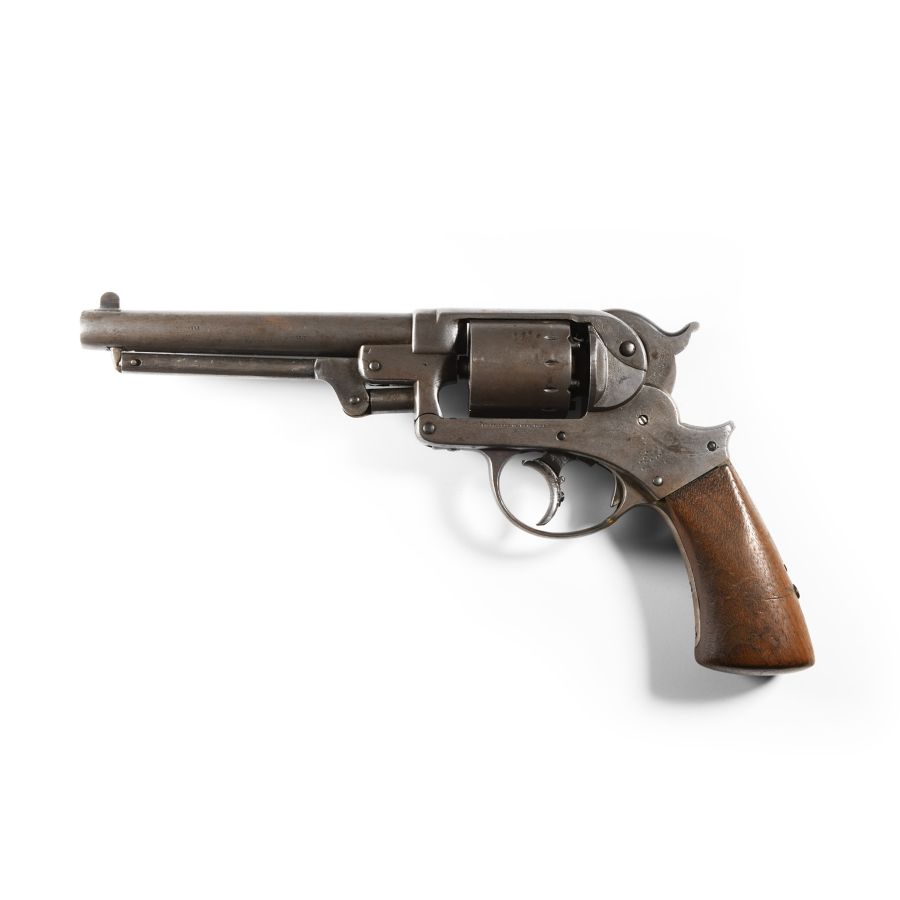
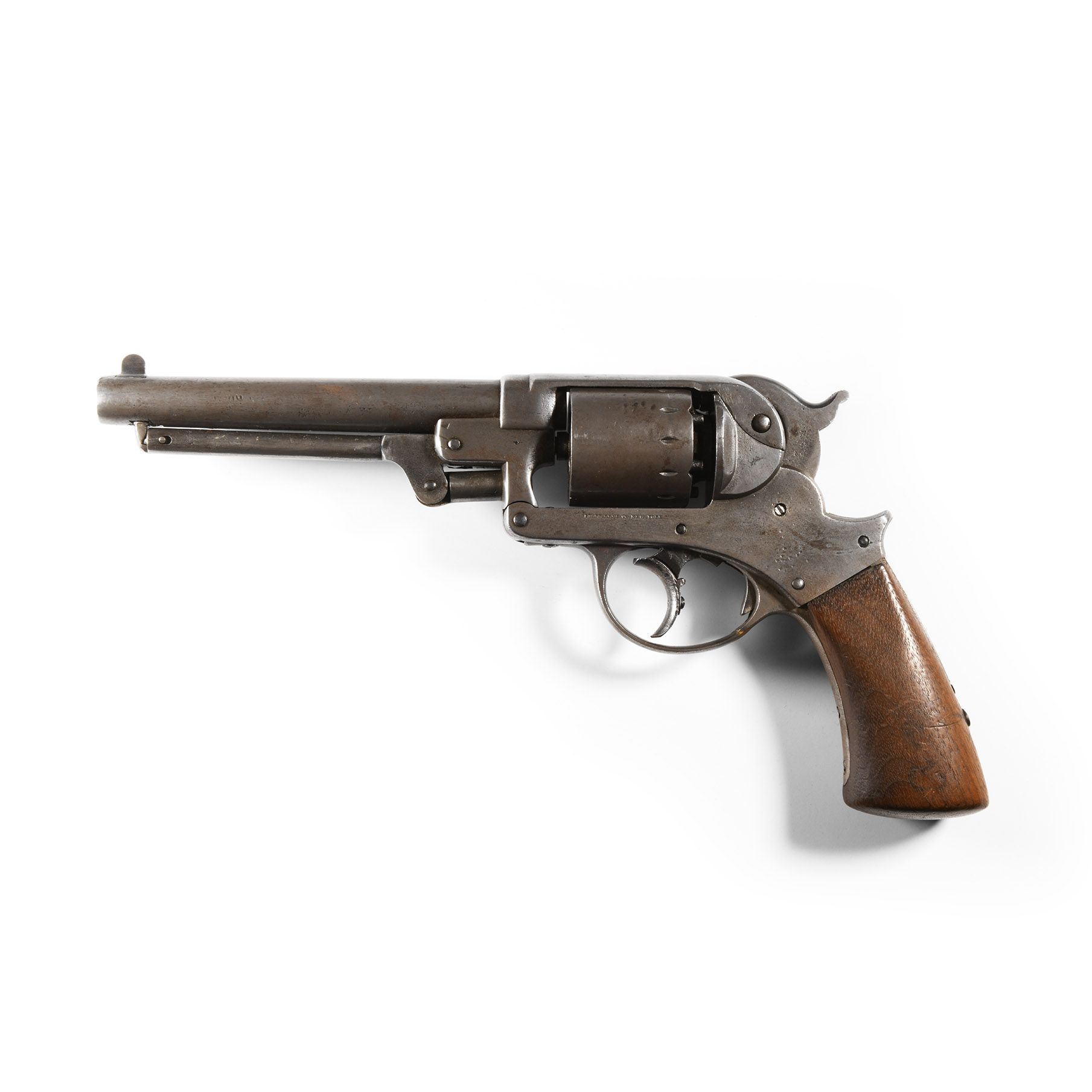
Civil War Starr Percussion 1858 Army Revolver
1861-1865 A.D.
11 1/2 in. (1.12 kg, 29 cm).
Double-action with .44 calibre six-shot cylinder, hinged frame and loading arm with 15cm (6") barrel; marked 'STARR ARMS CO NEW YORK' to left frame, 'STARR'S PATENT JAN 15 1858' to right, numbered 705 to cylinder and 8795/W to front frame; plain wood grip with illegible stamped inspector mark each side; action slightly weak.
ProvenanceAcquired from Bottomley Antiques & Armour, 2014.
The Kusmirek Collection, UK.
Accompanied by a copy of the Bottomley invoice.
See Flayderman, N., Guide to Antique American Firearms, 9th edition, 2007, p.374, No.7A-113, for details.
FootnotesSold as an exempt item under Section 58 (2) of the Firearms Act, 1968, to be held as a curiosity or ornament. No license required but buyer must be over 18 years of age. Overseas bidders should note that, due to UK regulations governing export of all firearms, overseas buyers will need to make arrangements for shipping this lot out of the UK directly, by air freight, with a specialist company or agent.
CONDITIONTimeLine Auctions follows a vetting process to ensure the authenticity and legality of all items, reinforcing our commitment to integrity and responsible trading. Each antiquity, antique, and coin lot undergoes thorough examination by a vetting committee of at least ten external specialists, professional trade association members, scientists, and archaeologists: Our Vetting Process
AUCTIONS:
TimeLine is a leading auction house specialising in antiquities, ancient art, collectables, natural history, coins, medals, and books. Our auctions offer museums, collectors, historians, and enthusiasts the opportunity to acquire unique and historically significant pieces.
LOT 0302
Civil War Starr Percussion 1858 Army Revolver
Estimate £1,200 - 1,700€1,390 - 1,970 (for guidance only)$1,620 - 2,300 (for guidance only)
-
Viking Iron Sword with Inlaid Hilt
8th-10th century A.D.Sold for (Inc. bp): £6,240
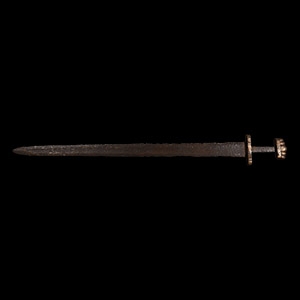
Comprising a double-edged tapering blade showing shallow fullers and wide cutting edges; boat-shaped lower guard with inlaid vertical copper bands; the upper guard decorated in similar fashion; five-lobed pommel with deep grooves between the lobes, each lobe inlaid with copper bands. 1.05 kg, 90 cm
Acquired 1990s-early 2000s. East Anglian private collection. Accompanied by an academic report by Dr Raffaele D'Amato. This lot has been checked against the Interpol Database of stolen works of art and is accompanied by search certificate number no.11592-199910.
It is the decoration and the structure of the sword that suggest classifying it as a type H of Petersen, rather than type R which usually presents a five-lobed pommel. The copper markings are artistically consistent with archaeological examples of decorative work of Viking swords, notably with the one in Suomen Kansallismuseo, Helsinki, published by Peirce (2002, pp.6off.). The decoration, which here takes the form of vertical copper lines, is striped as on the Helsinki specimen. -
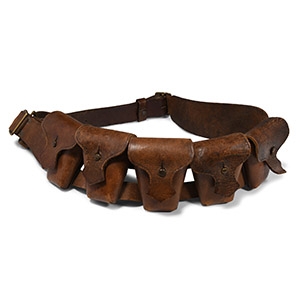
British Leather Ammunition Pouch Belt
1940s A.D.Sold for (Inc. bp): £26
A leather belt with brass buckles to which are rivetted five leather cartridge holders each with internal retaining strap and cover; the reverse of the belt stamped '2575665'. 591 grams, 90 cm long
The Kusmirek Collection, UK. -
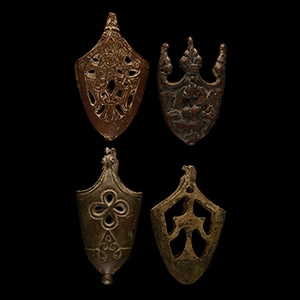
Viking Age Bronze Sword Scabbard Chape Collection
9th-11th century A.D.Sold for (Inc. bp): £715
Comprising: one heater-shaped with openwork raven motif to each face; one similar with openwork raven enmeshed in tendrils; one with fleur-de-lys to the centre of each upper edge and a lobed spur to each side; one with openwork quatrefoil to each face and knop finial to the apex. 145 grams total, 55-85 mm
From the collection of a North American gentleman, formed in the 1990s.
