
Loading, please wait...
LOT 0429
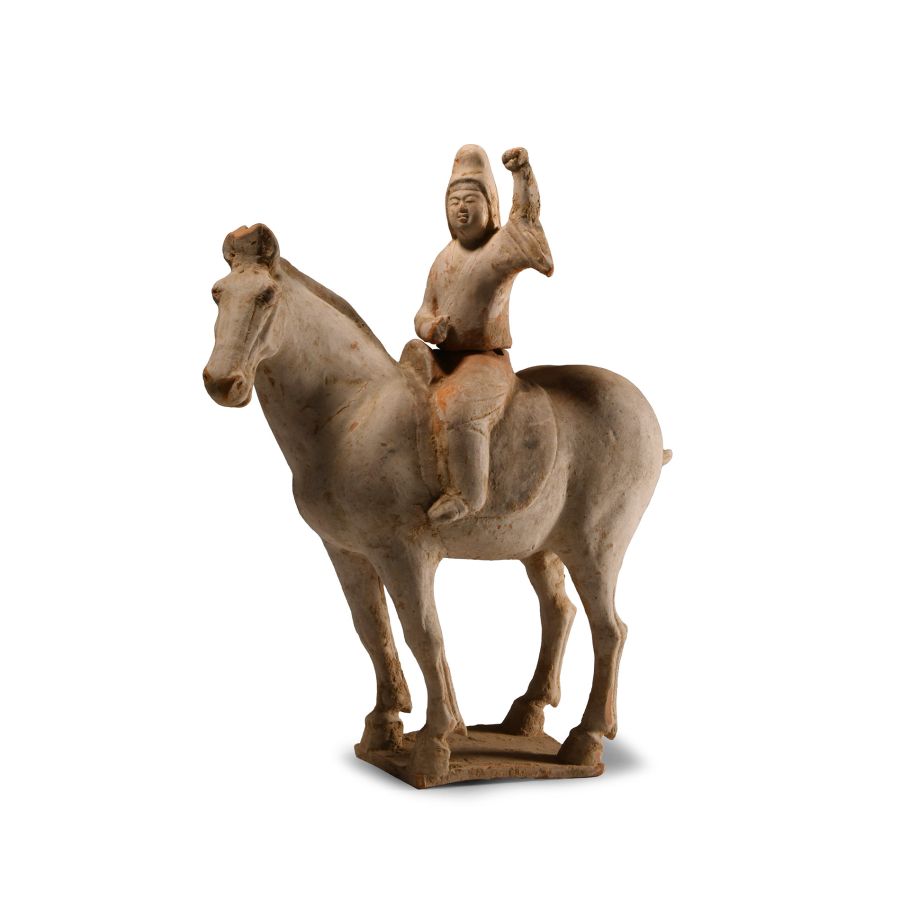
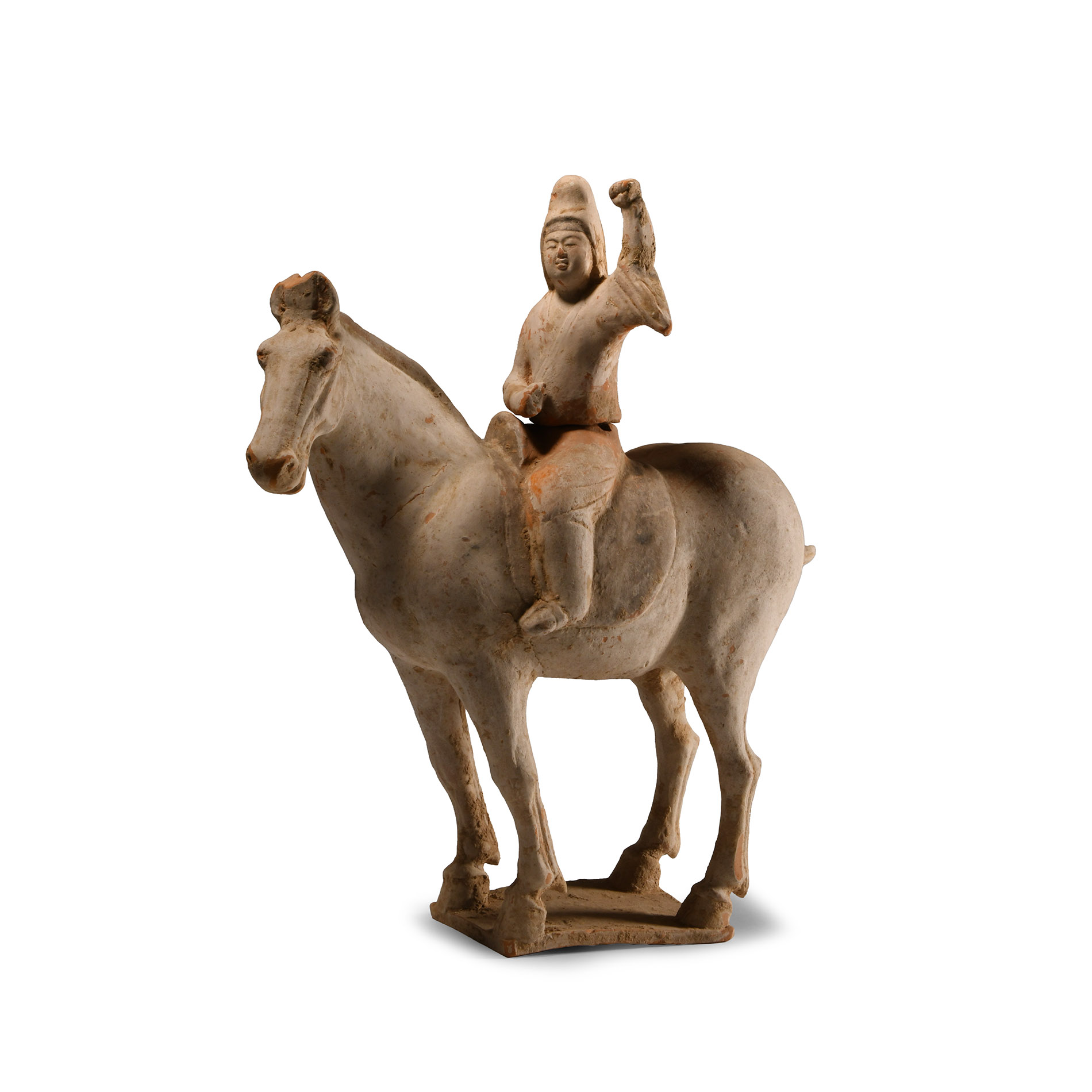
Chinese Tang Horse with Rider
TANG DYNASTY, 618-907 A.D.
12 5/8 in. (1.75 kg, 32 cm high).
Modelled in the round with semi-naturalistic anatomical detailing, the horse standing on a rectangular base, its stocky neck and head slightly turned to the right, ears pricked forwards, cropped mane and short, dressed tail; the separate rider seated in saddle wearing a knee-length robe, hood and riding boots, one arm held in front of his body, the other raised above his head, detailing to his face; remains of polychrome pigmentation; the upper half of the rider's body modelled separately.
ProvenanceFrom the R.M.Hicks OBE private collection, UK.
Accompanied by an original thermoluminescence analysis report no.C106u29 from Oxford Authentication.
Cf. The Metropolitan Museum, New York, accession numbers 54.169 and 1991.253.7a, b, for similar figures.
FootnotesA symbol of military strength and social status, the horse was ever a potent mythological and symbolic animal in China. During the Tang Dynasty, both polo and hunting from horseback became fashionable for men and women. It was also during the Tang Dynasty period that female court attendants on horses appeared in art and in tomb sculpture. The fruits of China's relationship with the horse include three of the most important innovations in equestrian history: the horse collar, the stirrup and harnesses based on the breast strap. The failure of China's domestic horse breeding programmes forced them to artificially inflate the price of tea (the production of which was controlled by China), so that tea could be traded for horses from their neighbours.
CONDITIONTimeLine Auctions follows a vetting process to ensure the authenticity and legality of all items, reinforcing our commitment to integrity and responsible trading. Each antiquity, antique, and coin lot undergoes thorough examination by a vetting committee of at least ten external specialists, professional trade association members, scientists, and archaeologists: Our Vetting Process
AUCTIONS:
TimeLine is a leading auction house specialising in antiquities, ancient art, collectables, natural history, coins, medals, and books. Our auctions offer museums, collectors, historians, and enthusiasts the opportunity to acquire unique and historically significant pieces.
-
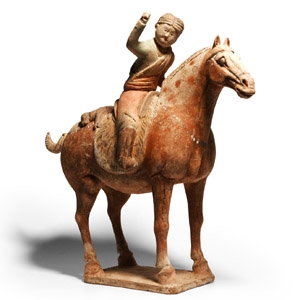
Chinese Tang Hunter on Horseback
Tang Dynasty, 618-907 A.D. or laterEstimate: £1,800 - 2,400 (+bp*)
Opening Bid: £1,000
Modelled with semi-naturalistic anatomical detailing, standing on a rectangular base, extensive remains of painted pigmentation, the horse with a cropped mane, painted bridle, harness and decorative saddlecloth, prey animal slung behind saddle, rider in the saddle leaning forwards with one arm raised, hand in a gripping position forming a socket to accept a weapon or other object. 3.8 kg, 40 cm
Fine condition.
Acquired 1990s. West Country, UK, collection. This lot has been checked against the Interpol Database of stolen works of art and is accompanied by search certificate no.11364-193072.
The Lari Festival was a Chinese celebration observed during the Tang era, intended to offer sacrifice to various gods at the end of the year. In the Tang Dynasty, it was a custom to hunt on this day, which was not only meant to meet the demand for sacrifice, but also to emphasise warrior culture, with his love of the hunt. In the poem titled Hunting On Lari Festival, Yao He in the mid and late periods of the Tang Dynasty also mentioned one of his collective hunting events to meet the demand for sacrifice on that festival when he was governor of Jin Zhou. Emperor Xianzong was very much astounded at such slaughters of foxes and hares and observed, "Every Lari Festival recent years, I heard some prefectures and counties, to take something to the capital, catch and raise foxes and hares to serve as tributes” (Complete Tang Proses,Vol. 60); therefore he issued the Fox & Hare Hunting Forbidding Decree. -
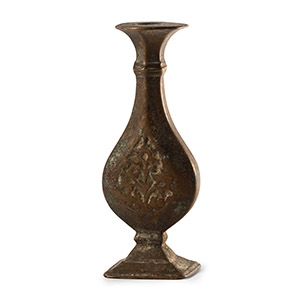
South East Asian Bronze Kohl Pot
18th-19th century A.D.Sold for (Inc. bp): £20
Baluster-shaped with a rectangular foot and hexagonal rim, both faces with floral ornament. 71 grams, 82 mm
From the collection of H.N., Milton Keynes, 1980s-1990s. -
.jpg)
South East Asian Bronze Kohl Pot
18th-19th century A.D.Sold for (Inc. bp): £7
The squat body supported on four legs, cylindrical neck with collars and flange rim with incised linear decoration. 297 grams, 12 cm high
From the collection of H.N., Milton Keynes, 1980s-1990s.
