
Loading, please wait...
LOT 1442
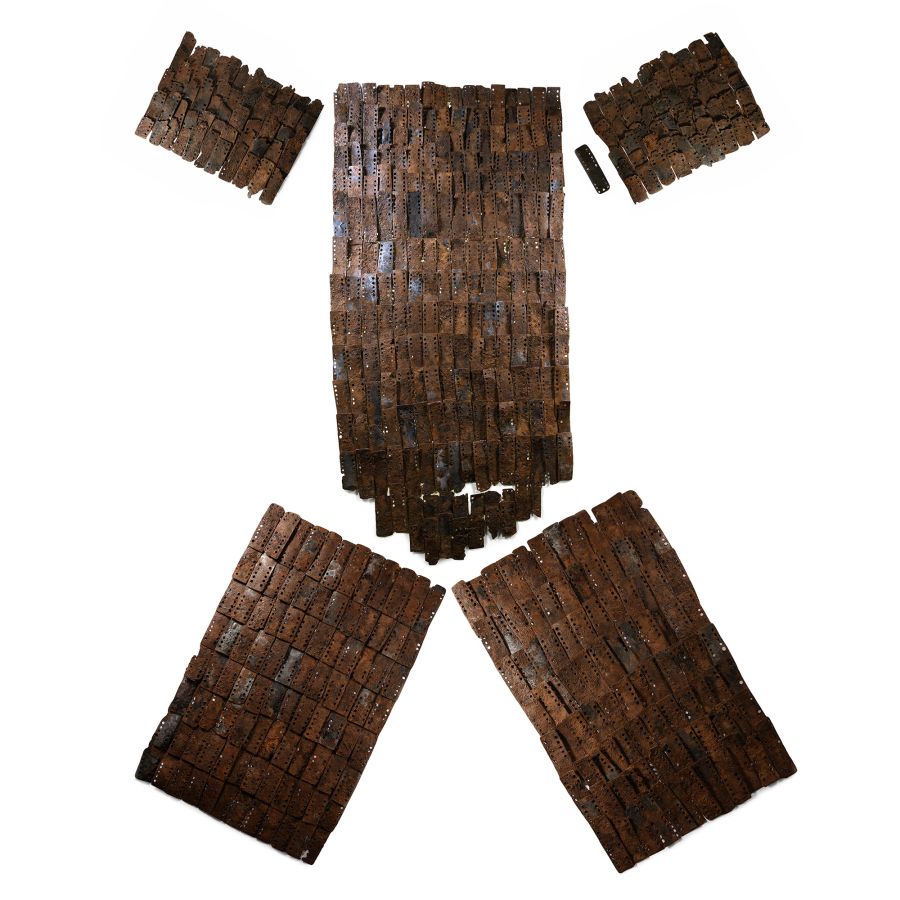
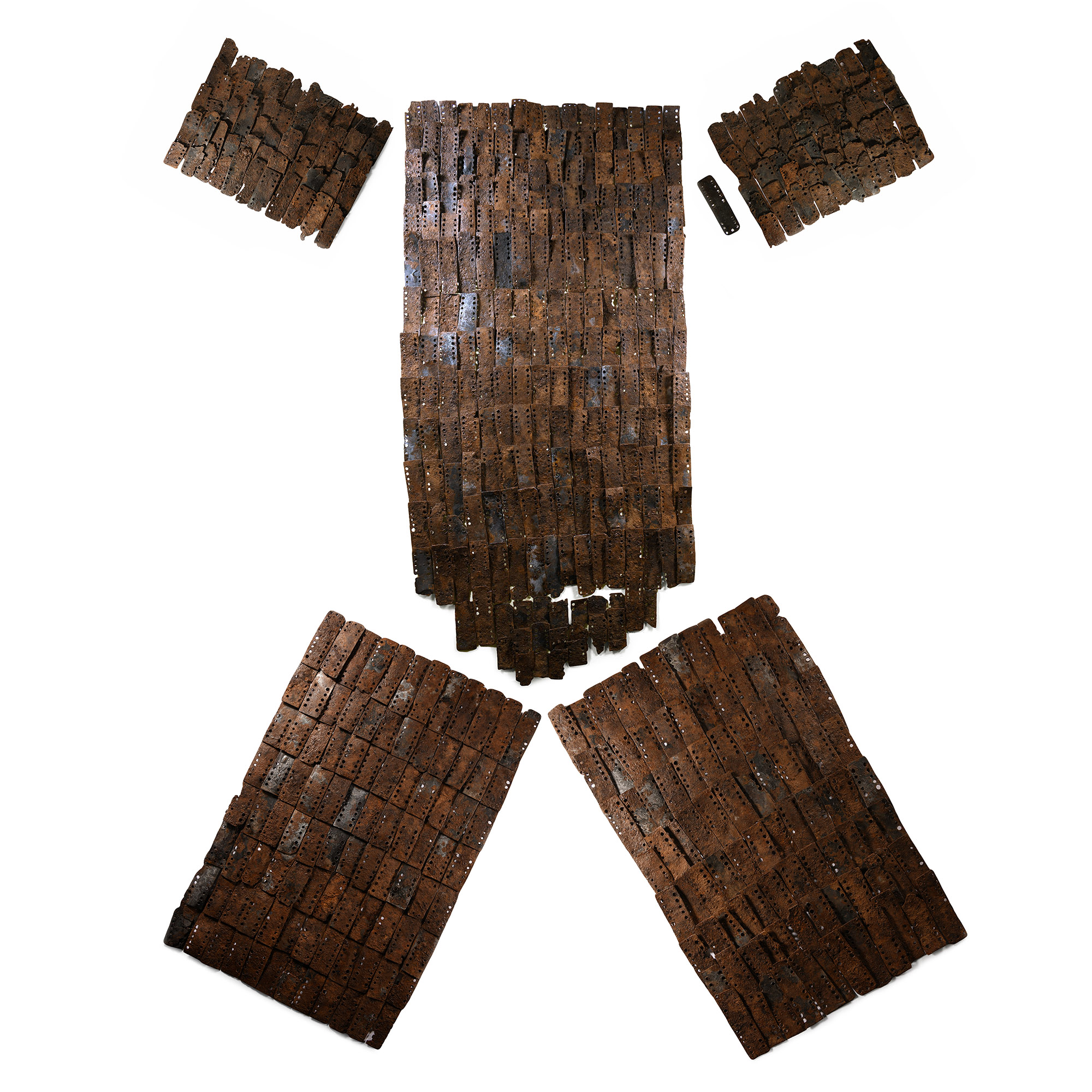
Chinese Jin Jurchen Warrior Signed Suit of Iron Plate Armour
1224 A.D.
1 1/8 - 4 1/4 in. (8.5 kg total, 3-11.1 cm).
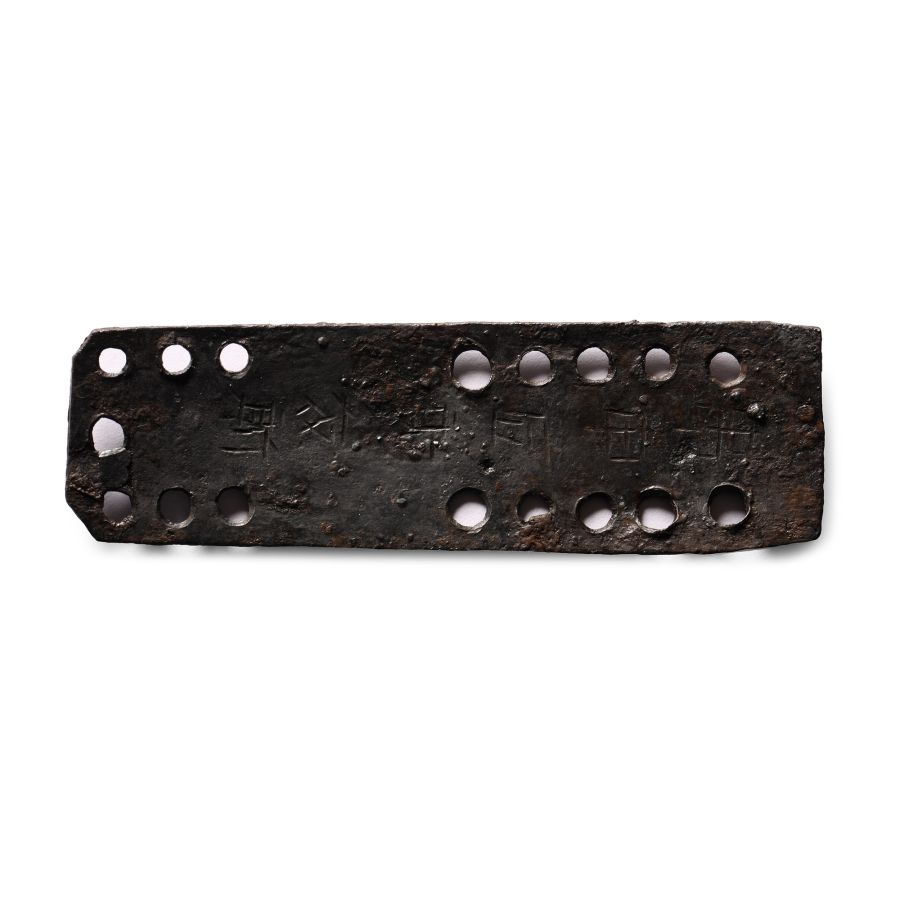
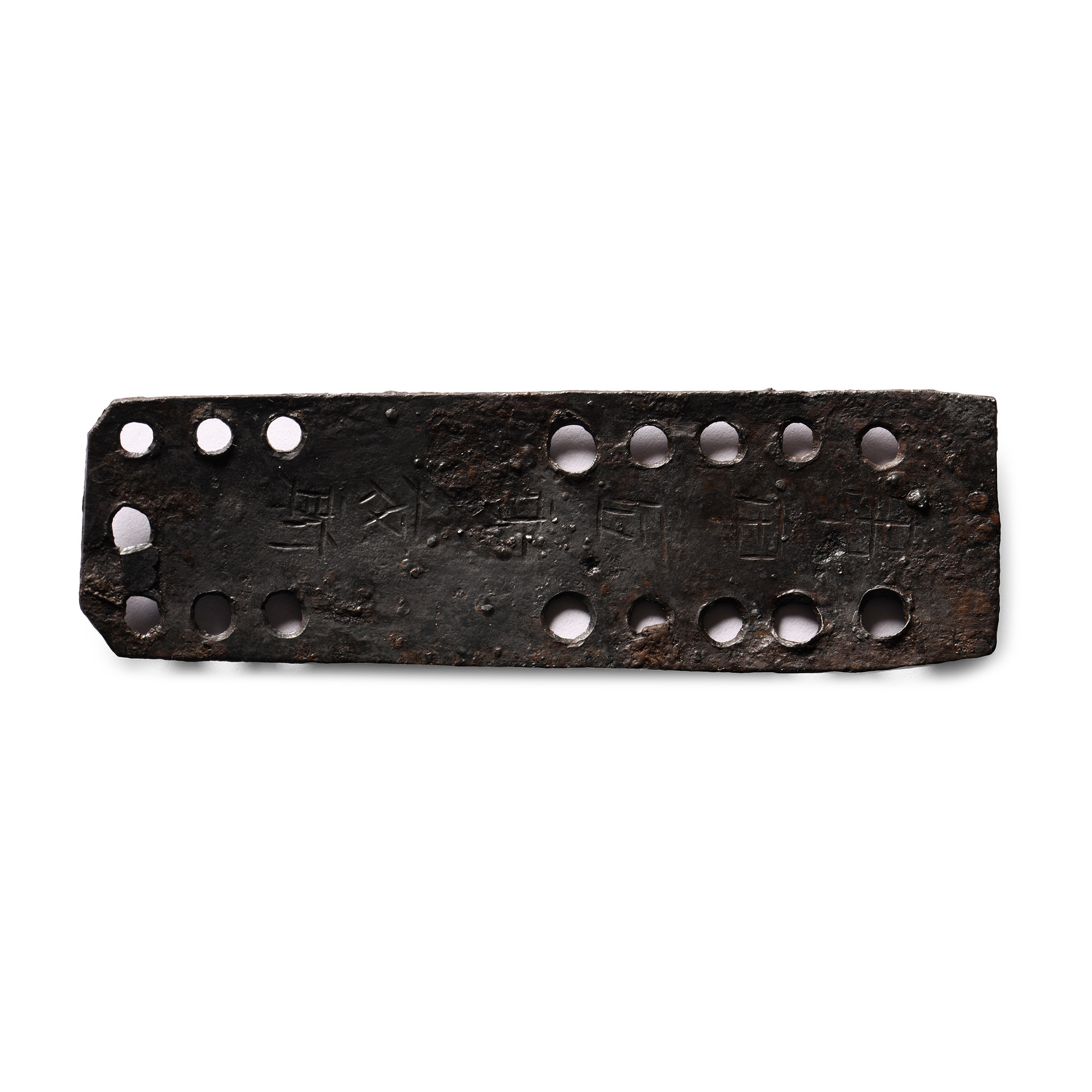
A complete suite of rectangular iron plates to form a protective coat; the plates provided with a series of holes close to the long edges by which they were laced together into articulating panels; one plate with inscription in Chinese script recording: 'first month of the Datong era / control of the propagation of Armour. Yanhui'. [894, No Reserve]
ProvenanceFrom the private collection of a London gentleman, from his grandfather's collection formed before the early 1970s.
Accompanied by a positive archaeometallurgy report by Dr Brian Gilmour PhD, Dip Cons, FSA, FCIFA, FRMS.
Accompanied by an academic report by Dr Raffaele D’Amato.
This lot has been checked against the Interpol Database of stolen works of art and is accompanied by a search certificate number no.12051-216403.
This lot has been cleared against the Art Loss Register database, and is accompanied by an illustrated lot declaration signed by the Head of the Antiquities Department, Dr Raffaele D'Amato.
Cf. Thordeman, B., Armour from the battle of Wisby, 1361, Malmo, 1939 (London, 2001), pp.245-264; Artemyeva, N., Prokopets, S., ‘Defensive weapons of the Jurchen warrior’ in Russian Archaeology, No. 1-2012, pp.129-142.
FootnotesThe Datong Era (大同, 1224–1233) is a name used for the reign of Puxian Wannu, a Jurchen warlord who established the Eastern Xia Dynasty in 13th century China. However, the war with the Jurchen states took more than 30 years: having first invaded the Jurchen borders in 1211, the Mongols finally defeated the Jin Empire only in 1234, while the Eastern Xia fell in 1246.
CONDITIONTimeLine Auctions follows a vetting process to ensure the authenticity and legality of all items, reinforcing our commitment to integrity and responsible trading. Each antiquity, antique, and coin lot undergoes thorough examination by a vetting committee of at least ten external specialists, professional trade association members, scientists, and archaeologists: Our Vetting Process
AUCTIONS:
TimeLine is a leading auction house specialising in antiquities, ancient art, collectables, natural history, coins, medals, and books. Our auctions offer museums, collectors, historians, and enthusiasts the opportunity to acquire unique and historically significant pieces.
LOT 1442
Chinese Jin Jurchen Warrior Signed Suit of Iron Plate Armour
Estimate £4,000 - 6,000€4,640 - 6,960 (for guidance only)$5,400 - 8,100 (for guidance only)
-
Greek and Luristan Bronze Arrowhead Collection
2nd-1st millennium B.C.Sold for (Inc. bp): £117
Mainly triangular-headed and leaf-shaped tanged types. 168 grams total, 3.9-10.3 cm
Ex London, UK, collection, 1990s. -
Very Large Finno-Ugrian Iron Socketted Spearhead
Circa 12th-13th century A.D.Sold for (Inc. bp): £111
Leaf-shaped blade with raised midrib extending to facetted-section tapering socket with fastening hole; professionally cleaned, conserved, and restored. 745 grams, 38.7 cm
Cleaned, conserved and restored.
From the family collection of a South East London collector; formerly acquired in the late 1950s.
The more common weapons of Finno-Ugrian people were axes commonly found from all Finnic areas, as well as spears. Among Baltic and Finnic people, especially in Finland and Karelia, knives called 'puukko' were common, as well as axes, spears, flat bows and longbows. Swords were usually imported from Germanic areas, Sweden, or from elsewhere in Scandinavia, some having often typically Scandinavian animal ornaments, although Finnish-made items have also been found. -
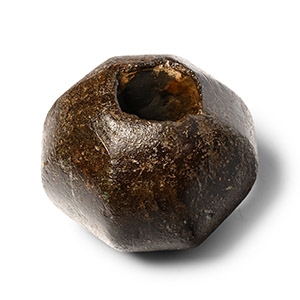
Large Medieval Bronze Sword Pommel
1300-1400 A.D.Sold for (Inc. bp): £104
Of 'wheel' type, Ward Perkins 1940, Type VIII; octagonal in plan with chamfered edges and roughly circular in section, a rectangular perforation running through the length of the object, wider at the blade end and narrowing at the butt end; at the base; the perforation off-centre and worn to one edge. 114 grams, 48 mm
Found whilst searching with a metal detector in Warslow and Elkstones, Staffordshire Moorlands, West Midlands, UK. Accompanied by a copy of the British Museum's Portable Antiquities Scheme (PAS) report no.WWID-94E7C5.
