
Loading, please wait...
_900x900.jpg "Chinese Han Style Bronze Bear Finial")
_200x200.jpg "Chinese Han Style Bronze Bear Finial")
.jpg "Chinese Han Style Bronze Bear Finial")
LOT 2176
Chinese Han Style Bronze Bear Finial
19TH-20TH CENTURY A.D.
2 1/4 in. (135 grams, 58 mm).
In a seated position, one leg drawn up beside its body with left paw resting upon it, the other pushed out to the side of its body, the right paw resting upon it, large head with gaping mouth exposing teeth and tongue, pricked ears and bulging eyes, sagging breasts resting atop the creature's pot-belly, incised fur detailing and a short tail to the reverse; hollow-formed.
ProvenanceAcquired 1980-1990s.
From a West Country collection.
TimeLine Auctions follows a vetting process to ensure the authenticity and legality of all items, reinforcing our commitment to integrity and responsible trading. Each antiquity, antique, and coin lot undergoes thorough examination by a vetting committee of at least ten external specialists, professional trade association members, scientists, and archaeologists: Our Vetting Process
AUCTIONS:
TimeLine is a leading auction house specialising in antiquities, ancient art, collectables, natural history, coins, medals, and books. Our auctions offer museums, collectors, historians, and enthusiasts the opportunity to acquire unique and historically significant pieces.
LOT 2176
Chinese Han Style Bronze Bear Finial
Estimate £250 - 350€290 - 410 (for guidance only)$340 - 470 (for guidance only)
-
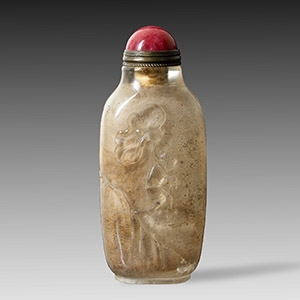
Chinese Crystal Carved Snuff Bottle
19th century A.D.Estimate: £100 - 140 (+bp*)
Opening Bid: £40
Displaying a figural scene in relief, deep pick cabochon to lid. 74 grams, 87 mm high
Property of a lady, from her grandfather's collection, 1960s-1970s; thence by decent. -
.jpg)
Chinese Jade Snuff Bottle
19th century A.D.Estimate: £400 - 600 (+bp*)
Opening Bid: £160
Bearing a figural scene in relief of an attendant serving tea to a seated scholar to one face and characters to the other; polished stone cabochon in the stopper. 94.6 grams, 62 mm high
Property of a lady, from her grandfather's collection, 1960s-1970s; thence by descent. -
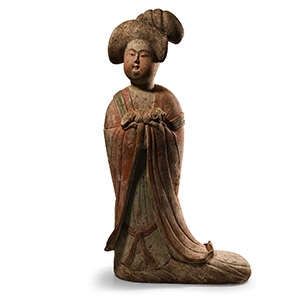
Chinese Tang Ceramic Court Lady with Flowing Gown
Tang Dynasty, 618-907 A.D.Estimate: £4,000 - 6,000 (+bp*)
Opening Bid: £2,000
In floor-length courtly dress with hands enfolded within the sleeves; pink and green pigment, on an integral base formed as a train to the robe, some restoration. 7 kg, 59.5 cm high
Finely modelled.
Acquired 1990s-2000. Ex D.N. collection. Accompanied by a thermoluminescence test certificate no.C122f60 issued by Oxford Authentication. Accompanied by a thermoluminescence test certificate no.CJ10255222022 issued by Laboratory Kotalla. This lot has been checked against the Interpol Database of stolen works of art and is accompanied by AIAD certificate no.11249-189440.
