
Loading, please wait...

LOT 1378
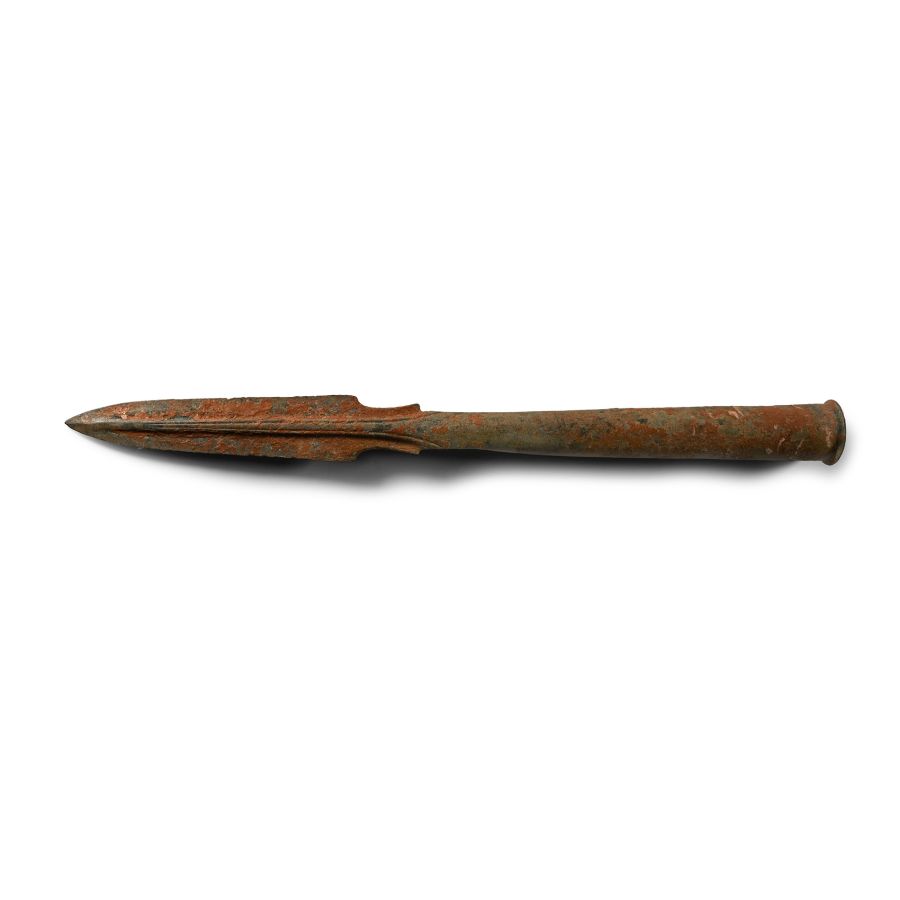
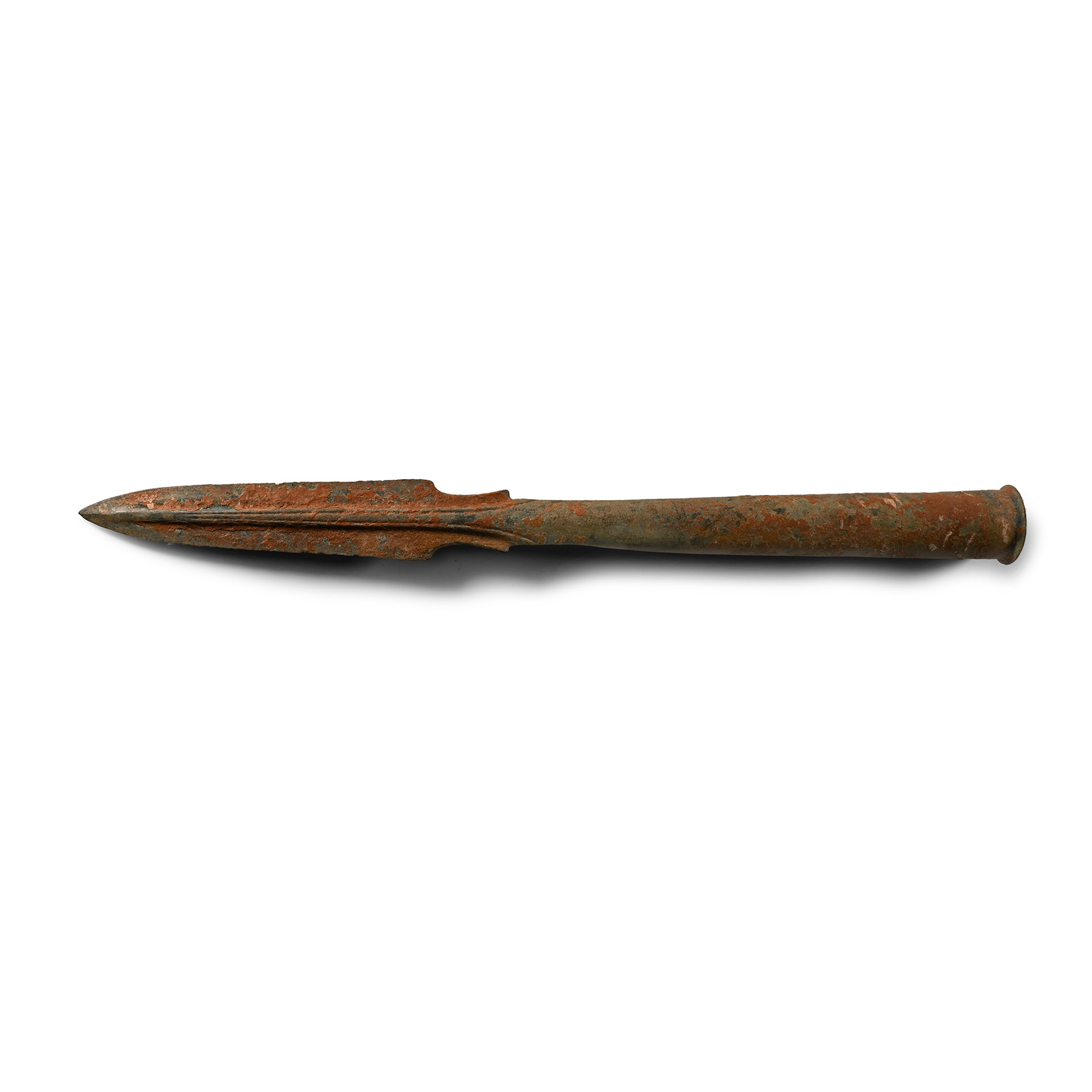
Chinese Chou Bronze Spearhead
4TH-3RD CENTURY B.C.
12 1/2 in. (250 grams, 32 cm).
With thick midrib, leaf-shaped blade with lateral spurs, deep tubular socket with fastening hole for the attachment to the wooden shaft.
ProvenanceAcquired in the mid 1980s-1990s.
Private collection, Switzerland, thence by descent.
Private collection, since the late 1990s.
Cf. Gorelik, M., Weapons of Ancient East, IV millennium BC-IV century BC, Saint Petersburg, 2003, in Russian, (plate XXXVIII nos.47-48, for a similar spearhead from Wuchengqiao, country of Liuhe, Prov. Jiangsu, and Fengshuiling, near Changzhen, prov. Shanxi.
FootnotesThe Chou chariot carried three crewmen, a driver, an archer on the left and a man armed with spear or dagger-axe on the right. The long spears were in bronze until the 300 B.C., when the Chou warriors began to adopt steel spearheads, 'as sharp as a bee's sting'.
CONDITIONTimeLine Auctions follows a vetting process to ensure the authenticity and legality of all items, reinforcing our commitment to integrity and responsible trading. Each antiquity, antique, and coin lot undergoes thorough examination by a vetting committee of at least ten external specialists, professional trade association members, scientists, and archaeologists: Our Vetting Process
AUCTIONS:
TimeLine is a leading auction house specialising in antiquities, ancient art, collectables, natural history, coins, medals, and books. Our auctions offer museums, collectors, historians, and enthusiasts the opportunity to acquire unique and historically significant pieces.
LOT 1378
Chinese Chou Bronze Spearhead
Estimate £700 - 900€810 - 1,040 (for guidance only)$950 - 1,220 (for guidance only)
-
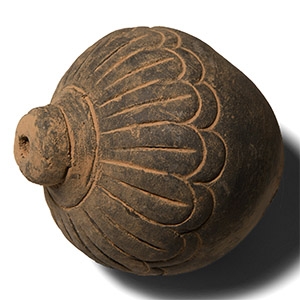
Byzantine 'Greek Fire' Ceramic Fire Bomb or Hand Grenade
9th-11th century A.D.Sold for (Inc. bp): £169
Piriform body with domed filler-hole, the upper body decorated with petals radiating from the filler-hole; intended to be filled with explosive liquid and wick, used as a hand grenade. 430 grams, 10.6 cm
From a specialist collection of militaria, London, UK, collected 1990s onwards. Accompanied by an academic paper by military specialist Dr Raffaele D'Amato, dated 15 July 2019 and titled 'Eastern Roman Empire - Greek Fire Bomb or Hand Grenade (μεσαίον kακάβιον) 9th-11th century AD'.
Apart from the use of siphons or manual flame-throwers called cheirosiphona, special corps of Roman soldiers employed terracotta grenades, in the form of small jars, abundantly evidenced in archaeological excavations. They were called μεσαία kακαβιά or κυτροκακάβια where the former had a bulbous shape and the latter a more cylindrical form. -
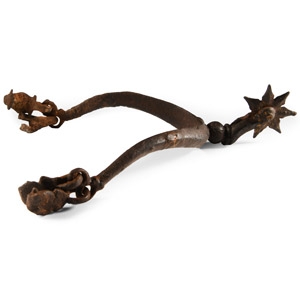
Medieval Iron Spur with Rowel
Circa 14th century A.D.Sold for (Inc. bp): £59
Comprising a U-shaped shank with carinated outer face, locket to each finial, ball and curved arms supporting a seven-pointed rowel. 70 grams, 13.5 cm
Private collection, UK, formed 1980s-1990s. -
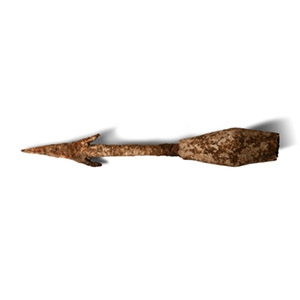
Roman Iron Plumbata
4th-5th century A.D.Sold for (Inc. bp): £364
The barbed head with tapering cylindrical stem and biconical lead weight; socket to the reverse. 95 grams, 13.4 cm
Ex B. Posey collection, UK, 1990s.
The lead-weighted darts known as plumbatae mamillatae (or 'breasted javelin') were short darts mounted upon a shaft of the same shape, and thrown from a short distance. A Roman soldier would typically carry around 5-6 of these darts at any one time, fastened to the back of his shield. They could be thrown overhand or underhand, with an effective throwing range of up to 60 metres by trained soldiers.
