
Loading, please wait...
LOT 1456
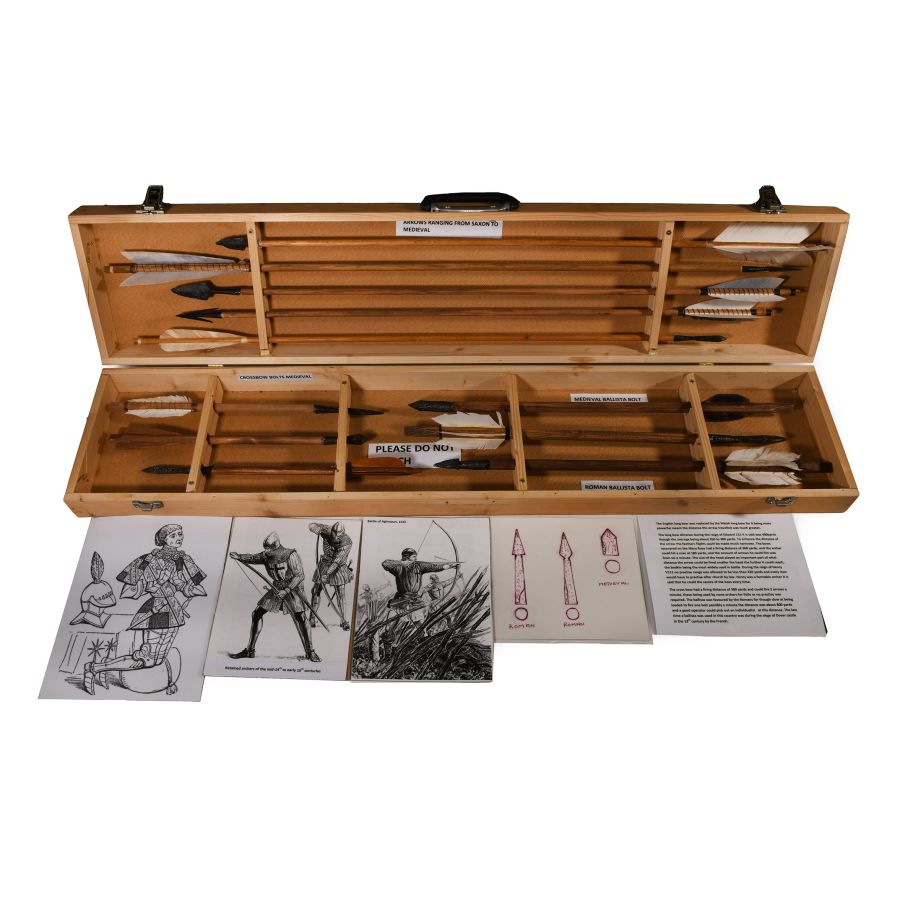
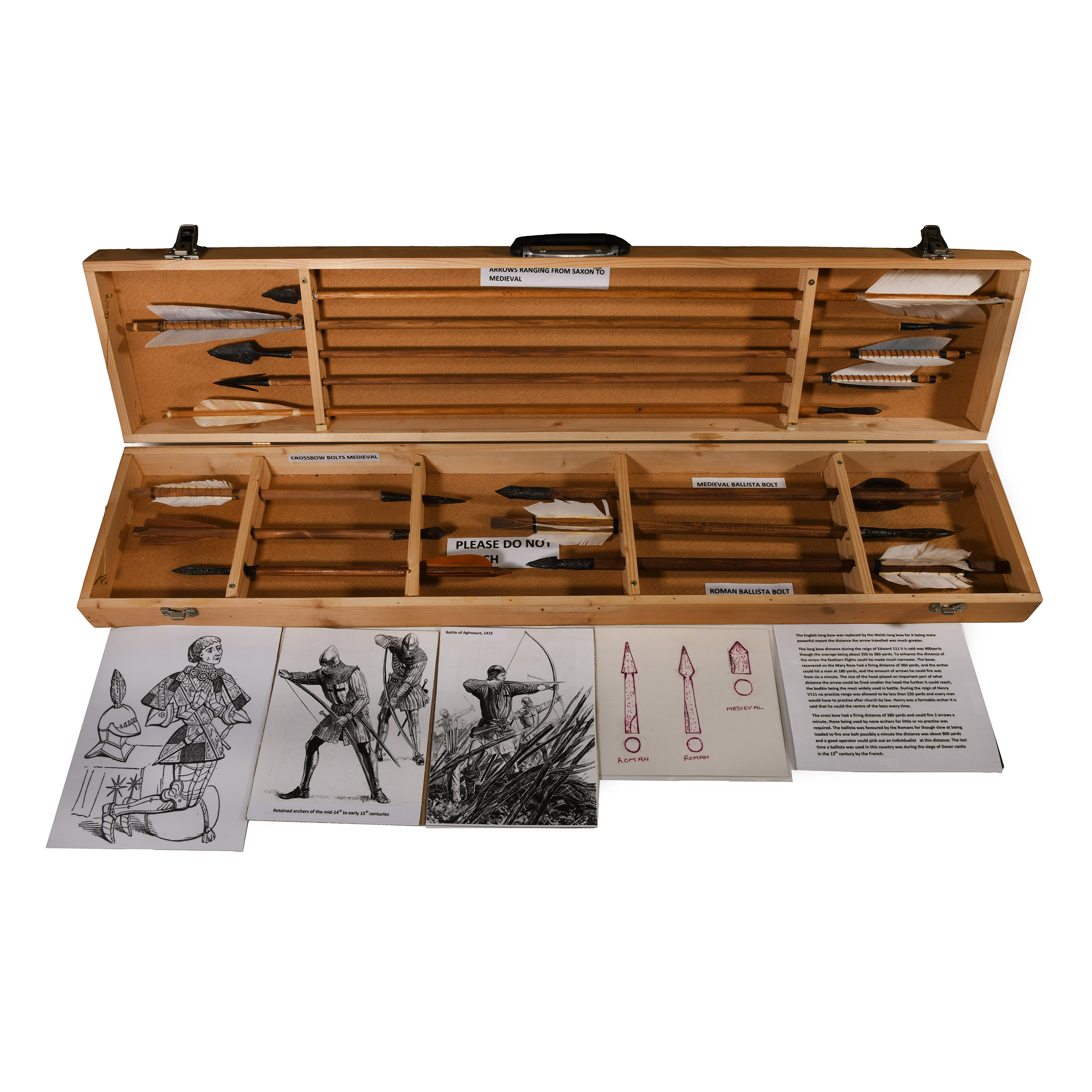
Cased Roman to Medieval Arrow Teaching Aid Collection
1ST CENTURY A.D.-15TH CENTURY A.D.
41 x 8 5/8 x 3 3/4 in. (3.83 kg total, 104 x 22 x 9.5 cm including case).
Comprising: a Roman ballista bolt with a pyramidal head; a 15th century iron swallowtail arrowhead; three iron medieval crossbow bolts, with pyramidal point, square-section shaft, tubular socket; two medieval ballista bolts with pyramidal point, square-section shaft, tubular socket; two triangular-shaped arrowheads, with pyramidal head; a triangular Eastern Roman bladed arrowhead with a slightly raised mid-rib; a small Anglo-Saxon arrowhead with lozenge form blade and round socket; all mounted on reconstructed modern shafts with their feathered directional lugs, and presented in a wooden display box. [No Reserve]
ProvenanceFrom the collection of the famous author, writer and speaker, Gordon Bailey, Essex, UK; formed since 1968.
PublishedMills, N., Medieval Artefacts Witham, 2003, pp.90-91, for two (nos.NM241a; NM242;).
LiteratureCf. Mills, N., Medieval Artefacts, Witham, 2003, pp.90-91, nos.243, for similar swallowtail arrowhead.
FootnotesCrossbow and bows were the protagonist of the 100 Years War between France and England. The crossbow, a bow fixed at its centre to a wooden stock, was a formidable weapon used by the Genoese crossbowmen, mainly in French service; its heavy bolt could easily penetrate a shield or armour breast plate at close range. The longbow, mainly used by the Welsh archers, was able to pierce armours at greater distance. During the reign of Edward III, the long bow distance was estimated to be 400 yards. The capability of the English and Welsh archers enabled the English to secure a victory over the powerful French Cavalry at the battles of Crecy, Poitiers and Agincourt.
CONDITIONTimeLine Auctions follows a vetting process to ensure the authenticity and legality of all items, reinforcing our commitment to integrity and responsible trading. Each antiquity, antique, and coin lot undergoes thorough examination by a vetting committee of at least ten external specialists, professional trade association members, scientists, and archaeologists: Our Vetting Process
AUCTIONS:
TimeLine is a leading auction house specialising in antiquities, ancient art, collectables, natural history, coins, medals, and books. Our auctions offer museums, collectors, historians, and enthusiasts the opportunity to acquire unique and historically significant pieces.
-
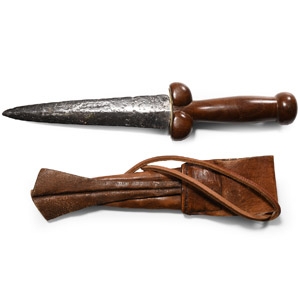
Medieval Iron Kidney Dagger with Replacement Handle and Sheath
15th century A.D. and laterSold for (Inc. bp): £442
Hand-forged two-edged iron knife blade with modern replacement hilt and leather sheath with saddle-stitched detailing. 336 grams total, 34.5 cm
From the collection of the famous author, writer and speaker, Gordon Bailey, Essex, UK; formed since 1968. -
.jpg)
Medieval Iron Axehead
15th-16th century A.D.Sold for (Inc. bp): £33
With square butt, scooped underside and a flared blade. 1.04 kg, 16 cm
Acquired on the UK market before 1992. Ex property of a North London gentleman. -
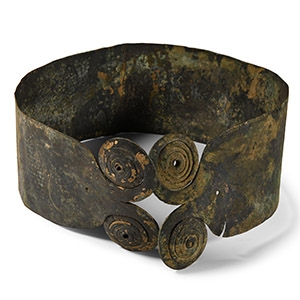
Luristan Bronze Armour Belt with Double Scroll Terminals
9th-7th century B.C.Sold for (Inc. bp): £169
A broad hammered military belt or cuirass band with plain surface, the terminals shaped as a double spiral ornament, holes in the centre of both ends for fastening. 330 grams, 22 cm
UK private collection before 2000. Acquired on the UK art market. Property of a London gentleman.
The rich and noble aristocrats of Luristan, Elamites, Hurrians, Lullubians, Kutians, and Kassites, went to battle splendidly equipped and used magnificent bronze armours. For metal sheets used for quiver plaques and bronze protective belts or shields, they used the hammering technique (Čakoškāri).
