
Loading, please wait...
_900x900.jpg "Carolingian Iron Spur with Silver Studs")
_200x200.jpg "Carolingian Iron Spur with Silver Studs")
.jpg "Carolingian Iron Spur with Silver Studs")
LOT 1403
Carolingian Iron Spur with Silver Studs
CIRCA 8TH CENTURY A.D.
7 in. (150 grams, 18 cm).
With D-section arms, attachment loop, prick spur with two bands of applied studs. [No Reserve]
ProvenanceEx B Posey collection, 1990s.
Ex Den of Antiquity, Cambridgeshire, UK.
Accompanied by a dealer's catalogue information card.
TimeLine Auctions follows a vetting process to ensure the authenticity and legality of all items, reinforcing our commitment to integrity and responsible trading. Each antiquity, antique, and coin lot undergoes thorough examination by a vetting committee of at least ten external specialists, professional trade association members, scientists, and archaeologists: Our Vetting Process
AUCTIONS:
TimeLine is a leading auction house specialising in antiquities, ancient art, collectables, natural history, coins, medals, and books. Our auctions offer museums, collectors, historians, and enthusiasts the opportunity to acquire unique and historically significant pieces.
-
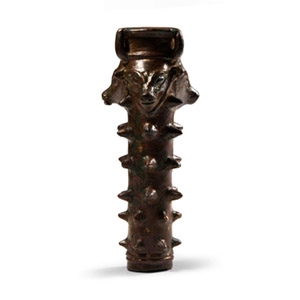
Elamite Spiked Bronze Macehead with Bulls
Late 2nd-early 1st millennium B.C.Estimate: £1,800 - 2,400 (+bp*)
Opening Bid: £1,000
With three adjoining bull heads in high relief to the top, with three ears and three horns serving all the three heads; the horns curving towards the rim of the the closed top; the shaft adorned with vertical rows of pointed spikes; hollow socket tube with ring collar at the base. 349 grams, 14.5 cm
with a London, UK gallery, 1971-early 2000s. Accompanied by an academic report by Dr Raffaele D'Amato. This lot has been checked against the Interpol Database of stolen works of art and is accompanied by search certificate number no.11997-22061. -
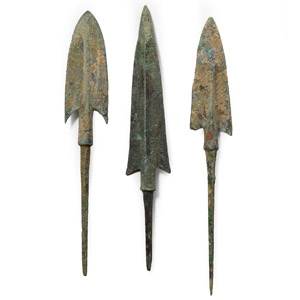
Luristan Bronze Arrowhead Group
Circa 14th-10th century B.C.Sold for (Inc. bp): £130
Each with a sturdy square-section tang, narrow barbed head with midrib. 98 grams total, 15.5-16 cm
Ex London, UK, collection, 1990s.
These arrowheads seem to belong to the type V, subcategory types A and C according to the classification of Khorasani and Negahban. In the four categories of triangular bronze arrowheads from Luristan, Marlik and Northern Iran individuated by Negahban, subtypes A and C of type V are larger arrow heads with barbed shoulders and triangular heads. These types of arrowheads were commonly used in Anatolia and Mesopotamia from the 2nd millennium B.C., but apparently their employment began earlier in this area, where types like these occur alongside the non-barbed, predominantly ribbed and tanged types. -
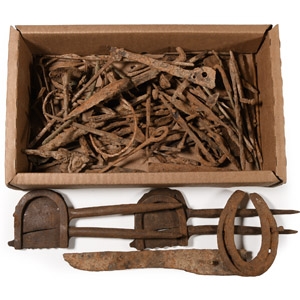
Roman Iron Arrowhead and Other Artefact Group
1st-4th century A.D.Sold for (Inc. bp): £117
Including horseshoes, arrowheads, surgical tools, architectural fittings and other items. 1.6 kg total, 4-19 cm
Ex Cambridge, UK, gentleman, 1990s.
