
Loading, please wait...
_900x900.jpg "Carolingian Bone Comb")
_200x200.jpg "Carolingian Bone Comb")
.jpg "Carolingian Bone Comb")
LOT 1696
Carolingian Bone Comb
8TH-10TH CENTURY A.D.
3 1/4 in. (15.09 grams, 82 mm).
Lentoid in section with thick-cut teeth to one edge and fine-cut to the other.
ProvenanceEx private central European collection.
with Tkalec AG, Limmatquai 48, Zurich, early 2000s.
Acquired from the above, 2006.
TimeLine Auctions follows a vetting process to ensure the authenticity and legality of all items, reinforcing our commitment to integrity and responsible trading. Each antiquity, antique, and coin lot undergoes thorough examination by a vetting committee of at least ten external specialists, professional trade association members, scientists, and archaeologists: Our Vetting Process
AUCTIONS:
TimeLine is a leading auction house specialising in antiquities, ancient art, collectables, natural history, coins, medals, and books. Our auctions offer museums, collectors, historians, and enthusiasts the opportunity to acquire unique and historically significant pieces.
LOT 1696
Carolingian Bone Comb
Estimate £500 - 700€580 - 810 (for guidance only)$680 - 950 (for guidance only)
-
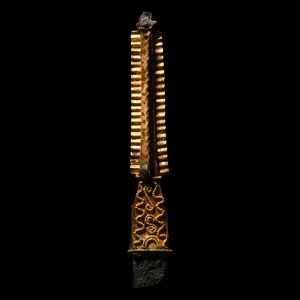
Dark Age Gold Filigree Decorated Element
7th century A.D. or laterSold for (Inc. bp): £293
Comprising: bronze blade fixed into a sheet-gold sleeve with applied beaded wire scrolls to obverse, impressed saltire to reverse; four radiating longitudinal bars with corrugated ornament; bronze granule cluster as a finial. 5.55 grams, 57 mm
Private English collection, formed between the late 1970s and early 1990s. Private collection, UK.
The delicate nature of the piece and its decoration in the round make is likely that it is an element of jewellery or perhaps the shank of a key. -
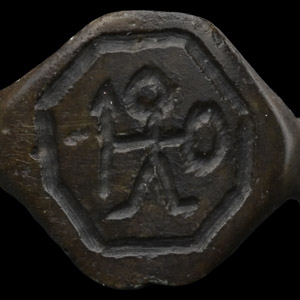
European Dark Age Bronze Ring with Warrior
6th-8th century A.D.Sold for (Inc. bp): £182
With bulb to each shoulder, octagonal bezel with incised border enclosing a standing figure with spear and shield. 2.14 grams, 21.86 mm overall, 18.33 x 19.27 mm internal diameter (approximate size British Q, USA 8, Europe 17.49, Japan 16)
Ex P Chapman collection, 1980s-1990s. -
.jpg)
Langobardic Gold Bishop's Ring with Amethyst
7th-8th century AD.Estimate: £15,000 - 20,000 (+bp*)
Opening Bid: £7,500
A finely crafted ring featuring a prominent square bezel adorned with stylised crucifixes, flanked by outward-facing birds with hooked beaks and large ring-and-dot eyes, the bezel set with a polished amethyst pebble; keeled decorative hoop with three integral collars at the base. 11.38 grams, 34.70 mm overall, 17.74 mm internal diameter (approximate size British M 1/2, USA 6 1/4, Europe 13.09, Japan 12)
Private English collection, formed between the late 1970s and early 1990s. Private collection, UK. This lot has been checked against the Interpol Database of stolen works of art and is accompanied by search certificate number no.12983-245992.
The Langobards (or Lombards) were a Germanic people who invaded and ruled much of the Italian Peninsula from 568 to 774 AD. Their kingdom, known for its fusion of Germanic and Byzantine artistic traditions, persisted until the Carolingian conquest under Charlemagne. A Bishop’s ring is a large, often ornate ring worn by bishops as a symbol of their office and spiritual authority. Traditionally, it signifies the bishop’s commitment to the Church and is considered a mark of his episcopal dignity.
