
Loading, please wait...
LOT 1444
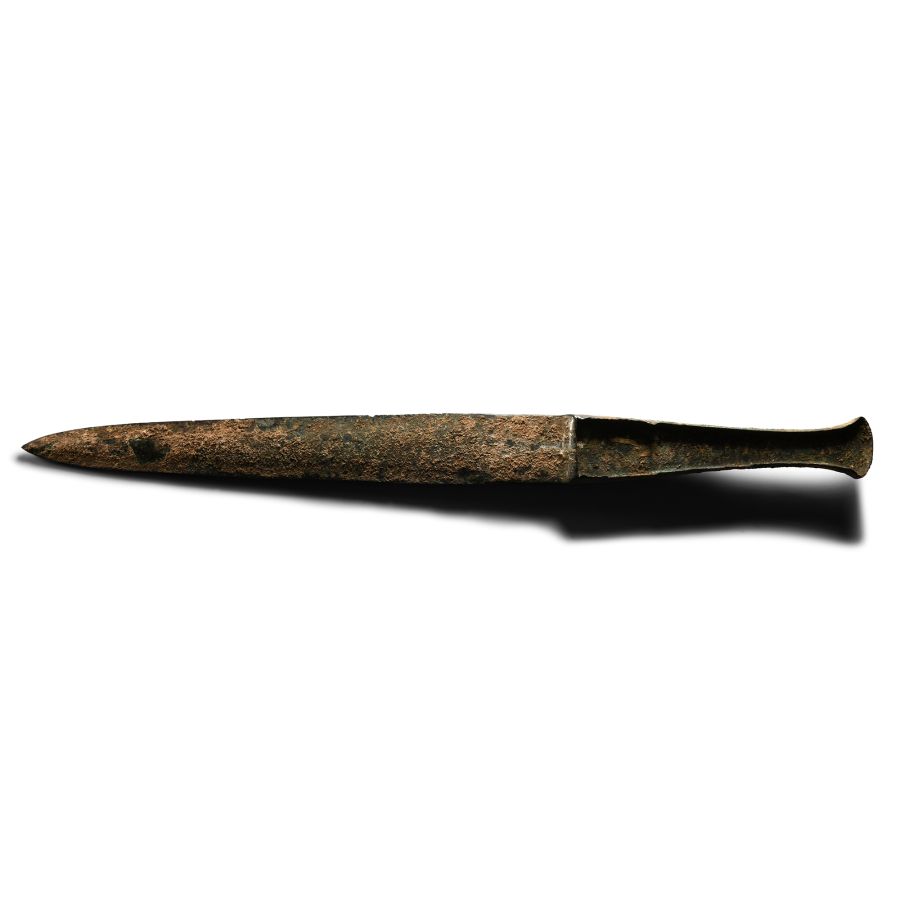
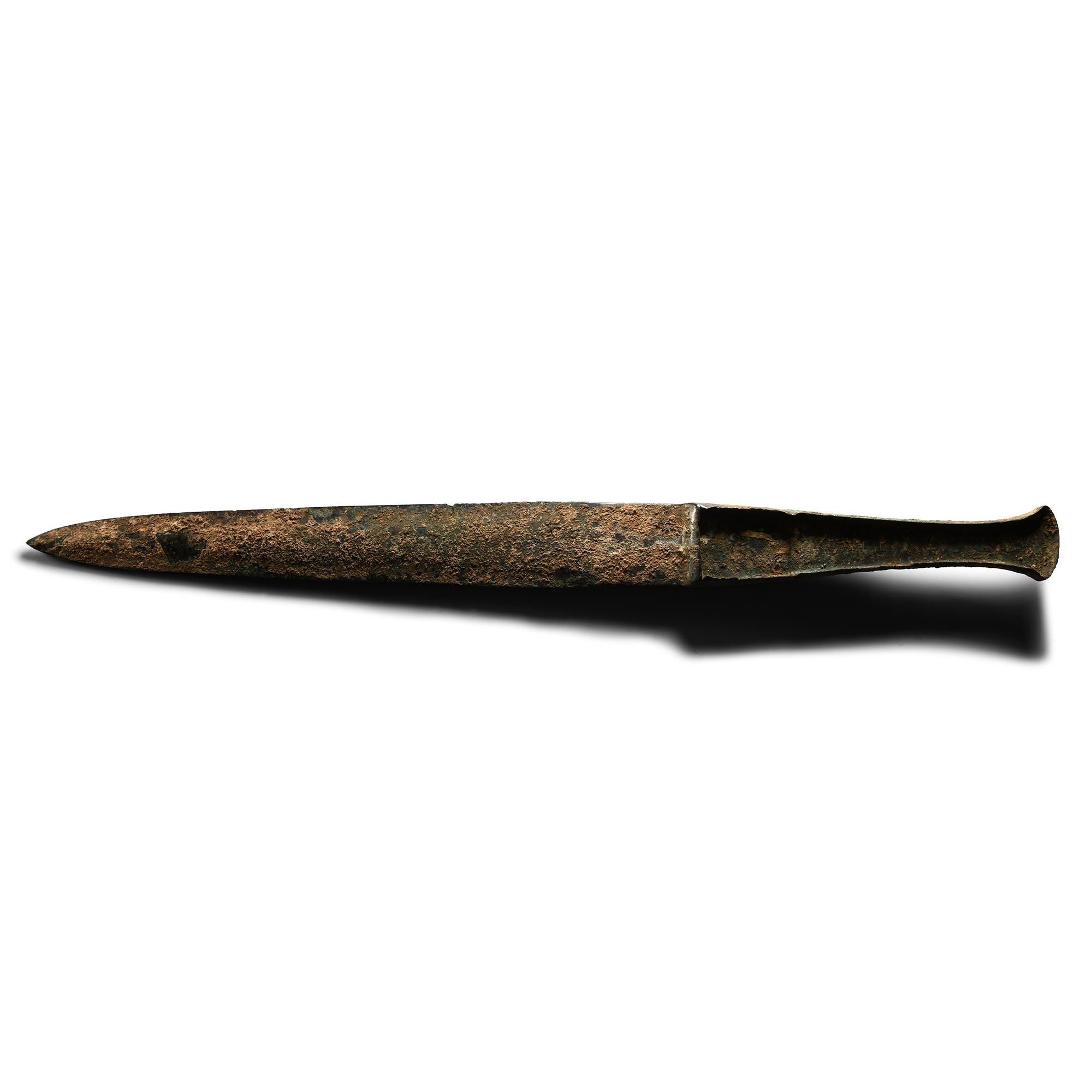
Canaanite Bronze Dirk
13TH-12TH CENTURY B.C.
13 3/8 in. (174 grams, 34 cm).
With lentoid-section blade, tongue-shaped in plan, integral tapering hilt with flared finial, lateral flanges to accept a panel of bone or wood to each face forming the grip.
ProvenanceEx Joseph J. Gancie (1923-2010), Washington, Silver Spring, Maryland.
with Alex Cooper Auctioneers Inc., sale 1035, 27 January 2013, lot 162a.
Cf. Khorasani, M.M., Arms and Armour from Iran - The Bronze Age to the End of the Qajar Period, Tübingen, 2006, p.377, cat.6.
FootnotesThe dirk belongs to the type III in the Medvedskaya classification, used in Near East from the 13th to the 6th century B.C. The type is the 32a of the Maxwell-Hyslop study. The Asiatic daggers of this type are confined to Syria and Persia, but Transcaucasia also provides an interesting analogy from Kalekent on the Baku peninsula, where a pointed straight-sided dagger blade has a flanged hilt with the whole of the side flanges bent over the centre.
CONDITIONTimeLine Auctions follows a vetting process to ensure the authenticity and legality of all items, reinforcing our commitment to integrity and responsible trading. Each antiquity, antique, and coin lot undergoes thorough examination by a vetting committee of at least ten external specialists, professional trade association members, scientists, and archaeologists: Our Vetting Process
AUCTIONS:
TimeLine is a leading auction house specialising in antiquities, ancient art, collectables, natural history, coins, medals, and books. Our auctions offer museums, collectors, historians, and enthusiasts the opportunity to acquire unique and historically significant pieces.
LOT 1444
Canaanite Bronze Dirk
Estimate £400 - 600€460 - 700 (for guidance only)$540 - 810 (for guidance only)
-
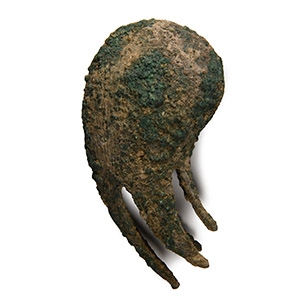
Bactrian Bronze Claw Axehead-Mace
2nd-1st millennium B.C.Sold for (Inc. bp): £130
Egg-shaped with spiked sleeves or prongs, the top of the weapon with a narrow edge, the sleeves with small internal tangs for mounting. 127 grams, 10.1 cm
Acquired 1980-2015. Ex Abelita family collection.
The 'claw mace' was an enigmatic ancient bronze weapon from the Bronze Age Near East. The hollow bulbous head was trailed by tines of varying lengths. It is believed that it was affixed over a wooden shaft and used like a club in combat, and not necessarily used as ceremonial weapon. The knife edge bulb end could have broken bones and proven to be a formidable striking weapon requiring no skill to wield. The tines would have not only been decorative, but have served to add strength below the striking end to prevent breakage. In battle, maces were often used by commanders to display rank when giving orders in battle and leading soldiers, inspiring leadership and power. -
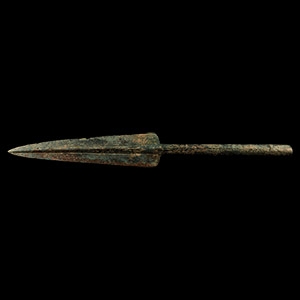
Large Marlik Type Bronze Socketted Spearhead with Blood Channels
14th-10th century B.C.Sold for (Inc. bp): £211
Comprising a triangular blade with prominent midrib, long split socket with two piercings for attachment and lower part decorated by horizontal circular grooves. 336 grams, 48 cm
Acquired 1980-2015. Ex Abelita family collection.
According to Khorasani, this spearhead belongs to the type VIII of his classification, characterised by a well-projecting midrib and long folded socket. The triangular blade is related to the subtype 2. Similar spearhead was excavated by Dr Negahban in the Royal Cemetery of Marlik (tomb 2, trench III D). -
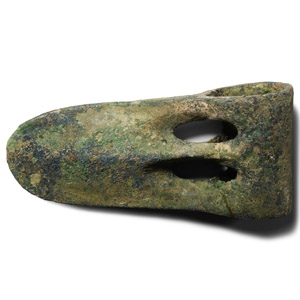
Babylonian Bronze Duck-Billed Axehead
2nd millennium B.C.Sold for (Inc. bp): £156
Duck-billed shaft-hole axehead featuring a curved, tongue-shaped blade with two voided 'eyes' and a raised median ridge; repaired. 168 grams, 10.3 cm
Collected from 1969-1999. From the collection of the late Mr S.M., London, UK.
